Custom Hotel Signage Design Guide for Brand Consistency
Custom hotel signage design guide covering brand plates, room numbers, ADA tactile rules, materials, costs, MOQ, and how to specify compliant signage.
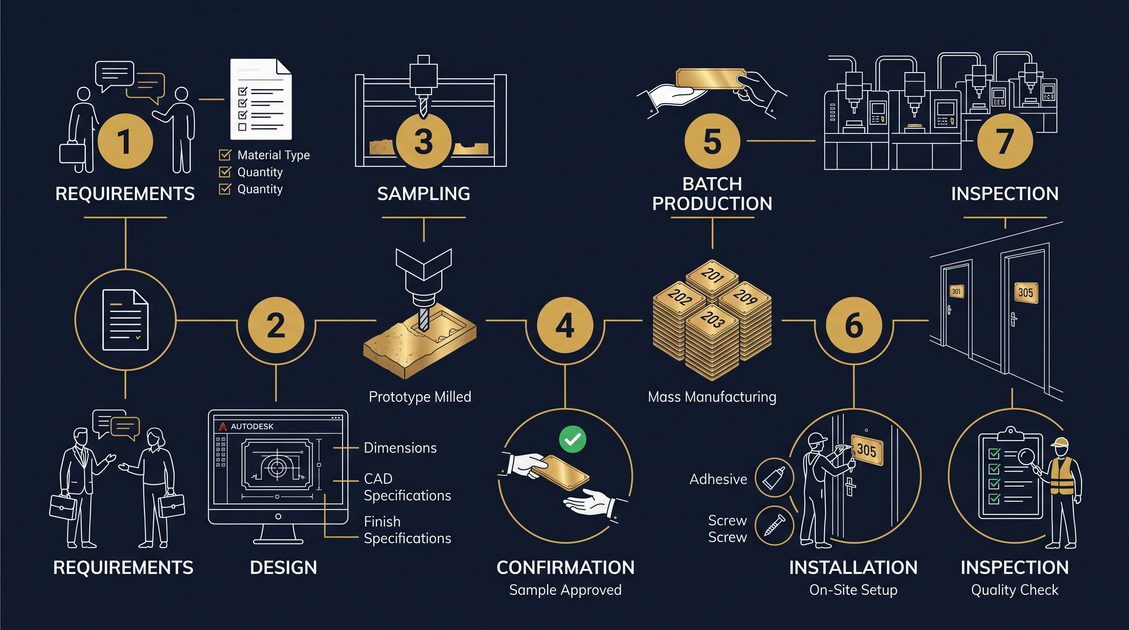
Custom hotel signage is bespoke wayfinding and identification artwork produced to a property's brand standard rather than a generic template, carrying the logo, typeface, finish, and color of the hotel on every door, wall, and directory. Custom hotel signage differs from stock plates because the artwork is developed once and applied across room numbers, floor markers, restroom signs, and amenity labels so a guest meets one coherent visual language from lobby to bedroom. A typical custom hotel signage unit measures 100 by 250 mm for doors and is produced in brass, stainless steel, aluminum, or acrylic, with engraving for permanence or printing for color. Pricing for custom hotel signage starts near USD 3.50 for printed acrylic and reaches USD 25 for engraved branded brass at a 50-piece minimum order. Reputable suppliers hold CE, RoHS, and ISO 9001 certification and ship from Shenzhen with a 100,000-piece monthly capacity to the United States, United Kingdom, Canada, Australia, Singapore, and Germany.
Why custom hotel signage matters for brand consistency
Custom hotel signage matters for brand consistency because the sign on every door is the most-touched, most-photographed surface a guest meets, and a mismatch between the lobby logo and the room plate silently tells the visitor the brand is not in control of its own details. When a property deploys custom hotel signage from one artwork source, the logo, typeface, and finish stay identical from the entrance directory to the penthouse number, so a returning guest recognizes the brand without reading the name. Brand studies on hospitality indicate that consistent visual identity across touchpoints lifts guest trust and recall by a measurable margin, and custom hotel signage is the touchpoint guests see most often during a stay. Custom hotel signage is also a compliance surface: US sites must meet ADA Title III tactile and finish rules, UK sites follow BS 8300 and the Equality Act 2010, and EU sites align with EN 301 549, so the branded plate is not decor but a legal device that must carry the brand and the Braille. Beyond compliance, durable custom hotel signage protects the fit-out investment by resisting daily contact, cleaning agents, and sunlight for five to fifteen years.
Materials for custom hotel signage
The principal materials for custom hotel signage are brass, stainless steel, aluminum, acrylic (PMMA), and wood-composite board, each chosen for how well it carries the brand finish and for its cost profile against the property's tier. Brass custom hotel signage conveys premium warmth suited to five-star floors and heritage hotels, resists indoor corrosion, and holds deep engraved logos legibly for a decade. Stainless steel custom hotel signage reads clean and clinical, ideal for modern design hotels sanitized often. Aluminum keeps weight and price down for sprawling deployments while permitting anodized brand color and laser etching. Acrylic custom hotel signage is the most flexible for backlit and LED builds, transmitting light evenly and supporting full-color brand graphics. Wood composite fits boutique and wellness brands seeking an organic touch but needs a sealant near humid areas.
| Material | Relative cost | Indoor lifespan | Best finish | Typical use |
|---|---|---|---|---|
| Brass | High | 8 to 12 years | Brushed or lacquered | Luxury, heritage hotels |
| Stainless steel | Medium-high | 10 to 15 years | Brushed, mirrored | Design hotels, towers |
| Aluminum | Low-medium | 7 to 10 years | Anodized, etched | Large campuses |
| Acrylic | Low-medium | 5 to 8 years | Printed, backlit | LED signage, branding |
| Wood composite | Medium | 4 to 6 years | Sealed matte | Boutique, wellness |
Brand finishes and logos on custom hotel signage
Brand finishes and logos on custom hotel signage are where the property's identity is literally etched into the building, and the finish choice signals tier as clearly as the logo itself. A five-star property uses brushed brass or bronze with deep engraved logos and a fingerprint-resistant lacquer, while a select-service brand uses anodized aluminum or printed acrylic to control cost across hundreds of doors. Custom hotel signage supports three logo application methods: laser engraving cuts the mark into the substrate for a permanent tactile brand, UV printing lays full-color logo and gradient for graphic richness, and a hybrid pairs an engraved logo with a printed color header. For ADA custom hotel signage, the room number and any tactile text must be engraved or applied as separate raised elements regardless of logo decoration, because surface ink lacks a tactile profile. Color matching matters: the brand supplies a Pantone or hex reference and the supplier proofs it on the actual substrate, because brass engraving with black infill reads differently than the same logo on white acrylic.
| Logo method | Permanence | Color richness | Cost add |
|---|---|---|---|
| Laser engrave | Permanent | Monochrome | USD 2 to 8 |
| UV print | 3 to 5 years | Full color | USD 0 to 3 |
| Hybrid | Permanent number | Full color header | USD 4 to 10 |
| Applied raised | Permanent | Single color | USD 1 to 4 |
| Backlit acrylic | 5 to 8 years | Glow color | USD 4 to 12 |
The custom hotel signage design process
The custom hotel signage design process runs from brand intake through proof to production in a sequence that protects consistency and catches errors before the full run. A buyer sends the brand guideline, logo files, typeface, and Pantone references, the supplier returns a digital proof and then a physical proof plate in 7 to 10 days, and on approval mass production runs 20 to 30 days for engraving, anodizing, printing, and QA. Custom hotel signage design starts with a template that defines plate size, margin, logo position, number size, and tactile zone so every plate in the estate shares one grid. The brand team reviews the digital proof for logo scale and color, then the physical proof under real corridor light for glare and contrast, because a logo that looks right on screen can disappear on a glossy brass plate. Proof plates matter because a brand phrase or logo can read differently once engraved than it did in the guideline, so the sample catches sizing and contrast problems before the full run of custom hotel signage ships.
| Step | Duration | Output |
|---|---|---|
| Brand intake | 1 to 3 days | Guideline pack |
| Digital proof | 2 to 4 days | On-screen mock |
| Physical proof | 7 to 10 days | Sample plate |
| Mass production | 20 to 30 days | Full estate run |
| QA and ship | 3 to 5 days | Crated plates |
OEM and ODM for custom hotel signage
OEM and ODM for custom hotel signage describe two depths of customization, and the choice sets how much of the product the supplier designs versus applies. OEM custom hotel signage applies your artwork, logo, and finish to a standard shape and size the supplier already tooled, which is fast and cheap because no new tooling is needed; the brand supplies the file and the factory engraves or prints it onto a proven plate. ODM custom hotel signage develops a bespoke shape, such as a room plate cut to the brand's monogram silhouette, a new mounting system, or a combined number-and-status device, which the supplier engineers from scratch and which becomes exclusive to the brand. ODM carries higher tooling (USD 200 to USD 1,500 depending on complexity) and longer lead, but it yields a custom hotel signage object competitors cannot buy, which matters for a flagship that must look unlike any other property. Most estates use a mix: ODM for the lobby and suite identifiers that define the brand, OEM for the hundreds of standard room plates that repeat the look.
| Model | Tooling | Exclusive | Best for |
|---|---|---|---|
| OEM | None or low | No | Repeat room plates |
| ODM | USD 200 to 1,500 | Yes | Flagship, suite IDs |
Prototyping and proof plates for custom hotel signage
Prototyping and proof plates for custom hotel signage are the gate that separates a brand-winning rollout from a costly recall, and the step exists to catch errors no screen mock reveals. A proof plate is a single physical custom hotel signage piece produced by the real process, engraved or printed on the actual substrate, and shipped in 7 to 10 days so the brand and facilities teams can judge it under installed corridor light. The proof catches logo scale drift, contrast loss on a glossy finish, Braille placement error, and mount-height mismatch before the full estate run ships from the Shenzhen facility. Custom hotel signage prototyping should include at least one tactile-compliance proof with Braille for the target market, because a logo that looks right can still fail the raised-character rule if the number is printed rather than engraved. Suppliers retain the approved proof as the master so every later reorder of custom hotel signage matches the original release, preventing the color or font drift that a regular guest would notice between visits.
| Proof check | Why it matters |
|---|---|
| Logo scale | Avoids tiny mark |
| Contrast | Legible in dim light |
| Braille place | Compliance pass |
| Mount height | Consistent datum |
| Substrate match | True color |
ADA compliance in custom hotel signage
ADA compliance in custom hotel signage in the United States comes from the 2010 ADA Standards for Accessible Design, which require permanent rooms to display signs with raised characters and Grade 2 Braille even when the plate carries a brand logo. A compliant custom hotel signage piece uses uppercase sans-serif raised characters 50 to 75 mm (2 to 3 inches) tall with a minimum 1/32-inch (0.8 mm) raise, a non-glare finish, and strong contrast between characters and background, with the logo placed so it does not crowd the tactile zone. Raised characters must sit with Braille, and the sign belongs on the wall beside the door latch side, centered 1400 to 1700 mm (55 to 67 inches) above the finished floor. Equivalent rules exist abroad: the UK Equality Act 2010 with BS 8300, the EU EN 301 549, and Australia's AS 1428.1 each mandate tactile, high-contrast signage for permanent spaces. For custom hotel signage that spans the US, UK, Canada, Australia, Singapore, and Germany, the prudent specification adopts the strictest common baseline: raised tactile characters, Braille, matte non-glare surfaces, and wall-adjacent mounting, with the brand logo kept clear of the tactile field.
Cost of custom hotel signage
The cost of custom hotel signage divides into design and tooling, substrate and decoration, electronics for LED units, hardware and mounting, and freight, and tooling is the line that distinguishes a bespoke program from a stock one. Design and tooling for a custom hotel signage template usually run USD 80 to USD 300 for OEM artwork and USD 200 to USD 1,500 for ODM shape development, often waived above a 500-piece order. Substrate and decoration are the largest recurring line: brass engraved custom hotel signage costs USD 8 to USD 25 each, stainless USD 6 to USD 18, aluminum USD 4 to USD 12, and acrylic USD 3 to USD 11 at MOQ 50, with per-unit price dropping 15 to 30 percent above 1,000 units. LED electronics add USD 6 to USD 35 depending on display type and connectivity. Mounting hardware (adhesive, standoffs, or concealed screws) costs USD 0.30 to USD 2.00 per plate. Sea freight from Shenzhen to the US west coast adds about USD 0.40 to USD 1.20 per kilogram, so a 200-gram plate carries roughly USD 0.10 to USD 0.25 of shipping. A realistic 500-plate brass engraved custom hotel signage program lands near USD 4,000 to USD 12,000 all-in, while a 2,000-plate acrylic LED program ranges USD 12,000 to USD 35,000. Budget 5 to 10 percent extra for spare custom hotel signage covering fit-out damage and future renames.
| Cost line | Range | Notes | |---|---|---|---| | Design and tooling | USD 80 to 1,500 | ODM higher | | Substrate | USD 3 to 25 | By material | | LED electronics | USD 6 to 35 | By display type | | Mounting | USD 0.30 to 2.00 | Per plate | | Freight | USD 0.10 to 0.25 | Per 200 g plate |
MOQ and capacity for custom hotel signage
Minimum order quantity and production capacity shape how a custom hotel signage program is phased across a property, and the standard 50-piece minimum fits a single-floor pilot or a boutique hotel, letting the brand validate finish and ADA detail before a campus-wide commitment. With a monthly capacity of 100,000 pieces, a supplier can absorb a 5,000-plate multinational deployment in one production month while serving other clients, which matters when several buildings renovate on overlapping timelines and all want custom hotel signage at once. Lead time splits into sampling (7 to 10 days for proof plates) and mass production (20 to 30 days for engraving, anodizing, printing, and QA). For custom hotel signage with integrated LED, add five to seven days for electronics assembly and function testing. Procurement should sequence orders so guest-facing or highest-traffic floors get plates first, then back-of-house and storage. Because brand details shift during a rebrand, negotiate a 10 to 15 percent over-run of blank or easily re-engraved plates; acrylic and aluminum accept re-work more readily than lacquered brass. Confirm the supplier can retain your artwork and Braille translation on file so later reorders stay identical to the original custom hotel signage release.
| Phase | MOQ | Lead time | Purpose |
|---|---|---|---|
| Pilot | 50 pcs | 20 to 30 days | Validate brand |
| Floor | 200 pcs | 20 to 30 days | One wing |
| Estate | 5,000 pcs | 20 to 30 days | Full rollout |
| Reorder | Any | 20 to 30 days | Match original |
Installation of custom hotel signage
Installation of custom hotel signage determines both compliance and longevity, so the method must suit the wall substrate and the ADA mounting zone while preserving the brand datum. Adhesive mounting uses VHB or epoxide tape and fits smooth painted drywall, glass, and metal doors where drilling is unwanted; it holds plates up to about 1.5 kg but needs surface prep and a 24-hour cure. Screw mounting with concealed or decorative caps is most secure for heavy brass plates and high-touch corridors. Standoff mounting floats acrylic or metal custom hotel signage 12 to 25 mm off the wall, creating a premium shadow gap and simplifying LED wire routing behind the plate. For ADA compliance, the sign must sit beside the door on the latch side, 1400 to 1700 mm to center, never on the door itself, because a door-mounted sign leaves the tactile reading zone. Installers should use a laser level and jig to keep every plate on the same horizontal datum across a floor, since uneven height undermines aesthetics and the brand consistency that custom hotel signage exists to build. A 100-room hotel typically needs one to two installers for two to three days to fit all custom hotel signage and wayfinding markers, with LED units taking longer due to wiring and network pairing.
| Mount method | Holds up to | Best for | Note |
|---|---|---|---|
| Adhesive | 1.5 kg | Glass, smooth wall | 24 h cure |
| Screw | Heavy | Brass corridors | Most secure |
| Standoff | Light-medium | Backlit acrylic | Hides wire |
| Concealed | Medium | Design hotels | Clean look |
Readability and contrast in custom hotel signage
Readability and contrast decide whether custom hotel signage actually informs anyone, especially in low light or for low-vision users, and accessibility standards require a minimum 70 percent contrast between characters and background for tactile signs. In practice that means dark characters on a light matte plate or light characters on a dark matte plate, never glossy surfaces that glare, even when the brand wants a shiny look. A custom hotel signage piece in brushed brass with black engraved infill meets this easily, as does white acrylic with charcoal lettering carrying the brand. Color should encode zone, not carry the only meaning: a blue floor versus a green floor is intuitive but must be reinforced by the number because about 8 percent of men have color-vision deficiency. Font choice matters; use a clean sans-serif at a size readable from three meters in a corridor, typically 20 to 40 mm cap height for the room name on door-level custom hotel signage. Avoid decorative scripts and thin strokes that disappear under corridor shadows, even if the brand guideline specifies a fancy face for print. For bilingual estates, allocate vertical space so neither language is cramped, and keep the primary language's characters at least as large as the secondary.
Rollout of custom hotel signage across properties
Rollout of custom hotel signage across properties is where a single brand standard becomes a multi-building reality, and the sequence protects consistency while phasing the spend. A brand starts with a flagship pilot of 50 to 200 custom hotel signage plates to validate finish, logo scale, and ADA detail, then expands floor by floor and property by property using the approved proof as the master. The 100,000-piece monthly capacity from a single Shenzhen facility means a 5,000-plate global deployment absorbs in one production month while the supplier still serves concurrent clients, which matters when several buildings renovate on overlapping schedules. Procurement sequences orders so guest-facing or highest-traffic floors get custom hotel signage first, then back-of-house and storage, because the visible doors drive the brand recall that justifies the spend. Because brand details shift during a rebrand, negotiate a 10 to 15 percent over-run of blank or easily re-engraved plates; acrylic and aluminum accept re-work more readily than lacquered brass. Confirm the supplier retains the artwork and Braille translation on file so later reorders stay identical to the original custom hotel signage release across every market.
| Phase | Volume | Lead time | Goal |
|---|---|---|---|
| Flagship pilot | 50 to 200 | 20 to 30 days | Validate brand |
| Floor rollout | 200 to 1,000 | 20 to 30 days | One property |
| Portfolio | 1,000 to 5,000 | 20 to 30 days | Multi-property |
| Reorder | Any | 20 to 30 days | Match master |
Procurement checklist for custom hotel signage
A procurement checklist for custom hotel signage keeps a multi-building program on schedule and within budget while preserving brand consistency and accessibility law. Begin by auditing every space needing a permanent marker: guest rooms, suites, accessible rooms, restrooms, and amenity spaces, because accessibility rules apply to permanent rooms. Record the room number, type, floor, and required pictogram for each, then decide which need LED status versus static plates. Specify substrate by zone: brass or stainless for guest-facing prestige areas, acrylic or aluminum for high-volume back-of-house. Require a compliance declaration referencing ADA 2010, BS 8300, EN 301 549, or the local equivalent, and request Braille translation for the target market. Confirm MOQ (commonly 50 pieces), lead time (20 to 30 days mass production), and monthly capacity (100,000 pieces) against your rollout dates. Request a single proof plate before full production, and negotiate a 10 percent spare over-run. Finally, verify certifications (CE, RoHS, ISO 9001) and the supplier's ability to store your artwork for future reorders so the custom hotel signage stays visually consistent across phases and years.
| Checklist item | Action |
|---|---|
| Audit rooms | List every permanent room |
| Brand file | Logo, typeface, Pantone |
| Specify substrate | By zone tier |
| Compliance | ADA, BS 8300, EN 301 549 |
| MOQ and lead | 50 pcs, 20 to 30 days |
| Proof plate | One before full run |
| Certifications | CE, RoHS, ISO 9001 |
Mistakes to avoid with custom hotel signage
Mistakes to avoid with custom hotel signage cost brands budget and sometimes trigger compliance failures that dilute the identity the program was meant to build. The first is mounting plates on the door rather than the adjacent wall, which breaks ADA tactile-height rules and forces users to open the door to read the brand. The second is choosing glossy finishes that glare under corridor lighting and fail the non-glare requirement, making the custom hotel signage unreadable for low-vision occupants. The third is printing rather than engraving tactile characters, yielding a sign with no raised profile and no legal standing as accessible custom hotel signage. The fourth is inconsistent placement height across a floor, where one plate sits at 1500 mm and the next at 1650 mm, undermining aesthetics and the muscle memory of repeat guests. The fifth is omitting Braille or using a non-Grade-2 code, a common error in cross-border programs that assume one Braille serves all markets. The sixth is under-ordering spares, so a single damaged custom hotel signage piece during fit-out stalls a floor's handover. The seventh is neglecting LED integration standards, buying plates that cannot pair with the building system and become decorative only. The eighth is an inconsistent logo scale where the lobby mark is large and the room plate mark is tiny, breaking the brand rhythm. The ninth is skipping the physical proof and trusting the screen mock, which hides contrast and glare until the full run ships.
Future of custom hotel signage
The future of custom hotel signage trends toward deeper building-system integration, sustainable materials, and personalized brand expression that still meets accessibility law. E-ink and low-power LED custom hotel signage will increasingly connect to the property management system, showing not just the number but do-not-disturb state, cleaning status, and the guest's name in brand typeface, all without a battery change for years. NFC and QR codes etched into the plate let a guest tap a phone to open the door or join the hotel's app, turning a static custom hotel signage into a doorway to the digital stay. Sustainable substrates such as recycled aluminum and bio-based acrylic are gaining traction as hotels pursue green-building certifications, and suppliers with ISO 14001 increasingly win enterprise bids. Modular custom hotel signage with replaceable inserts will dominate chains because it absorbs rebrands at near-zero cost, letting a franchise swap the logo without replacing the whole plate. Finally, AI-driven wayfinding may generate dynamic directional signs on shared screens near elevators, but the permanently mounted tactile custom hotel signage will remain legally required for accessibility.
Sustainability and green building credits for custom hotel signage
Sustainability and green building credits for custom hotel signage are increasingly part of procurement scoring as hotels pursue LEED, BREEAM, and WELL certification, and the material choice contributes to credit categories such as materials and resources. Recycled-content aluminum and bio-based acrylic custom hotel signage earn more points than virgin brass, though a long-life brass plate offsets its mining footprint through avoided replacement over a decade. Low-power LED custom hotel signage draws under 1.5 watts per unit, so a tower-wide deployment adds negligible energy load while improving guest experience, which indirectly supports energy credits by reducing staff trips to check status. Suppliers with ISO 14001 environmental management certification and RoHS compliance simplify the documentation burden for green-building submissions, and a 100,000-piece monthly capacity from a single Shenzhen facility reduces per-unit shipping emissions compared with multiple regional suppliers. Specifiers should request a declaration of recycled content and a take-back or recyclability statement for end-of-life custom hotel signage, because auditors increasingly ask for the full lifecycle picture.
Choosing a supplier for custom hotel signage programs
Choosing a supplier for custom hotel signage programs determines not just unit price but the consistency, compliance, and scalability of the entire rollout across a property portfolio. A qualified manufacturer should hold ISO 9001 for quality management and provide CE and RoHS declarations for the materials and any electronics used in the custom hotel signage, since these certifications are commonly required by United States, United Kingdom, Canadian, Australian, Singaporean, and German buyers and customs. Production capacity is a practical gate: a supplier with a 100,000-piece monthly capacity can absorb a 5,000-plate multinational deployment within a single production month while still serving concurrent clients, which matters when several buildings renovate on overlapping schedules. Ask for a single proof plate before full production, and verify the supplier can store your artwork and Braille translation on file so later reorders stay visually identical to the original release of custom hotel signage. Evaluate the supplier's ability to support bulk provisioning of LED custom hotel signage from a CSV namespace, because manual configuration per plate becomes a bottleneck during rapid expansion of a chain.
Custom hotel signage for resorts and boutique brands
Custom hotel signage for resorts and boutique brands faces a harder identity job than a city tower because the estate spreads across wings, villas, and beaches where a bare number means little without a brand zone prefix. Resort procurement adds a zone word to the custom hotel signage, such as "Beach" or "Tower", so the plate carries both identity and location and a golf-cart shuttle driver can route a guest without a map. Boutique brands use a softer palette and a routed wooden or lacquered brass custom hotel signage piece that reads as decor rather than sign, but the tactile number and Braille must still comply. Durability still matters because outdoor and semi-outdoor custom hotel signage faces sun and salt near the beach, so anodized aluminum or lacquered brass outlasts printed acrylic there. LED find-in-dark glow helps on dim resort paths where a guest returns late and needs the door without squinting.
| Estate type | Substrate | Brand feel | Note |
|---|---|---|---|
| Beach resort | Anodized aluminum | Airy, salt-proof | Outdoor rated |
| Mountain lodge | Lacquered brass | Warm, heritage | Cozy look |
| City boutique | Wood composite | Organic, soft | Sealed matte |
| Design tower | Stainless | Clean, modern | Clinical shine |
Lifecycle and replacement planning for custom hotel signage
Lifecycle and replacement planning for custom hotel signage protects the fit-out investment and keeps brand consistency intact years after the initial install. Engraved brass or stainless custom hotel signage typically lasts eight to fifteen years indoors, while acrylic and printed plates wear in five to eight, so budget replacements on that curve rather than treating signage as permanent. A practical plan reserves 5 to 10 percent spares from the original order to cover fit-out damage and early renames, and stores the artwork and Braille translation with the supplier so reorders match visually across phases. When a brand is refreshed, prefer modular custom hotel signage with replaceable inserts or re-engravable acrylic and aluminum, because lacquered brass is expensive to rework. LED electronics have a shorter life than the plate; specify a separate sealed indicator module so the compliant tactile face stays serviceable if the light fails, and keep a small stock of replacement modules. Audit custom hotel signage annually for glare, contrast loss, loose mounts, and Braille legibility, because a plate that looked compliant at handover can degrade under cleaning and sunlight. A documented lifecycle plan turns custom hotel signage from a one-time purchase into a managed asset that sustains brand consistency and accessibility throughout the building's operating life and across every renovation that touches the guest rooms.
Glossary of custom hotel signage terms
A glossary of custom hotel signage terms helps procurement and brand teams speak the same language and avoid specification errors that surface only at install. ADA (Americans with Disabilities Act) is the US law whose 2010 Standards govern tactile signage for permanent rooms, and custom hotel signage used as the primary marker must comply. Braille is the raised dot code on compliant plates; Grade 2 is the contracted form required in the US. Tactile characters are raised letters or numbers you can read by touch, with a minimum 1/32-inch (0.8 mm) profile. Non-glare finish means a matte surface that does not reflect light into a low-vision user's eyes, essential for dim corridors. Pictogram is the symbol (bed, elevator, exit) that carries meaning across languages even when the number is missed. Standoff mounting floats the custom hotel signage off the wall on small posts, creating a shadow gap and hiding wires. VHB tape is a high-bond acrylic adhesive used for drill-free mounting of light plates. PoE (Power over Ethernet) delivers both power and data on one cable, ideal for LED custom hotel signage. E-ink is a low-power reflective display that shows status without a backlight. OEM applies your artwork to a standard shape; ODM develops a bespoke shape exclusive to the brand. MOQ (minimum order quantity) is the smallest batch a supplier will produce, commonly 50 pieces for standard custom hotel signage models. Capacity is the monthly production volume, here 100,000 pieces, that determines how large a rollout can be absorbed in one month.
Not sure which sensor fits your project?
Talk to our mmWave application engineers for a free consultation.
Specify your hotel project with our engineers
Send your room count, ceiling type, and protocol preference. We will return a sample plan and quote within 24 business hours.
- Move from general guidance into a product or application discussion.
- Use RFQ when pricing, drawings, MOQ, or launch timing needs structure.
- Keep a direct contact path visible for fast clarifications and handoff.