Door Signs for Business: Design and Spec Guide
Door signs for business guide: types, materials, ADA plates, cost, MOQ 50, 100k capacity, storefront entrance signs for US UK CA AU SG DE export buyers.
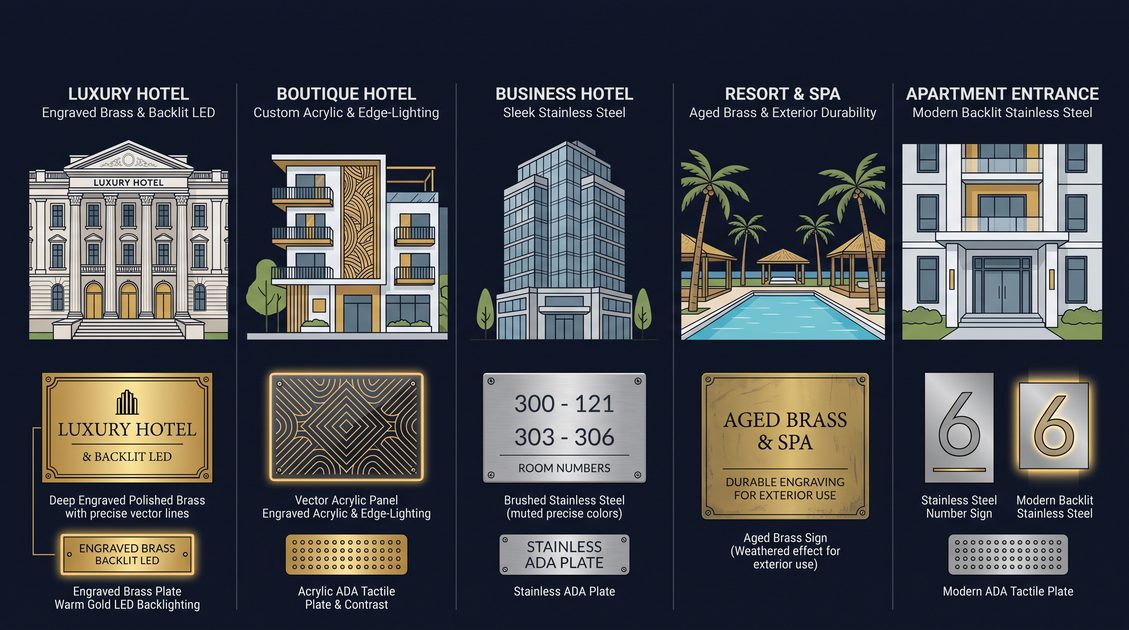
Door signs for business are the permanent identification and wayfinding markers mounted at office doors, hotel rooms, retail entrances, and meeting spaces, combining engraved or printed room numbers, names, logos, tactile characters, and sometimes LED status to identify and direct people. A standard door signs for business unit is a 100 by 250 mm or 120 by 300 mm plate in brass, stainless steel, aluminum, or acrylic, finished matte or brushed to resist glare, with raised or contrast characters sized for corridor reading. In hospitality and retail the same door signs for business may include an illuminated number or an occupied/vacant indicator, though the base identification must stay static and legible. Per-unit cost for standard engraved door signs for business runs USD 3.00 to USD 18.00 at MOQ 50 pieces, while LED versions reach USD 20 to USD 60. Certified manufacturers provide CE, RoHS, and ISO 9001 documentation, and a 100,000-piece monthly capacity supports programs across offices, hotels, shops, and schools in the US, UK, Canada, Australia, Singapore, and Germany.
Why door signs for business matter for branding
Door signs for business matter for branding because they perform three jobs at once: wayfinding for every visitor, a permanent identity at the most-touched surface in any facility, and a quality signal at the room. A clear door signs for business marker lets a first-time guest reach the right office, reducing reception congestion and protecting the floor's professional image. For returning clients, a consistent door signs for business design builds recognition and trust, because the plate is the same one they saw before. Branding and accessibility converge here: tactile characters and Braille on a door signs for business unit satisfy access law while the finish and logo express tier, from brushed brass in a five-star lobby to printed acrylic in a lean startup suite. Non-compliant or shabby door signs for business expose owners to failed audits and a cheapened first impression that no lobby renovation can repair. Durable door signs for business survive constant contact and sunlight for five to ten years, protecting the fit-out investment.
Beyond branding, consistent door signs for business reduce the daily load on reception and security staff, because visitors self-navigate instead of queuing to ask. A property that invests in aligned door signs for business also protects its audit record, since accessibility inspectors read door signs for business as the first proof of compliance. The same door signs for business that welcome a guest on day one still perform on day three thousand, which is the real test of a specification done well. A neglected door signs for business program, by contrast, quietly erodes both wayfinding and the brand promise door signs for business was meant to carry through the building. The door signs for business is the only fixture a guest touches on the way in and reads on the way out, so its condition is the building's first impression made literal. The door signs for business that greets a guest on arrival is also the last thing they read on the way out, so its condition carries the building's reputation in both directions at once. A neglected door signs for business also signals to a visitor that the rest of the facility may be under-managed, which is a first impression no lobby renovation can quietly undo after the guest has already formed it. A clean, compliant door signs for business also reassures the visitor that the rest of the facility is managed with the same care they are about to rely on during their stay or meeting. The door signs for business that is cleaned weekly and inspected yearly is the one that still reads on day three thousand, which is the only test of a specification that matters once the fit-out team has left the building for good. A maintained door signs for business also protects the asset value, because the next buyer sees a building that was cared for rather than one where door signs for business were installed and forgotten until a complaint forced a rushed replacement that cost triple.
Types of door signs for business
Door signs for business are the functional markers that identify and direct people at offices, hotels, clinics, and shops, and they fall into several types selected by the space they serve. A room-number door signs for business is the most common, a single engraved or printed plate with the number and sometimes the occupant name beneath. A name plate door signs for business carries a person or team, often with a logo, and suits offices, clinics, and studios. A suite marker door signs for business labels a group of rooms or a whole floor identity, while a directional door signs for business points along a corridor to the next decision point. Status-equipped door signs for business add an LED or e-ink face showing whether a room is in use, valuable in meeting rooms, treatment rooms, and hotel housekeeping. For storefronts, a door signs for business may combine the business name, hours, and an entrance symbol in one acrylic or metal plate.
The right door signs for business for each door depends on who uses the space and how often the name changes. A hotel room needs a durable number plate, while a meeting room benefits from a status indicator that reduces knocks from people unsure if it is free. Matching the door signs for business type to the traffic and function avoids both over-specifying simple closets and under-specifying busy public rooms that take daily abuse from carts and cleaners. A well-planned door signs for business list also shortens the install, because the installer is never deciding at the door what should have been decided in the specification months earlier. The door signs for business that arrives with a clear type assigned to every room is the one that goes up in a day rather than a week, which is the difference between hitting and missing an opening date. A door signs for business program planned this way also trains the installer once, so the second building goes up faster than the first and the standard compounds across the portfolio.
| Type | Common substrate | Typical use |
|---|---|---|
| Room number | Brass, acrylic, aluminum | Hotels, offices, dorms |
| Name plate | Brass, stainless, acrylic | Offices, clinics, studios |
| Suite marker | Stainless, aluminum | Floors, departments |
| Directional | Acrylic, aluminum | Corridors, lobbies |
| Status indicator | Acrylic + LED | Meeting, treatment rooms |
Materials for door signs for business
Door signs for business are produced in brass, stainless steel, aluminum, and acrylic, chosen for durability, finish, and cost across offices, hotels, and retail. Stainless steel door signs for business resist humidity, cleaning chemicals, and fingerprints better than most alternatives and read as modern and hygienic, the top pick for public corridors. Brass door signs for business suit upscale hotels and law firms where a warm premium tone is wanted, though it needs lacquer near steam to slow tarnish. Aluminum door signs for business keep weight and price down for large buildings such as schools and transit-linked offices while allowing anodized color. Acrylic door signs for business enable backlit and LED builds and full-color logos, useful in dim corridors and nightlife venues. A mix of substrates by zone is the economical answer: stainless at humid public entries, brass at prestige fronts, and acrylic or aluminum at high-volume back-of-house doors.
Selecting substrate for door signs for business should follow the zone, not the catalog: humid entries get stainless, prestige fronts get brass, and high-volume back-of-house gets acrylic or aluminum. A facilities team that standardizes door signs for business by zone spends less on replacements and keeps one spare pool instead of four. The substrate choice also sets the engraving method, which in turn decides whether the door signs for business can be reworked when a room is renamed during a fit-out. In practice, the door signs for business that survives longest is the one matched honestly to its environment rather than to a showroom sample that looks right but fails at the threshold. A mixed-substrate door signs for business plan also hedges the budget, because the expensive brass fronts are few while the cheap acrylic backs are many, and the total spend lands where the building actually earns its tier.
| Material | Relative cost | Wear resistance | Best finish | Typical use |
|---|---|---|---|---|
| Stainless steel | Medium-high | Excellent | Brushed, mirrored | Public, hospitality |
| Brass | High | Good (lacquered) | Brushed or lacquered | Upscale hotels, firms |
| Aluminum | Low-medium | Good | Anodized, etched | Schools, offices |
| Acrylic | Low-medium | Good (sealed) | Printed, backlit | LED, dim venues |
For most estates, a mix of substrates by zone is the economical answer: stainless at humid public entries, brass at prestige fronts, and acrylic or aluminum at high-volume back-of-house doors where the door signs for business is seen less but must still stay compliant and readable for years of service. The door signs for business chosen by zone also photographs as a coherent system, which is what a brand audit or a sales listing will capture when the property is shown to a prospective buyer or tenant. A zone-based door signs for business plan also means the spare pool is logical, because every substrate has its own reorder line instead of a mixed bin of mismatched plates that no one can name. The door signs for business chosen by zone also means the right plate is at the right door, which is what keeps the audit clean and the guest oriented at the same time across the estate. A zoned door signs for business plan also simplifies training, because the facilities team learns four substrate rules instead of guessing at every door whether brass or acrylic belongs on the wall in front of them.
Door signs for business and storefront entrances
Door signs for business and storefront entrances are the highest-traffic identification a company owns, because the entrance plate is the first and last thing a customer touches or reads on a visit. A storefront door signs for business pairs the business name, logo, and hours on one weather-rated acrylic or metal plate mounted beside the glass, while a second marker on the door itself may show open or closed, accessible entry, or push-pull. For retail, the door signs for business must survive sunlight, rain at the threshold, and constant hand contact, so sealed acrylic or anodized aluminum outperform lacquered brass at the glass. Illuminated door signs for business extend visibility into evening trading and improve footfall, since a lit name reads from the street. A supplier with a 100,000-piece monthly capacity and CE, RoHS, ISO 9001 certification delivers identical plates to all six export markets.
Storefront door signs for business and storefront entrances should be specified as a system, not one plate, because the glass, the door, and the wall each need a different marker. A weather-rated door signs for business and storefront entrances set uses sealed acrylic or anodized aluminum that shrugs off rain and UV, while an interior door signs for business and storefront entrances plate can be lighter and quieter. Planning the full door signs for business and storefront entrances set before fit-out prevents the mismatch where the outside plate outlasts the inside one by years. A retailer who treats the door signs for business and storefront entrances as one purchase order rather than one coordinated system usually ends up with a lit exterior and a faded interior within eighteen months of trading. The door signs for business and storefront entrances that are planned together, by contrast, age as one set and keep the brand coherent from the street to the corridor for the full lease. The door signs for business and storefront entrances planned as one set also simplifies the spare pool, because the exterior and interior plates share substrate and artwork from a single approved file. A coordinated door signs for business and storefront entrances also lets the brand refresh the exterior without touching the interior, because the two were specced as a system rather than as a single impulse buy. The coordinated door signs for business and storefront entrances also means one supplier declaration covers the whole entrance, which simplifies the customs and audit paperwork for every export market the brand serves. The door signs for business and storefront entrances that share one artwork file also simplify the refit, because the whole entrance refreshes from a single approved source rather than two disconnected purchase orders placed months apart. The door signs for business and storefront entrances that a retailer specifies together also age as one set, so the brand looks coherent from the street to the corridor instead of mismatched halfway through the lease of the building. A unified door signs for business and storefront entrances program also cuts the supplier count, because one manufacturer delivers the whole entrance rather than two vendors blaming each other when door signs for business do not align at the glass.
ADA and accessibility for door signs for business
Door signs for business that mark permanent rooms must meet accessibility law, and in the United States the 2010 ADA Standards for Accessible Design require raised characters and Grade 2 Braille on permanent spaces. Compliant door signs for business use uppercase sans-serif raised letters with a minimum 1/32-inch raise, a non-glare finish, and high contrast between characters and background. The sign mounts on the wall adjacent to the door latch side, centered 1400 to 1700 mm above the finished floor, never on the door itself because a moving door leaves the tactile reading zone. International equivalents broaden the duty: the UK Equality Act 2010 with BS 8300, the EU EN 301 549, and Australia's Disability standard each mandate tactile, high-contrast door signs for business. For a program spanning six markets, the safest specification adopts the strictest common baseline of raised characters, Braille, matte surfaces, and wall-adjacent mounting.
ADA compliance for door signs for business is not a one-time checkbox but a property-wide standard that must hold on every permanent room across the estate. A single non-compliant door signs for business can fail an entire floor's audit, so the safest path is to specify one compliant door signs for business template and apply it everywhere. Because door signs for business must survive independently of any LED, the base door signs for business should be specced and tested as a standalone compliant unit first. The door signs for business that passes ADA as a static plate is the only version worth installing, because the lit version is a convenience layered on top of that legal core rather than a replacement for it. The door signs for business that meets ADA as a static plate is the only version worth installing, because the lit version is a convenience layered on top of that legal core. The door signs for business that satisfies ADA as a standalone plate is the one that passes audit without a follow-up, because the inspector reads the base identification first and the electronics second. A compliant door signs for business also protects the lease, because an accessibility finding can trigger a cure notice that stalls a renewal the landlord was counting on for the quarter. The door signs for business that is compliant as a static plate also satisfies the inspector on the first walk, because the tactile face is the element the law actually measures and the LED is merely the convenience on top. A compliant door signs for business also reduces insurance risk, because an accessibility claim is far less likely when door signs for business meets the standard the day it is installed rather than the day a lawyer points out that it does not.
Custom door signs for business and branding
Door signs for business are the brand expression a company controls at the door, and custom versions let a brand show tier and identity through material, engraving depth, color infill, and logo integration. A custom door signs for business pairs the room number or name with a debossed or printed logo, a brand color infill in the engraved grooves, and a finish matched to the lobby, from brushed brass in a five-star hotel to printed acrylic in a lean co-working suite. Custom door signs for business also solve non-standard doors: glass entries need standoff or adhesive mounting, historic buildings need slim plates, and clinics need discreet name plates that still carry Braille. The artwork is held on file by the manufacturer so reorders stay identical across years and phases. Design and tooling for a custom template usually runs USD 80 to USD 300, often waived above a 500-piece order.
A custom door signs for business program pays back when the brand is the product, as in hotels, law firms, and flagship retail. The custom door signs for business carries the logo and tier cues that a generic plate cannot, and because the artwork is retained, later phases match the first. When several buildings share a custom door signs for business design, procurement gains volume pricing and a single spare pool, turning a brand expense into a managed, repeatable asset across the portfolio and its many entrances. The custom door signs for business also ages better than a stock plate, because the design was chosen for the building rather than lifted from a catalog that will look dated in three years. The custom door signs for business that carries the logo in the engraving rather than as a sticker is the version that survives cleaning, because the identity is cut into the metal rather than stuck on the surface. The custom door signs for business is also door signs for business a guest photographs when they post about the stay, so the brand earns its impression from the door rather than despite it. A custom door signs for business also lets a boutique operator punch above its weight, because the plate reads as considered even when the rest of the fit-out is modest and the budget was tight from the start of the project.
Cost of door signs for business
Door signs for business cost divides into design and tooling, substrate and decoration, electronics for LED units, hardware and mounting, and freight. Design and tooling usually run USD 80 to USD 300 for a custom brand or logo template, often waived above 500 pieces. Substrate and decoration are the largest recurring line: stainless engraved door signs for business cost USD 8 to USD 20 each, brass USD 10 to USD 22, aluminum USD 5 to USD 12, and acrylic USD 3 to USD 10 at MOQ 50, with per-unit price dropping 15 to 30 percent above 1,000 units. LED electronics add USD 6 to USD 40 depending on display type, and mounting hardware costs USD 0.30 to USD 2.00 per plate. Sea freight from Shenzhen adds about USD 0.40 to USD 1.20 per kilogram, so a 250-gram plate carries roughly USD 0.10 to USD 0.30 of shipping.
Budgeting door signs for business should model the three-to-ten-year cost rather than the purchase order, because cheap printed plates need replacing twice while engraved ones last. A durable door signs for business program has a lower lifetime cost even with a higher starting invoice, and LED adds negligible energy at under 1.5 watts per unit. Facilities that track door signs for business as a managed asset, with spares and re-engraving budgeted, avoid the panic of a missing plate stalling a floor's handover during opening week. Treating door signs for business as a consumable rather than an asset is the single most common reason a signage budget quietly doubles across the operating life of a building. The door signs for business bought on price alone is the one that gets reordered at twice the cost three years later, once the fit-out team has moved on and the original supplier file is lost.
| Cost component | Range (USD) | Notes |
|---|---|---|
| Design and tooling | 80 to 300 | Waived above 500 pcs |
| Stainless engraved | 8 to 20 per plate | At MOQ 50 |
| Brass engraved | 10 to 22 per plate | Lacquer near steam |
| Aluminum engraved | 5 to 12 per plate | Anodized |
| Acrylic printed | 3 to 10 per plate | Backlit option |
| LED electronics | 6 to 40 per plate | By display type |
| Mounting hardware | 0.30 to 2.00 per plate | Adhesive to standoff |
MOQ and capacity for door signs for business
Minimum order quantity and production capacity shape how a door signs for business program is phased across a property or portfolio. A standard MOQ of 50 pieces fits a single building pilot or a boutique hotel, letting facilities validate material and ADA detail before a portfolio-wide commitment. With monthly capacity of 100,000 pieces, a supplier can absorb a 10,000-plate multi-site deployment of door signs for business in one production month while serving other clients, which matters when several buildings renovate on overlapping schedules. Lead time splits into sampling, 7 to 10 days for proof plates, and mass production, 20 to 30 days for engraving, anodizing, and QA. For door signs for business with integrated LED, add five to seven days for electronics assembly. Procurement should sequence orders so guest-facing doors receive plates first, then back-of-house, and negotiate a 10 to 15 percent over-run of re-engravable plates.
Phasing door signs for business by capacity lets a portfolio roll out without blocking any single building's opening date. Because a 100,000-piece monthly capacity absorbs a 10,000-plate order in one month, several properties can renovate on overlapping schedules from one file. The door signs for business program should ship guest-facing plates first and back-of-house later, and should include a 10 to 15 percent over-run of re-engravable blanks so a last-minute room rename never delays the handover of the building. A supplier that cannot flex the door signs for business schedule around your opening is the hidden risk behind most late-fit-out stories facilities teams tell after the fact. The door signs for business that ships first to guest floors also earns its keep earliest, because those are door signs for business visitors judge the building by during the opening week of the property. The door signs for business that ships first to guest floors also earns its keep earliest, because those are door signs for businesss visitors judge the building by during the opening week of the property. A phased door signs for business rollout also lets the facilities team learn the install rhythm on low-risk doors before the VIP floors open to the public and the schedule tightens. The door signs for business that ships first to guest floors also earns its keep earliest, because those are the plates visitors judge the building by during the opening week of the property. A phased door signs for business rollout also protects the schedule, because a delay in the back-of-house plates never pushes the opening when the guest-facing doors are already hung and inspected and ready for the first arrivals to read.
Mounting door signs for business
Mounting door signs for business determines both compliance and longevity, so the method must match the wall or door substrate and the ADA mounting zone. Adhesive mounting uses VHB or epoxide tape and fits smooth tile, painted drywall, glass, and metal doors where drilling is undesirable; it holds plates up to about 1.5 kg but needs surface cleaning and a 24-hour cure. Screw mounting with concealed caps is the most secure for heavy brass door signs for business and high-touch public corridors. Standoff mounting floats acrylic or metal door signs for business 12 to 25 mm off the wall, creating a premium shadow gap and simplifying LED wire routing. For ADA compliance, the sign must sit beside the door on the latch side, 1400 to 1700 mm to center, never on the door itself. Installers should use a laser level to keep every door signs for business on the same horizontal datum across a floor.
Correct mounting makes the door signs for business both compliant and long-lived, because door signs for business that falls or drifts becomes a liability and a rework cost. Adhesive mounting suits glass and tile where drilling is unwanted, while screw and standoff mounting suit heavy brass and LED wire routing respectively. Whatever method, the door signs for business must land on the same horizontal datum across the floor, since uneven height undermines both aesthetics and the muscle memory of repeat visitors who navigate by touch at the entrance. A door signs for business installed a few centimeters off the datum is not a small error; it is a daily, visible signal that the facility does not sweat the details that accessibility law requires. The door signs for business that holds its height across every floor is the one visitors stop noticing, which is the highest praise a wayfinding element can earn from the people who rely on it. The door signs for business mounted with a laser level and jig also photographs well for the asset record, which is the evidence a later audit or sale will ask for without warning. The door signs for business mounted on the correct datum also protects the audit, because the inspector measures from the finished floor and a plate off-height is an instant non-compliant finding on the floor. A correctly mounted door signs for business also reads at a consistent eye line, which is what a repeat visitor learns to trust when they navigate a corridor by touch and memory rather than by hunting for door signs for business. A well-mounted door signs for business also lasts longer, because a plate set on the correct datum is less likely to be re-drilled or re-stuck after a failed inspection finds it a few centimeters off the line the standard requires.
Door signs for business for offices and hotels
Door signs for business for offices and hotels must balance brand expression, guest wayfinding, and accessibility across lobbies, guest floors, staff areas, and back-of-house. Hotel guests are transient and multilingual, so the pictogram and number carry more weight than text; a well-designed door signs for business pairs the room number with the occupant name and an optional bilingual indicator. Finish signals tier: five-star properties lean toward brushed brass or bronze with deep engraving and a fingerprint-resistant lacquer, while select-service brands use anodized aluminum or printed acrylic to control cost across hundreds of doors. Lighting integration is valuable in dimly lit corridors, where an illuminated door signs for business helps attendees find the room without staff assistance. Offices prioritize durability and ADA consistency across floors. Both sectors must satisfy local accessibility law in every market, adopting one compliant door signs for business design rather than three to simplify audits.
The door signs for business for offices and hotels should speak the building's tier without words, using finish and engraving depth to signal five-star or select-service at a glance. In hotels the transient, multilingual guest relies on the number and pictogram more than text, so the door signs for business must read clearly from the corridor in any language. Offices value consistency across floors, and both sectors benefit from one compliant door signs for business design that satisfies law in every market the estate operates from Singapore to California. A coherent door signs for business language also lets a brand open a new building in a new country without reteaching its guests what door signs for business means at the door. The door signs for business that reads the same in London, Singapore, and Los Angeles is the one that lets a global operator train its front desk once and trust the plate to carry the message everywhere the estate opens its doors. A consistent door signs for business across markets also simplifies the audit, because one compliant template is presented once and accepted in every jurisdiction the estate operates rather than defended room by room under local law. The door signs for business that signals tier at the door also reduces front-desk calls, because guests self-identify the space instead of asking which room is which. The door signs for business that signals tier at the door also sets rate expectations, because a guest reads the finish and infers the room quality before they ever open the door to the suite. The door signs for business and storefront entrances at a hotel should read as one brand moment, because the guest forms the tier impression at the entrance before they ever reach the room door on the floor above. A consistent door signs for business across the floors also builds the brand, because the guest who stays on three different levels still meets the same plate and leaves with one coherent memory of the property rather than a confusing mix.
Readability and contrast in door signs for business
Readability and contrast decide whether door signs for business actually inform anyone, especially in poor lighting or for low-vision users. Accessibility standards require a minimum 70 percent contrast between characters and background for tactile signs, which in practice means dark characters on a light matte plate or light characters on a dark matte plate, never glossy surfaces that create glare. Door signs for business in brushed stainless with black engraved infill meets this easily, as does white acrylic with charcoal lettering. Color should encode status, not carry the only meaning: red occupied and green vacant is intuitive but must be reinforced by text because about 8 percent of men have color-vision deficiency. Font choice matters; use a clean sans-serif at a size readable from three meters in a corridor, typically 20 to 40 mm cap height for the room name. Avoid decorative scripts that vanish under corridor shadows or steam at the entrance.
Testing door signs for business under real installed lighting catches most readability failures before mass production, especially at glass entries where reflections confuse the eye. A printed proof of the door signs for business on the actual wall shows whether the contrast holds and whether the font size survives shadow. Specifiers who skip this step often discover the door signs for business is unreadable only after install, when rework means drilling, patching, and a second procurement cycle that frustrates the operations team during opening. A ten-minute check of the door signs for business under the building's own lights is the cheapest insurance a facilities team can buy against a failed-handover story. The door signs for business checked under real light is the one that avoids the expensive redo, because a contrast failure caught at install costs door signs for business while one caught at audit costs a floor. The door signs for business that meets the contrast rule also reads for the low-vision user, which is the population the standard was written for and the one most harmed by a glossy, low-contrast plate at the door. A contrast-compliant door signs for business also photographs well for the asset file, because the characters stay legible under the flat light of a phone camera used during the annual audit walk. A contrast-compliant door signs for business also helps the sighted guest, because a plate that reads from three meters in a dim corridor is door signs for business that prevents the wrong-room knock that interrupts a meeting or a treatment that should not have been disturbed at all.
Illuminated door signs for business
Illuminated door signs for business are plates with a backlight or edge-lit LED that make the room number or name glow for visibility in dim corridors and after-dark trading. The lit element answers a single question at the door: which room is this, and is it open? Edge-lit acrylic door signs for business spread light evenly so the engraved characters stay readable while the panel glows, and red-green status LEDs show occupied or vacant in meeting and treatment rooms. Illuminated door signs for business draw under 1.5 watts per unit, connect via low-voltage wire, PoE, or battery with a door sensor, and need no network for a simple name glow. For storefronts, illuminated door signs for business extend the brand into the evening street scene and lift footfall. When specifying them, verify the ingress rating, the dimming behavior, and whether the indicator is a separate sealed module so the compliant base plate stays serviceable if electronics fail.
Specifying illuminated door signs for business as a sealed module on a compliant base plate is the key to longevity, because electronics fail long before engraved metal wears out. A separate indicator lets the door signs for business stay serviceable and accessible even when the light dies, and lets facilities swap a module instead of a whole plate. For storefronts, illuminated door signs for business should use an IP44 rating near the threshold, where splash and condensation would otherwise kill a sealed-less build within a single rainy season. The illuminated door signs for business that cannot be serviced without removing the compliant face is the wrong build, because it trades a five-minute module swap for a full re-install that disrupts the entrance for a day. The illuminated door signs for business specified with a sealed module also protects the audit, because the compliant face stays live even when the driver is dead and waiting for a swap. An illuminated door signs for business at the storefront also extends trading hours in the perception of passers-by, because a lit name reads as open long after a flat plate has vanished into the dusk. The illuminated door signs for business that uses a sealed LED module also survives the weather, because the electronics sit behind a gasket that keeps the rain out of the very part a printed plate would have let the moisture reach first.
Procurement checklist for door signs for business
A procurement checklist for door signs for business keeps a multi-building program on schedule and within budget while satisfying accessibility law. Start by auditing every room that needs a permanent marker, including guest rooms, offices, accessible variants, and staff spaces, because accessibility rules apply to permanent rooms. Record the required pictograms, the word form, capacity notes, and any accessibility symbol for each, then decide which need LED status versus static plates. Specify substrate by zone: stainless for humid public areas, brass for prestige, acrylic or aluminum for high-volume back-of-house. Require a compliance declaration referencing ADA 2010, BS 8300, EN 301 549, or the local equivalent, and request Braille translation. Confirm MOQ of 50 pieces, lead time of 20 to 30 days, and monthly capacity of 100,000 pieces against your rollout dates, then request a single proof plate before full production and negotiate a 10 percent spare over-run.
The procurement checklist for door signs for business should be written once and reused across the portfolio, because a single source of truth prevents drift between buildings and phases. Each door signs for business entry in the checklist carries its pictogram, word form, substrate, LED need, and compliance reference, so nothing is forgotten at order time. Facilities that keep the checklist current avoid the common failure of ordering door signs for business that pass law in one market but fail the next when the estate expands across borders and jurisdictions. The door signs for business checklist is also the document an auditor will ask for first, so keeping it current is itself a compliance control rather than mere paperwork. A checklist that names the substrate, the compliance standard, and the spare over-run for every door signs for business turns a vague purchase into a defensible, repeatable record that survives staff changes and building sales alike. The door signs for business on a current checklist is the one that reorders correctly years later, because the spec lives in the document rather than in the memory of a facilities person who has since moved on. A checklist that names the substrate for every door signs for business also prevents the common error of mixing finishes on one floor, which is the detail auditors and guests both notice immediately. The door signs for business checklist that travels with the file also trains the next buyer, because the logic is written down rather than lost when the original specifier leaves the company for another project.
Mistakes with door signs for business
Mistakes with door signs for business cost facilities teams time and budget and sometimes trigger compliance failures. The first is mounting plates on the door rather than the adjacent wall, which violates ADA tactile-height rules and forces users to open the door to read the name. The second is choosing glossy finishes that glare under corridor lighting and fail the non-glare requirement, making the door signs for business unreadable for low-vision occupants. The third is printing rather than engraving tactile characters, yielding a sign with no raised profile and no legal standing as accessible. The fourth is inconsistent placement height across a floor, undermining aesthetics and the muscle memory of repeat visitors. The fifth is omitting Braille or using a non-Grade-2 code, a frequent error in cross-border programs. The sixth is under-ordering spares, and the seventh is neglecting LED ingress rating near splash zones, buying plates that fail within a year.
Most mistakes with door signs for business trace back to a thin specification written without accessibility staff at the table. A proof plate reviewed by both facilities and accessibility teams before release catches the mounting, finish, and Braille errors that otherwise surface at install or audit. Treating door signs for business as a compliance item first and a brand item second keeps door signs for business both legal and attractive, and spares the facilities team the cost of a redo across an entire floor of the building. When the door signs for business fails audit, the failure is rarely the plate itself; it is the missing conversation that should have happened before the purchase order was cut. A proof plate reviewed jointly is the cheapest hour a facilities team can spend, because it converts a vague worry into a concrete, signed-off sample that the whole estate can be built from with confidence. The door signs for business reviewed by accessibility staff before release is the one that avoids the floor-wide redo, because the error is caught on a proof plate instead of on a wall of installed signs. A door signs for business that fails the Braille check at install is a quick swap, while the same failure at audit is a floor stripped and remounted at the worst possible moment for the operations team. A reviewed door signs for business also builds trust with the inspector, because the audit becomes a confirmation of a process the team already ran rather than a surprise that exposes a gap no one on the facilities side had noticed until the law arrived at the door.
Future of door signs for business
The future of door signs for business trends toward smarter status, sustainable materials, and connected wayfinding. E-ink and low-power LED door signs for business will increasingly show room availability and cleaning status pulled from building management platforms, reducing confusion in offices, clinics, and hotels. NFC and QR codes etched into the plate may let a visitor report a fault or request supplies, turning static door signs for business into an interaction point. Sustainable substrates such as recycled aluminum and bio-based acrylic are gaining traction as corporates pursue green-building certifications, and suppliers with ISO 14001 increasingly win enterprise bids. Modular door signs for business with replaceable name or number inserts will dominate venues that rebrand because it absorbs changes at near-zero cost. AI-driven wayfinding may generate dynamic directional door signs for business on shared screens, but the permanently mounted tactile plate will remain legally required for accessibility wherever the room is permanent.
The future of door signs for business favors connected status because building managers want utilization data, not just labels on doors. A door signs for business that reports occupied or vacant back to the building platform cuts queue frustration and speeds housekeeping turnover between events. Even as e-ink and NFC arrive, the engraved tactile door signs for business remains the legally required core, so procurement should specify a base plate that is future-proof in mounting while never compromising the compliant identification that accessibility law demands of every permanent room. The door signs for business that looks smart today but cannot be serviced tomorrow is a liability the moment the LED dies and the tactile face goes with it. Facilities that specify a future-proof door signs for business mount now avoid that cliff, because the base plate holds while only the electronics are swapped out years later when the standard inevitably moves on. The future-proof door signs for business that separates electronics from the tactile face is the one that stays compliant when the LED dies, because the identification never depended on the powered part. The door signs for business and storefront entrances that a hotel specifies as one brand moment also lifts the guest experience, because the entrance reads as intentional before the lobby ever does. A coordinated door signs for business and storefront entrances also simplifies the audit abroad, because one compliant set satisfies the inspector in Singapore and the one in Los Angeles without a second design pass that costs the estate time and money.
Door signs for business for healthcare and education
Door signs for business for healthcare and education face heavier traffic and more varied users than corporate offices, which raises both durability and accessibility stakes. A hospital, school, university, or clinic needs door signs for business that survives constant contact, cleaning chemicals, and occasional vandalism while remaining fully compliant with ADA 2010, BS 8300, EN 301 549, and Australia's Disability standard wherever the room is permanent. Public estates often prefer stainless steel or anodized aluminum door signs for business because these substrates resist moisture and disinfectant and shrug off rough treatment better than lacquered brass. LED status door signs for business is especially valuable in treatment rooms and consultation suites, where a red-green indicator at the door cuts confusion. Pictogram and number clarity matters more in public settings because users span many languages. Procurement should standardize one compliant design language across the estate and negotiate a higher spare over-run given the wear.
Healthcare and education door signs for business must tolerate rougher use and more languages than a corporate floor, so durability and clarity outweigh fashion. A hospital door signs for business sees constant contact, cleaning chemicals, and occasional impact, which is why stainless and anodized aluminum dominate public estates. Because users span many languages, the number and pictogram on the door signs for business must read in grayscale, and a higher spare over-run should be negotiated given the wear that these demanding environments impose on every plate at the entrance. The door signs for business in a clinic is read by someone in pain or in a hurry, which is exactly why door signs for business must never be the thing that slows them down on the way to the room. The door signs for business specced for the clinic also reduces staff interruptions, because patients self-navigate to the right room instead of stopping a nurse to ask which door is which. A clear door signs for business in a treatment wing also lowers anxiety, because a patient who can read the room from the corridor arrives calmer than one who has to ask at every junction along the way. A clear door signs for business in a treatment wing also lowers anxiety, because a patient who can read the room from the corridor arrives calmer than one who has to ask at every junction and wonders whether they are even in the right part of the building at all.
Sustainability and green building credits for door signs for business
Sustainability and green building credits for door signs for business are increasingly part of procurement scoring as commercial buildings pursue LEED, BREEAM, and WELL certification. The material choice for door signs for business contributes to credit categories such as materials and resources and indoor environmental quality: recycled-content aluminum and bio-based acrylic earn more points than virgin brass, though brass's long service life offsets its mining footprint through avoided replacement. Low-power LED door signs for business draws under 1.5 watts per unit, so a venue-wide deployment adds negligible energy load while improving room utilization. Suppliers with ISO 14001 certification and RoHS compliance simplify the documentation burden for green-building submissions, and a 100,000-piece monthly capacity from a single Shenzhen facility reduces per-unit shipping emissions. Specifiers should request a declaration of recycled content and a take-back statement for end-of-life door signs for business, because auditors increasingly ask for the full lifecycle picture.
Green-building credit for door signs for business rewards thoughtful material and lifecycle choice, not just a recycled label on the box. A durable engraved door signs for business avoids the waste of repeat production runs, and a single Shenzhen facility with 100,000-piece monthly capacity cuts per-unit shipping emissions versus scattered regional suppliers. Specifiers who request a recycled-content declaration and an end-of-life take-back for the door signs for business give auditors the full lifecycle picture that LEED, BREEAM, and WELL submissions increasingly demand from the estate. The door signs for business is small, but across a 10,000-door portfolio the material choice compounds into a measurable share of the building's reported footprint over the decades door signs for business stay mounted. The door signs for business chosen for its lifecycle is the one that earns the green credit without a second application, because the declaration travels with the approved artwork file from the start of the project. A lifecycle-minded door signs for business also reduces the waste stream, because one engraved plate outlasts three printed ones and keeps the spent material out of the bin for the full decade. A lifecycle-minded door signs for business also reduces the waste stream, because one engraved plate outlasts three printed ones and keeps the spent material out of the bin for the full decade the building operates before its first signage review comes due.
Wayfinding strategy with door signs for business
Wayfinding strategy with door signs for business determines whether visitors navigate a building or merely find a labeled door. A strong strategy places door signs for business where it is visible from the main approach path, not tucked beside a recessed door, and reinforces it with directional signs at decision points such as elevator lobbies and corridor junctions. Consistent placement height across a floor matters enormously: ADA requires the tactile sign centered 1400 to 1700 mm above the finished floor on the latch side, and deviating by even a few centimeters forces blind users to re-learn the pattern. Use numbers and pictograms at a distance and words up close, because figures carry meaning across language barriers. Color-coding by floor helps sighted wayfinding but must never be the sole differentiator because about 8 percent of men have color-vision deficiency. Document the full placement scheme so every door signs for business plate is installed from one source of truth across the estate.
A wayfinding plan built around door signs for business keeps visitors oriented from the elevator to the room, not just at the door itself. Directional signs feed the door signs for business, and consistent height across floors lets blind and low-vision users build a reliable mental map of the building. Documenting the full placement scheme for every door signs for business from one source of truth prevents the drift where one floor mounts at 1500 mm and the next at 1650 mm with no logic a visitor could follow under pressure in an unfamiliar space. The door signs for business is the last sign a visitor reads before entering, so it must sit exactly where the mental map says it will be, every single time, on every floor of the estate. The door signs for business placed from one scheme is the one visitors stop noticing, which is the highest compliment a wayfinding element can earn from the people who rely on it daily. The door signs for business placed from one scheme also speeds evacuation, because occupants build a consistent mental map of where each room sits relative to the stairs and the lifts across every floor. A consistent door signs for business height also helps the cleaning crew, because the wipe pattern is the same on every floor and no one wastes time hunting for door signs for business on a wall that mounted it differently. A consistent door signs for business height also helps the cleaning crew, because the wipe pattern is the same on every floor and no one wastes time hunting for the plate on a wall that mounted it differently and broke the rhythm the team had built across the estate.
Lifecycle and replacement planning for door signs for business
Lifecycle and replacement planning for door signs for business protects the fit-out investment and keeps accessibility compliance intact years after the initial install. Engraved stainless or brass door signs for business typically lasts eight to fifteen years indoors even in humid conditions, while acrylic and printed plates wear in five to eight, so budget replacements on that curve. A practical plan reserves 5 to 10 percent spares from the original order to cover fit-out damage and early renames, and stores the artwork and Braille translation with the supplier so reorders match visually. When a facility is renamed, prefer modular door signs for business with replaceable inserts or re-engravable acrylic and aluminum, because lacquered brass is expensive to rework. LED electronics have a shorter life than the plate; specify a separate sealed indicator module. Audit door signs for business annually for glare, contrast loss, loose mounts, and Braille legibility, because a plate can degrade under cleaning chemicals.
Lifecycle planning for door signs for business turns a one-time purchase into a managed asset that sustains compliance and brand across renovations. Reserving spares and storing artwork with the supplier means a rename or a damaged plate is a quick reorder, not a crisis that stalls a floor. Auditing door signs for business yearly for glare, contrast, and Braille legibility catches degradation from cleaning chemicals before it becomes a legal problem, protecting both the fit-out investment and the accessibility record of the building program over its decades of operation. The door signs for business that is documented, photographed, and spares-stocked at handover is the one that still reads perfectly when the building is sold a decade later to a buyer who never met the original specifier. The door signs for business documented at handover is the one that survives the building sale, because the new owner inherits a spec and a spare pool rather than a mystery of mismatched plates. The door signs for business audited yearly also catches the faded plate before a complaint, because a quarterly walk beats a lawsuit that arrives the day after a visitor misses the accessible room they were told to find. A documented door signs for business program also speeds the warranty claim, because the manufacturer can match door signs for business to the file instead of debating whether the finish was ever under contract. A documented door signs for business program also speeds the warranty claim, because the manufacturer can match the plate to the file instead of debating whether the finish was ever under contract when the order was placed several years before the issue came up.
International standards for door signs for business
International standards for door signs for business matter because a single multinational estate often spans jurisdictions with different but overlapping accessibility codes, and specifying one compliant design language prevents costly rework. In the United States, the 2010 ADA Standards govern permanent door signs for business with raised characters, Grade 2 Braille, non-glare finish, and wall-adjacent mounting at 1400 to 1700 mm. In the United Kingdom, the Equality Act 2010 with BS 8300 sets similar expectations, while the EU harmonizes through EN 301 549. Canada follows CSA B651-18, Australia applies AS 1428.1, and Singapore references the Building and Construction Authority code. Although the core principles align, details differ: Braille code varies, pictogram sizes can differ by a few millimeters, and character height minima vary slightly. The safest approach for door signs for business is to adopt the strictest common denominator across all markets served and keep market-specific Braille on file.
International standards for door signs for business reward a strictest-common-denominator approach, because one compliant design with market-specific Braille satisfies audits everywhere the estate operates. A multinational that specifies six different door signs for business templates wastes budget and risks inconsistency that inspectors notice immediately. Keeping the artwork on file with per-market Braille lets the door signs for business stay visually identical across jurisdictions while meeting local law, which is the practical outcome every global facilities team wants from its signage program and its many entrances. The door signs for business that passes in California and London from one artwork file is also the one that survives the next market the estate decides to enter without a redesign. The door signs for business built on one strictest-common-denominator template is also the cheapest to maintain, because every spare and reorder draws from the same approved artwork file across the estate. A single door signs for business template across markets also shortens training, because the install crew learns one mounting and one Braille convention instead of six different rules per country. A single door signs for business template across markets also shortens training, because the install crew learns one mounting and one Braille convention instead of six different rules that vary by country and confuse the team during a fast multi-site rollout that overlaps several opening dates at once.
Choosing a supplier for door signs for business programs
Choosing a supplier for door signs for business programs determines not just unit price but the consistency, compliance, and scalability of the entire rollout across a property portfolio. A qualified manufacturer should hold ISO 9001 for quality management and provide CE and RoHS declarations for the materials and any electronics used in the door signs for business, since these certifications are required by US, UK, Canadian, Australian, Singaporean, and German buyers. Production capacity is a practical gate: a supplier with a 100,000-piece monthly capacity can absorb a 10,000-plate multi-site deployment within a single production month while serving concurrent clients. Ask for a single proof plate before full production, and verify the supplier can store your artwork and Braille translation on file. Confirm lead times, 7 to 10 days sampling and 20 to 30 days mass production, and the flexibility of the MOQ, which is commonly 50 pieces for standard models.
Choosing a supplier for door signs for business is a scalability decision as much as a price one, because the right partner absorbs overlapping renovations without slipping lead times. A manufacturer with ISO 9001, CE, RoHS, and a 100,000-piece monthly capacity supports rapid multi-site rollout and stores your artwork for identical reorders. Evaluating the supplier's bulk provisioning of LED door signs for business from a CSV namespace is the difference between a one-afternoon deployment and a week of per-plate configuration during the fast expansion of the estate. The supplier of door signs for business that cannot show a compliant proof plate and a capacity number on request is the one to avoid, because both are the only two facts that survive contact with a real opening date. The door signs for business supplier that stores your artwork is the partner that makes the second building cheaper than the first, because the proof plate and Braille files are already on file from the prior rollout. A supplier of door signs for business with a 100,000-piece monthly capacity also de-risks the portfolio, because a sudden six-building program never stalls on a capacity ceiling that a smaller shop would hit in week one. A supplier of door signs for business with a 100,000-piece monthly capacity also de-risks the portfolio, because a sudden six-building program never stalls on a capacity ceiling that a smaller shop would hit in week one and leave the estate scrambling for a second vendor at the worst possible time.
Glossary of door signs for business terms
A glossary of door signs for business terms helps procurement and facilities teams share one vocabulary and avoid errors that surface only at install. ADA is the US law whose 2010 Standards govern tactile signage for permanent rooms. Braille is the raised dot code on compliant door signs for business; Grade 2 is the contracted form required in the US. Tactile characters are raised letters you read by touch, with a minimum 1/32-inch profile. Non-glare finish means a matte surface that does not reflect light into a low-vision user's eyes. Standoff mounting floats the door signs for business off the wall on small posts, creating a shadow gap. VHB tape is a high-bond adhesive for drill-free mounting on tile. IP44 is an ingress rating that protects electronics from splash near entries. E-ink is a low-power reflective display. MOQ is the smallest batch a supplier will produce, commonly 50 pieces for standard door signs for business, and capacity is the 100,000-piece monthly volume that sets the rollout size.
Knowing the terms behind door signs for business helps a buyer write a specification a manufacturer can quote accurately the first time, reducing change orders and delays across the project. When facilities and procurement share one glossary for door signs for business, the proof plate matches the intent and the install goes smoothly. A clear vocabulary around tactile, non-glare, standoff, and ingress rating turns signage from a vague line item into a precise, auditable asset that serves the building and its visitors for the full operating life of the entrance. The door signs for business that arrives with a supplier declaration naming each term is the one that passes audit without a follow-up email, which is the quiet goal of every specification worth writing.
Not sure which sensor fits your project?
Talk to our mmWave application engineers for a free consultation.
Specify your hotel project with our engineers
Send your room count, ceiling type, and protocol preference. We will return a sample plan and quote within 24 business hours.
- Move from general guidance into a product or application discussion.
- Use RFQ when pricing, drawings, MOQ, or launch timing needs structure.
- Keep a direct contact path visible for fast clarifications and handoff.