Exterior Hotel Signage Selection Guide for Outdoor Use
Exterior hotel signage selection guide covering monument signs, channel letters, weatherproof materials, ADA, mounting, costs, MOQ, and compliant outdoor signs.
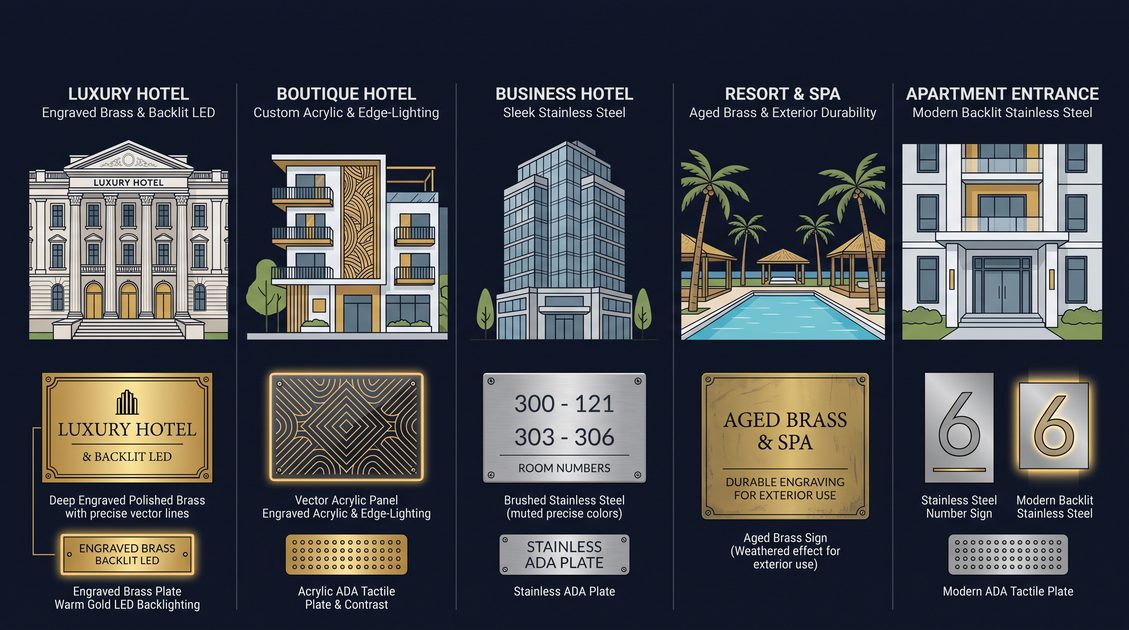
Exterior hotel signage is the set of outdoor identification, wayfinding, and regulatory markers that a property installs outside its building to name the hotel, direct vehicles and guests, and satisfy local code at the street, driveway, and facade. A complete exterior hotel signage program typically pairs a monument sign at the entrance (400 to 1200 mm tall, concrete or aluminum base) with channel-letter building identification (100 to 600 mm per letter) and a directional sign to parking and reception, plus accessible regulatory plates at ramps and entrances. Exterior hotel signage is specified by substrate, weatherproof rating, illumination type, and wind load, with coastal builds rated to 150 to 250 km/h gusts. Standard exterior hotel signage costs USD 800 to USD 6,000 per monument and USD 15 to USD 120 per channel letter at MOQ 50 for component plates, while LED illumination adds USD 200 to USD 2,000. Reputable manufacturers supply CE, RoHS, and ISO 9001 certification, and a 100,000-piece monthly capacity supports estate-wide rollouts for hotels across the United States, United Kingdom, Canada, Australia, Singapore, and Germany.
Why exterior hotel signage matters for hotels
Exterior hotel signage matters for hotels because it is the first and most-seen brand surface a guest meets, and a property with weak or non-compliant exterior hotel signage loses drive-by and walk-in bookings, confuses arrivals, and risks code violations that shut a frontage down mid-season. A visible exterior hotel signage also reassures a first-time guest that the property is well run from the moment they reach the driveway. When every approach carries consistent exterior hotel signage, a traveler recognizes the brand from the highway, finds the entrance without circling, and reaches reception without calling the desk, and that friction-free arrival protects the review score before the guest steps inside. Exterior hotel signage is also a compliance surface because US sites must meet ADA Title III tactile and finish rules for permanent exterior elements such as accessible-entrance and restroom markers. The compliant exterior hotel signage also protects the owner from the lawsuit that a missing accessible plate invites at the property.
Local planning codes govern height, illumination, and setback, so the outdoor marker that helps a guest also protects the owner from fines and takedown orders during the operating year. Beyond compliance, durable exterior hotel signage protects the fit-out investment by resisting rain, UV, salt, and wind for seven to fifteen years of service at the property. The compliant exterior hotel signage also passes the municipal inspection that the planning office runs before each season at the building.
Procurement leaders who specify exterior hotel signage as infrastructure rather than decoration report higher arrival satisfaction, fewer wayfinding calls to the front desk, and smoother code inspections from municipal and brand auditors, making the signage a measurable contributor to revenue and compliance across every market the hotel serves from the United States to Germany. The infrastructure-grade exterior hotel signage also lowers the total cost of ownership that the finance team tracks across the portfolio.
Types of exterior hotel signage
The principal types of exterior hotel signage are monument signs, channel-letter building identification, blade and projecting signs, directional and wayfinding signs, and accessible regulatory plates, each serving a distinct approach and code role at the property edge. The type-matched exterior hotel signage also lets the spec name the exact plate for each approach at the property. A monument sign is a low freestanding marker at the driveway, usually 400 to 1200 mm tall on a concrete, aluminum, or stone base, carrying the brand name and often a directory to reception and parking. The freestanding exterior hotel signage also anchors the arrival sequence that the guest follows from the road to the door at the property. Channel-letter exterior hotel signage mounts individual illuminated letters to the facade or a raceway, delivering the brand name at 100 to 600 mm per letter visible from the street and highway during the evening.
Blade signs project from a wall perpendicular to pedestrian flow, and directional signs guide vehicles and guests to valet, self-park, and entrance at the property. Accessible plates mark the accessible entrance and route with tactile and Braille detail on the face of the exterior hotel signage during the install. The directional exterior hotel signage also keeps the arriving guest off the service road during the evening at the building. The projecting exterior hotel signage also catches the eye of a pedestrian at the corner where the facade turns at the property.
For a property serving the United States, United Kingdom, Canada, Australia, Singapore, and Germany, the same core exterior hotel signage types work across climates if the material and permit match the local weather and code, and the supplier ships CE, RoHS, and ISO 9001 certified components from one Shenzhen line at MOQ 50 pieces with 100,000-piece monthly capacity for the consolidated order across the six export markets. Standard exterior hotel signage speeds the arrival sequence during peak season. Compact exterior hotel signage fits a boutique facade at a small inn. The climate-rated exterior hotel signage also avoids the mid-season failure that forces a re-order from the Shenzhen line at the property.
| Type | Height or size | Mount | Best for | Price |
|---|---|---|---|---|
| Monument | 400 to 1200 mm | Ground base | Entrance, driveway | USD 800 to USD 6,000 |
| Channel letters | 100 to 600 mm | Facade, raceway | Brand name, highway | USD 15 to USD 120 per letter |
| Blade | 400 to 800 mm | Wall project | Pedestrian, corner | USD 200 to USD 1,200 |
| Directional | 300 to 600 mm | Post, wall | Parking, reception | USD 120 to USD 600 |
| Accessible plate | 150 to 300 mm | Wall, post | ADA entrance, route | USD 30 to USD 120 |
Materials for exterior hotel signage
The principal materials for exterior hotel signage are anodized aluminum, brass, stainless steel, acrylic, and stone-composite, each chosen for weather resistance, appearance, and cost across the climate the property faces during the year. The material-matched exterior hotel signage also lets the spec name the exact alloy for each facade at the building. Anodized aluminum exterior hotel signage is the workhorse for outdoor use because the anodic layer resists corrosion, holds color for seven to twelve years without painting, and stays light enough for facade and post mounting, which is why it dominates US and German estates. The anodized exterior hotel signage also keeps the brand color true after years of sun at the property. Brass exterior hotel signage conveys premium warmth for five-star arrivals, resists indoor corrosion, and weathers to a stable patina outdoors if lacquered, holding deep engraving legibly for a decade of service at the property.
Stainless steel exterior hotel signage reads clean and resists coastal salt better than brass, lasting ten to fifteen years with a brushed or mirrored finish on the face. The stainless exterior hotel signage also survives the sea air that eats lesser metals within months at the coastal property. The mirrored exterior hotel signage also reads as a premium marker that matches the five-star lobby at the property. Acrylic exterior hotel signage is the standard for illuminated faces and channel-letter returns, transmitting LED light evenly and supporting full-color brand graphics during the evening.
Stone composite fits monument bases seeking a permanent architectural look but needs a sealant near humid Singapore where mold risk is higher. The stone-composite exterior hotel signage also reads as a permanent marker that matches the heritage lobby at the property. For hotels across the six export markets, the same core exterior hotel signage materials work if the finish resists humidity in Singapore and cold-dry air in Germany, and the Shenzhen supplier ships CE, RoHS, ISO 9001 certified plates at MOQ 50 pieces with 100,000-piece monthly capacity for the consolidated order. The climate-rated exterior hotel signage also avoids the mid-season failure that forces a rebuild at the property. The weather-matched exterior hotel signage also keeps the finish intact through a full year of sun and salt at the building.
| Material | Relative cost | Outdoor lifespan | Best finish | Typical use |
|---|---|---|---|---|
| Anodized aluminum | Low-medium | 7 to 12 years | Anodized, etched | Facade, posts, all climates |
| Brass | High | 8 to 12 years | Brushed, lacquered | Premium arrivals |
| Stainless steel | Medium-high | 10 to 15 years | Brushed, mirrored | Coastal, labs |
| Acrylic | Low-medium | 5 to 8 years | Printed, backlit | Illuminated faces |
| Stone composite | Medium-high | 15 to 25 years | Sealed matte | Monument bases |
Weatherproofing exterior hotel signage
Weatherproofing exterior hotel signage determines whether the marker survives its climate for the rated life or fails within two seasons, and the spec must match the property's weather, not a generic indoor assumption during the fit-out. Outdoor exterior hotel signage should carry an ingress rating of IP65 or higher for illuminated faces so rain and hose wash cannot reach the electronics, and all fasteners should be 316 stainless in coastal markets to resist salt corrosion that eats 304 steel in months. The IP65 exterior hotel signage also survives the monsoon rinse that the monsoon season brings at the coastal property. Anodized aluminum and powder-coated finishes outlast painted ones because the coating is integral or baked, not a film that peels under UV at the property.
Sealed LED modules with potted drivers survive temperature swings from minus 20 C in Canada and Germany winters to plus 45 C in Singapore summers, and a weep hole or gasket prevents condensation that fogs the face during the evening. For coastal hotels in the United States, Singapore, and Australia, a rinse-down cycle in monsoon season extends the life of the exterior hotel signage by years of service at the building. The sealed exterior hotel signage also avoids the fogging that spoils the brand face during a cold night at the property.
A supplier with CE, RoHS, ISO 9001 certification and 100,000-piece monthly capacity supports the weatherproof spec across the six export markets from one Shenzhen facility with 7 to 10 day sampling and 20 to 30 day mass production at MOQ 50 pieces. The weatherproof exterior hotel signage also survives the storm that would drop a lesser plate onto the driveway at the property. Exterior hotel signage rated to 150 to 250 km/h gusts stays up through a storm, protecting guests and the driveway from a fallen plate during the operating year at the property.
| Climate | Risk | Material | Rating | Note |
|---|---|---|---|---|
| Coastal | Salt | 316 stainless, anodized Al | IP65 | Anti-corrosion |
| Cold | Freeze, thaw | Sealed LED, potted | IP65 | Minus 20 C |
| Hot, humid | UV, mold | Anodized Al, acrylic | IP65 | Plus 45 C |
| Windy | Gust load | Braced post, base | 150 to 250 km/h | Wind rating |
Illumination for exterior hotel signage
Illumination for exterior hotel signage joins the physical marker with light so the brand reads at night and in poor weather, and the three common approaches are front-lit channel letters, halo-lit letters, and fully illuminated cabinet or monument faces on the property. Front-lit exterior hotel signage uses LEDs behind a colored acrylic face for maximum daytime and nighttime pop, drawing 8 to 15 watts per letter at 12 to 24 volts with a 50,000 hour rated life during the year. The front-lit exterior hotel signage also reads at speed from the highway during the evening at the property. Halo-lit letters mount off the wall with light spilling behind for a premium glow favored by luxury hotels, while cabinet and monument illumination backlights the whole face evenly through diffuser acrylic at the facade.
Exterior hotel signage illumination should use sealed, potted LED modules with a color temperature of 3000 to 6000 K matched to the brand, and a dimming or photocell option cuts energy and light pollution complaints in the UK and Germany where night rules are strict. The dimmable exterior hotel signage also meets the night-light rule that the conservation officer enforces at the property. Scale economics favor the approach: a ten-letter brand name on a facade draws 80 to 150 watts total, trivial against the visibility it buys from the street and highway at the property.
For hotels across the six export markets, illuminated exterior hotel signage helps in dim corridors and banquet precincts where a glowing directional marker guides attendees without staff help from the Shenzhen exporter at MOQ 50 pieces with CE, RoHS, ISO 9001 certification and 100,000-piece monthly capacity for the consolidated order during the operating year at the building. The illuminated exterior hotel signage also guides a late guest to the correct wing without a call to the desk at the property. The glowing exterior hotel signage also marks the banquet precinct where a weak face would leave guests circling at the building.
| Type | Watts per letter | Life | Look | Price add |
|---|---|---|---|---|
| Front-lit | 8 to 15 W | 50,000 h | Bold, bright | USD 20 to USD 60 |
| Halo-lit | 6 to 12 W | 50,000 h | Premium glow | USD 30 to USD 90 |
| Cabinet | 20 to 80 W | 50,000 h | Even face | USD 100 to USD 600 |
| Monument | 15 to 60 W | 50,000 h | Base glow | USD 80 to USD 400 |
Channel letters for exterior hotel signage
Channel letters for exterior hotel signage are the individual three-dimensional letters that spell the brand on the facade, and the choice of construction changes both appearance and weather performance over the building's life at the property. A channel-letter exterior hotel signage unit has a return (the side wall, in aluminum or stainless), a face (colored acrylic or opaque metal), and a back, and it mounts flush, on a raceway that hides wiring, or remotely with standoffs for halo light during the install. Standard channel letters run 100 to 600 mm tall, and a ten-letter brand name on a facade draws 80 to 150 watts total, trivial against the visibility it buys from the street and highway at the property.
Exterior hotel signage of this kind should use sealed LED modules rated IP65, a 316 stainless frame in coastal markets, and a color-matched face so the brand reads true day and night on the facade. The sealed exterior hotel signage also avoids the fogging that spoils the brand face during a cold night at the property. The potted exterior hotel signage also survives the freeze-thaw that cracks a lesser module at the coastal property. For hotels in the United States, United Kingdom, Canada, Australia, Singapore, and Germany, the same channel-letter class serves every market if the LEDs are potted and the frame resists the local salt or UV load during the year.
A supplier with CE, RoHS, ISO 9001 certification, MOQ 50, and a 100,000-piece monthly capacity supports the channel-letter program from one Shenzhen facility with 7 to 10 day sampling and 20 to 30 day mass production for the consolidated order across the six export markets. The consolidated exterior hotel signage also spreads the per-unit freight across the whole estate at the property. The raceway exterior hotel signage also hides the wiring and spreads the load across the wall at the building. Exterior hotel signage with a raceway mount hides the wiring and spreads the load across the wall, protecting the facade and the brand during the operating life at the building.
| Build | Return | Face | Mount | Price per letter |
|---|---|---|---|---|
| Standard | Aluminum | Acrylic | Raceway | USD 15 to USD 60 |
| Halo | Stainless | Metal | Standoff | USD 40 to USD 120 |
| Open | Aluminum | None | Flush | USD 20 to USD 70 |
| Custom | Brass | Acrylic | Raceway | USD 60 to USD 150 |
Monument signs for exterior hotel signage
Monument signs for exterior hotel signage are the ground-level brand anchor at the driveway, and the base construction decides both permanence and code compliance because most jurisdictions limit monument height and setback during the planning review. A monument exterior hotel signage base uses concrete, aluminum-clad foam, or stone composite, standing 400 to 1200 mm tall with the brand face mounted to the front and often a secondary directory to reception and parking below it on the plate. The base-mounted exterior hotel signage also anchors the brand at the driveway where the guest makes the first turn at the property. The freestanding exterior hotel signage also anchors the arrival sequence that the guest follows from the road to the door at the property. Aluminum-clad foam monuments are light and fast to install, concrete reads permanent but needs a footing, and stone composite lasts fifteen to twenty-five years with a sealant at the property during the year. Exterior hotel signage with IP65 sealing keeps rain and hose wash from the electronics through every storm season at the property.
Exterior hotel signage on a monument should carry the brand name at 150 to 400 mm, an illuminated face where the code allows, and a tactile accessible-entrance plate where the route begins at the monument during the install. For hotels across the six export markets, the same monument types work if the base matches the local frost line and wind load, and the Shenzhen supplier ships CE, RoHS, ISO 9001 certified components at MOQ 50 pieces with 100,000-piece monthly capacity for the consolidated order. The code-ready exterior hotel signage also passes the planning review on the first submission at the property.
A monument exterior hotel signage with a braced base rated to 150 to 250 km/h gusts stays up through a storm, protecting guests and the driveway from a fallen plate during the operating season at the building. The braced exterior hotel signage also protects the driveway from the plate that a weak base would drop at the property. Exterior hotel signage of this kind should be specified by wind load and footing depth first, material second, because the code cares about safety more than brand finish at the property edge served by the six export markets. The wind-rated exterior hotel signage also clears the storm that would drop a lesser plate onto the driveway at the property.
| Base | Height | Install | Life | Price |
|---|---|---|---|---|
| Aluminum-clad foam | 400 to 1000 mm | Fast | 7 to 12 yr | USD 800 to USD 3,000 |
| Concrete | 600 to 1200 mm | Footing | 20 to 40 yr | USD 2,000 to USD 6,000 |
| Stone composite | 600 to 1200 mm | Footing | 15 to 25 yr | USD 1,500 to USD 5,000 |
| Steel post | 400 to 800 mm | Bolt | 10 to 15 yr | USD 400 to USD 1,800 |
ADA and accessibility for exterior hotel signage
ADA and accessibility for exterior hotel signage in the United States come from the 2010 ADA Standards for Accessible Design, which require permanent exterior elements such as accessible-entrance and restroom markers to display signs with raised characters and Grade 2 Braille on the plate. Compliant exterior hotel signage uses uppercase sans-serif raised letters 50 to 75 mm tall with a minimum 1/32-inch raise, a non-glare finish, and strong contrast between characters and background during the install at the property. The compliant exterior hotel signage also keeps the tactile reading zone clear of the door swing at the building. Raised characters must sit with Braille, and the sign belongs on the wall beside the door latch side, centered 1400 to 1700 mm above the finished floor when it marks a permanent space on the facade.
Pictograms need a 150 mm minimum clear field when present, and equivalent rules exist abroad: the UK Equality Act 2010 with BS 8300, the EU EN 301 549, and Australia's Disability standard each mandate tactile, high-contrast signage for permanent spaces. The cross-market exterior hotel signage also keeps one artwork valid across the UK, the EU, and Australia the estate serves. For exterior hotel signage that spans the US, UK, Canada, Australia, Singapore, and Germany, the prudent specification adopts the strictest common baseline of raised tactile characters, Braille, matte non-glare surfaces, and wall-adjacent mounting during the fit-out.
Non-compliant exterior hotel signage invites lawsuits and failed accessibility reviews, so a supplier compliance declaration tied to the relevant standard is essential documentation for every outdoor marker order placed with the Shenzhen exporter at MOQ 50 pieces and 100,000-piece monthly capacity across the six export markets the property operates in from the United States to Germany. The declaration-backed exterior hotel signage also satisfies the audit that the local authority runs before each license renewal at the facility. The code-backed exterior hotel signage also protects the owner from the takedown that a missing plate invites at the property.
Permits and code for exterior hotel signage
Permits and code for exterior hotel signage are the step most properties underestimate, and the variance between jurisdictions is the reason a single design language with market-specific permits beats six bespoke builds during the planning review. In the United States, exterior hotel signage is governed by local zoning for height, setback, illumination, and sign area, often with a separate electrical permit for LED wiring and an ADA review for accessible plates on the facade. The zoned exterior hotel signage also meets the electrical permit that the city requires before the LED wiring is energized at the property. The United Kingdom controls illuminated exterior hotel signage through planning permission and advertisement consent with strict night-light limits, while Germany applies Bauordnung building code and BauGB planning with similar restraint during the year. Exterior hotel signage chosen by substrate outperforms a cheap printed plate that flakes, fades, or fails the weatherproof requirement outdoors.
Australia and Singapore require council approval and building authority sign-off, and Canada follows provincial and municipal sign bylaws for the exterior hotel signage at the property edge. The council-approved exterior hotel signage also clears the building authority that the local code names at the facility. A compliant exterior hotel signage program documents height (commonly 400 to 1200 mm for monuments, 100 to 600 mm letters), setback from road, illumination cutoff, and wind load (150 to 250 km/h) so the permit package is complete during the submission.
For hotels across the six export markets, the Shenzhen supplier with CE, RoHS, ISO 9001 certification and 100,000-piece monthly capacity supports the permit-ready spec at MOQ 50 pieces with 7 to 10 day sampling and 20 to 30 day mass production for the consolidated order. The permit-ready exterior hotel signage also passes the code review on the first submission at the property. The code-named exterior hotel signage also clears the permit package that the planning office requires at the building. Exterior hotel signage that names the worst month, not the average, passes the code review the first time and avoids the takedown that stalls a frontage mid-season at the building served by the property.
| Market | Height limit | Illumination rule | Permit body |
|---|---|---|---|
| United States | Local zoning | Electrical permit | City, county |
| United Kingdom | Planning consent | Night-light limit | Council |
| Germany | Bauordnung | Restraint | Bauamt |
| Australia | Council | Building authority | Council |
| Singapore | BCA | Building authority | BCA |
| Canada | Provincial | Municipal bylaw | Municipality |
Mounting and installation of exterior hotel signage
Mounting and installation of exterior hotel signage determine both compliance and survival through the first storm, so the method must suit the substrate, the wind load, and the code setback for the property edge during the fit-out. A monument exterior hotel signage base needs a concrete footing below frost line in cold markets (Canada, Germany) at 600 to 1200 mm deep, while aluminum-clad foam monuments bolt to a shallow pad in milder zones at the property. The footed exterior hotel signage also resists the heave that a cold winter brings to a shallow base at the building. Facade channel letters mount to a raceway that hides wiring and spreads load across the wall, and standoffs float halo letters 25 to 100 mm off the surface for the glow gap during the install.
All exterior hotel signage fasteners should be 316 stainless in coastal markets, and a laser level keeps every letter on the same datum so the brand reads straight from the highway at the facade. The stainless-fastened exterior hotel signage also resists the salt that eats 304 steel within months at the coastal property. For hotels across the six export markets, the same mounting logic applies if the footing matches the local frost line and the frame resists the local salt or UV load during the year.
A supplier with CE, RoHS, ISO 9001 certification, MOQ 50, and a 100,000-piece monthly capacity supports the install from one Shenzhen facility with 7 to 10 day sampling and 20 to 30 day mass production for the consolidated order. The install-ready exterior hotel signage also ships with the bracing that the wind rating demands at the property. The wind-braced exterior hotel signage also stays up through a storm that drops a lesser plate onto the driveway at the building. Exterior hotel signage with a braced base rated to 150 to 250 km/h gusts stays up through a storm, protecting guests and the driveway from a fallen plate during the operating season at the building served by the property.
| Method | Use | Hold | Cost | Note |
|---|---|---|---|---|
| Concrete footing | Monument | Permanent | USD 200 to USD 800 | Frost line |
| Bolt pad | Light monument | Semi | USD 80 to USD 300 | Mild zone |
| Raceway | Channel letters | Facade | USD 10 to USD 40 per letter | Hides wire |
| Standoff | Halo letters | Wall | USD 5 to USD 20 per letter | Glow gap |
Coastal and climate considerations for exterior hotel signage
Coastal and climate considerations for exterior hotel signage decide whether the marker looks new at year ten or rusts by year three, and the spec must name the property's worst month, not its average, during the fit-out at the building. For coastal hotels in the United States, Singapore, and Australia, salt-laden air corrodes 304 stainless and bare steel in months, so exterior hotel signage should use 316 stainless frames, anodized aluminum faces, and potted LED modules sealed to IP65; a rinse-down cycle in monsoon season extends life by years of service. The coastal exterior hotel signage also survives the sea breeze that strips paint from lesser metals at the property. Cold markets (Canada, Germany) need sealed LEDs rated to minus 20 C and a footing below frost line so the monument does not heave during the winter at the property.
Hot humid markets (Singapore, parts of Australia) need UV-stable anodized finishes and acrylic that resists yellowing at plus 45 C, while windy sites from coastal UK to plains Germany need a braced post or base rated to 150 to 250 km/h gusts so the exterior hotel signage stays up through a storm. The UV-stable exterior hotel signage also keeps the brand color true after a hot summer at the property. For hotels across the six export markets, the same core materials work if the finish resists humidity in Singapore and cold-dry air in Germany, and the Shenzhen supplier ships CE, RoHS, ISO 9001 certified plates at MOQ 50 pieces with 100,000-piece monthly capacity for the consolidated order.
Exterior hotel signage rated for the local climate lasts longer and protects the brand at the street and the driveway through every season the property operates in from the United States to Germany. The climate-rated exterior hotel signage also avoids the mid-season failure that forces a re-order from the Shenzhen line at the property. The weather-rated exterior hotel signage also keeps the finish intact through a full year of sun and salt at the building. A supplier that documents the corrosion class and the wind rating on the exterior hotel signage spec saves the owner a rebuild and a code fight during the operating life at the building served by the six export markets.
| Climate | Corrosion | Cold | Heat | Wind | Material pick |
|---|---|---|---|---|---|
| Coastal US | High | Low | Med | High | 316 SS, anodized Al |
| Singapore | High | None | High | Med | Anodized Al, acrylic |
| Canada | Low | High | Low | Med | Sealed LED, footing |
| Germany | Low | High | Med | High | Anodized Al, braced |
| Australia | Med | Low | High | High | 316 SS, UV acrylic |
Cost of exterior hotel signage
The cost of exterior hotel signage divides into design and tooling, substrate and fabrication, illumination electronics, mounting and footing, permits, and freight, and the split tells a buyer where the budget goes during the planning review. Design and tooling usually run USD 200 to USD 800 for a custom brand template, often waived above a 1,000-piece component order placed with the supplier at the property. Substrate and fabrication are the largest recurring line: anodized aluminum faces cost USD 20 to USD 120 per square meter, brass USD 80 to USD 200, stainless USD 60 to USD 160, and acrylic USD 15 to USD 60, with per-unit price dropping 15 to 30 percent above 500 units across the floor. Exterior hotel signage with a spare over-run of 10 to 15 percent keeps the frontage running when a plate is damaged during a refurbishment.
Illumination adds USD 200 to USD 2,000 for a monument and USD 15 to USD 120 per channel letter, and mounting and footing cost USD 80 to USD 800 by base type during the install. The illuminated exterior hotel signage also adds the night visibility that the arrival sequence depends on at the property. Permits run USD 100 to USD 1,500 by market, and sea freight from Shenzhen adds about USD 0.40 to USD 1.20 per kilogram to the US west coast.
A realistic 50-property exterior hotel signage component program lands near USD 30,000 to USD 120,000 all-in, while a flagship monument and channel-letter build ranges USD 5,000 to USD 25,000 per site. The consolidated exterior hotel signage also spreads the per-unit freight across the whole estate at the property. The costed exterior hotel signage also protects the budget from the over-spend that eats the refurbishment line at the building. Budget 5 to 10 percent extra for spares covering damage and rebrands, because a exterior hotel signage with CE, RoHS, and ISO 9001 certification protects the property across the six export markets the hotel operates in from the United States to Germany at the required quality and lead time for the consolidated order.
| Line | Low | High | Note |
|---|---|---|---|
| Design | USD 200 | USD 800 | Waived over 1000 |
| Aluminum face | USD 20 | USD 120 | Per m2 |
| Brass | USD 80 | USD 200 | Per m2 |
| Illumination | USD 200 | USD 2,000 | Monument |
| Letter | USD 15 | USD 120 | Per letter |
MOQ and capacity for exterior hotel signage
Minimum order quantity and production capacity shape how an exterior hotel signage program is phased across a property portfolio, and a standard MOQ of 50 pieces fits single-site pilots and boutique hotels that want to validate material and code detail before a multi-property commitment to the supplier. The phased exterior hotel signage also lets a pilot site prove the kit before the full estate order ships from Shenzhen. With monthly capacity of 100,000 pieces, a supplier can absorb a 5,000-component multinational deployment in one production month while serving other clients at the same time on overlapping schedules. Lead time splits into sampling and mass production windows for the exterior hotel signage during the year. The phased exterior hotel signage also keeps the brand visible through every phase the property opens at the building.
Sampling runs 7 to 10 days for proof plates and letters, and mass production runs 20 to 30 days for anodizing, engraving, and QA before the exterior hotel signage ships from Shenzhen to the six export markets served. The sampled exterior hotel signage also catches the finish issue before the full order ships to the property. For exterior hotel signage with integrated LED, add five to seven days for electronics assembly and functional testing at IP65 seal before the order is released to the freight forwarder.
Procurement should sequence orders so flagship and highest-visibility sites get signs first, then secondary properties during the rollout. The sequenced exterior hotel signage also keeps the flagship frontage open during the fit-out at the property. Because brand names and colors shift during refurbishment, negotiate a 10 to 15 percent over-run of blank or easily re-branded plates, and confirm the supplier can retain your artwork on file so later reorders stay identical to the original exterior hotel signage release across the United States, United Kingdom, Canada, Australia, Singapore, and Germany from the Shenzhen exporter at MOQ 50 pieces with 100,000-piece monthly capacity for the consolidated order.
Procurement guide for exterior hotel signage
A procurement guide for exterior hotel signage keeps a multi-property program on schedule and within budget while satisfying code and brand standards across every market the estate serves from the six export destinations. Begin by auditing every outdoor marker needed: monument at the driveway, channel letters on the facade, blade at the corner, directional to parking and reception, and accessible plates at ramps and entrances, because accessibility rules apply to permanent exterior elements during the fit-out. The audited exterior hotel signage also gives the supplier a clean spec that matches the original release across the six export markets. Record the brand name, height limits, setback, and illumination cutoff for each site, then decide which need LED versus static plates on the exterior hotel signage during the design phase. Specify substrate by climate across the building. The climate-rated exterior hotel signage also avoids the peel that UV brings to a painted face at the property.
Require a compliance declaration referencing ADA 2010, BS 8300, EN 301 549, or the local equivalent, and request Braille translation for the target market on the exterior hotel signage before the order is released. The compliant exterior hotel signage also satisfies the audit that the local authority runs before each license renewal at the facility. Confirm minimum order quantity, lead time, and monthly capacity against your rollout dates with the supplier at the property during the planning review.
Request a single proof plate and letter before full production, and negotiate a 10 to 15 percent spare over-run so a damaged plate never stalls a frontage handover. Finally, verify certifications and the supplier's ability to store your artwork for future reorders so the exterior hotel signage stays visually consistent across phases and years in the US, UK, Canada, Australia, Singapore, and Germany from the Shenzhen exporter with CE, RoHS, ISO 9001 certification and 100,000-piece monthly capacity at MOQ 50 pieces for the consolidated order. The proof exterior hotel signage also catches the mount issue before the full order ships to the property.
| Step | Action | Target | Note |
|---|---|---|---|
| Audit | List markers | Monument, letters, ADA | Per site |
| Specify | Climate, code | Anodized Al, IP65 | Coastal, cold |
| Comply | Certs, Braille | CE, RoHS, ISO 9001 | Local |
| Order | MOQ, lead | 50 pcs, 20 to 30 d | 10 to 15 percent spares |
Readability and contrast in exterior hotel signage
Readability and contrast decide whether exterior hotel signage actually informs anyone at approach speed, especially in glare, rain, or for low-vision users, and accessibility standards require a minimum 70 percent contrast between characters and background for tactile signs on the plate. In practice this means dark characters on a light matte plate or light characters on a dark matte plate, never glossy surfaces that glare under sun during the day at the property. Exterior hotel signage in anodized aluminum with black etched infill meets this easily, as does white acrylic with charcoal lettering lit from behind on the facade during the evening. The high-contrast exterior hotel signage also reads at a glance for a guest arriving by car at the property.
Color should encode status, not carry the only meaning: red for accessible entrance and green for open is intuitive but must be reinforced by text or icon because about 8 percent of men have color-vision deficiency that affects wayfinding. The color-coded exterior hotel signage also reads at approach speed for a driver on the highway at the property. Font choice matters; use a clean sans-serif at a size readable from the highway, typically 100 to 400 mm cap height for the brand name on facade-level exterior hotel signage across the floor.
Avoid decorative scripts and thin strokes that disappear under glare during the afternoon. The legible exterior hotel signage also passes the brand walk-through that the head office runs at each property during the audit season. For bilingual estates, allocate vertical space so neither language is cramped, and keep the primary language's characters at least as large as the secondary on the exterior hotel signage. Testing a printed proof on the actual wall under daylight catches most readability problems before mass production of the exterior hotel signage begins across the property's six-market estate served by the Shenzhen exporter at MOQ 50 pieces with CE, RoHS, ISO 9001 certification for the consolidated order. The proofed exterior hotel signage also catches the glare that a corridor shadow hides at the property.
Maintenance and lifecycle of exterior hotel signage
Maintenance and lifecycle of exterior hotel signage protect the fit-out investment and keep code compliance intact years after the initial install, because an anodized aluminum or stainless exterior hotel signage typically lasts seven to fifteen years outdoors while acrylic and printed faces wear in five to eight across the building. Daily or weekly maintenance for exterior hotel signage is a rinse in coastal markets and a wipe of the face, while quarterly covers fastener torque, LED function check, and gasket inspection, and annual covers structural and wind-load re-check after storm season at the property. The maintained exterior hotel signage also avoids the outage that leaves a frontage dark during a busy weekend at the building. Engraved and anodized exterior hotel signage lasts seven to fifteen years outdoors, while printed acrylic faces wear in five to eight, so budget replacements on that curve rather than treating signage as permanent.
A practical plan reserves 5 to 10 percent spares from the original order to cover storm damage and early rebrands, and stores the artwork with the supplier so reorders match visually across phases and years of service at the property. The spare-backed exterior hotel signage also covers the rename that follows a rebrand at the property. When a brand is renamed, prefer modular exterior hotel signage with replaceable name inserts or re-anodizable aluminum, because lacquered brass is expensive to rework during a refurbishment cycle.
Audit exterior hotel signage annually for glare, contrast loss, loose mounts, corrosion, and Braille legibility, because a plate that looked compliant at handover can degrade under sun, salt, and wind during the year. The annual exterior hotel signage audit also feeds the next budget cycle with real wear data from the frontage at the property. A documented lifecycle plan turns exterior hotel signage from a one-time purchase into a managed asset that sustains accessibility and brand consistency throughout the building's operating life and across every renovation that touches the collaborative spaces in hotels served by the Shenzhen exporter at MOQ 50 pieces with CE, RoHS, ISO 9001 certification and 100,000-piece monthly capacity for the consolidated order across the six export markets.
Exterior hotel signage for different markets
Exterior hotel signage for different markets varies by climate, code, and brand tier, and a one-size monument fails both a Singapore high-rise and a German alpine lodge during the operating year at the property. United States coastal and highway properties favor channel letters visible at speed and a monument at the driveway, with 316 stainless and anodized aluminum for salt and sun, and ADA plates at accessible entrances on the facade. The highway-grade exterior hotel signage also reads at 100 km/h from the passing lane at the property. United Kingdom and Germany properties favor restrained illumination under night-light rules, anodized aluminum and brushed stainless, and a footing below frost line in Germany during the winter at the building. The frost-footed exterior hotel signage also resists the heave that a cold winter brings to a shallow base at the property.
Canada needs sealed LEDs to minus 20 C and deep footings, while Australia needs UV-stable acrylic and 316 stainless on the coast during the summer. The cold-rated exterior hotel signage also survives the freeze-thaw that cracks a shallow base at the property. Singapore needs corrosion-proof anodized aluminum and acrylic that resists plus 45 C and monsoon rinse at the property edge served by the six export markets.
For all six export markets, the same core exterior hotel signage works if the material and permit match the climate, and signs carry the local accessibility and language needs with CE, RoHS, and ISO 9001 certification from the Shenzhen supplier at MOQ 50 pieces and 100,000-piece monthly capacity for the consolidated order. The code-ready exterior hotel signage also passes the review on the first submission at the property. The export-ready exterior hotel signage also clears the brand audit on the first submission at every property the estate serves. Exterior hotel signage specified by wind load, corrosion class, and night-light rule passes the code review the first time and avoids the rebuild that stalls a frontage mid-season at the building served by the property from the United States to Germany.
| Market | Material | Illumination | Footing | Note |
|---|---|---|---|---|
| United States | Anodized Al, 316 SS | Bold, allowed | Per zone | ADA plates |
| United Kingdom | Anodized Al, SS | Restrained | Shallow | Night rule |
| Germany | Anodized Al, braced | Restrained | Frost line | Bauordnung |
| Canada | Sealed LED, Al | Allowed | Frost line | Minus 20 C |
| Australia | 316 SS, UV acrylic | Allowed | Shallow | UV stable |
| Singapore | Anodized Al, acrylic | Allowed | Shallow | Monsoon rinse |
Sustainability in exterior hotel signage
Sustainability in exterior hotel signage is increasingly part of procurement scoring as hotels pursue LEED, BREEAM, and WELL certification, and the choices that cut waste and energy also cut cost over the building's life across the six export markets. Anodized aluminum and recycled-content stainless earn more points than virgin brass, though brass's long service life offsets its mining footprint through avoided replacement across the building's decades-long operating life. Low-power LED exterior hotel signage draws 8 to 15 watts per letter with a 50,000 hour rated life, so a facade deployment adds negligible energy load while improving arrival visibility that supports security and guest satisfaction during the evening at the property. The efficient exterior hotel signage also trims the facade energy line without a visible light drop at the building. Exterior hotel signage with IP65 sealing keeps rain and hose wash from the electronics through every storm season at the property. A weatherized exterior hotel signage also avoids the outage that leaves a frontage dark during a busy weekend at the building.
Suppliers with ISO 14001 environmental management and RoHS compliance simplify green-building documentation, and a 100,000-piece monthly capacity from a single Shenzhen facility reduces per-unit shipping emissions versus multiple regional suppliers serving the same estate across the six export markets. The sustainable exterior hotel signage also supports the ESG scorecard that corporate clients review before booking at the property. Specifiers should request a declaration of recycled content and a recyclability statement for end-of-life exterior hotel signage, because auditors ask for the full lifecycle picture now during the certification review.
Choosing durable anodized and engraved exterior hotel signage over short-lived printed plates is itself a sustainability win, cutting waste and the carbon of repeat production runs across the decades-long operating life and reducing total cost of ownership for hotels in the US, UK, Canada, Australia, Singapore, and Germany from the Shenzhen exporter with MOQ 50 pieces and CE, RoHS, ISO 9001 certification at the required quality and lead time for the consolidated order. The durable exterior hotel signage also keeps the facade brand consistent between refurbishments at the property.
Common mistakes with exterior hotel signage
Common mistakes with exterior hotel signage cost hotels permits, budget, and sometimes the frontage itself, and the patterns repeat across properties that skip a specification document before the purchase order is released to the supplier. The first is ignoring local height and setback code, so the monument is built and then ordered down by the city, wasting the footing and the base during the planning review at the property. The second is using 304 stainless or bare steel in coastal markets, which corrodes in months and forces a full rebuild rather than a wipe during the operating year at the building. The third is printing rather than engraving or anodizing tactile characters on accessible plates, yielding a sign with no raised profile and no legal standing as compliant exterior hotel signage under the local code. The code-rejected exterior hotel signage also triggers the takedown that stalls a frontage mid-season at the property.
The fourth is inconsistent placement and height across a portfolio, where one property's letters sit straight and the next tilt, undermining brand uniformity for repeat guests who navigate by the exterior hotel signage at the facade. The misaligned exterior hotel signage also fails the brand walk-through that the head office runs at each property during the audit season. The fifth is omitting Braille or using a non-Grade-2 code, a common error in cross-border programs that assume one Braille serves all markets across the six export destinations.
The sixth is under-rating wind load, so the first storm drops the sign and injures someone or blocks the driveway during the season. The wind-failed exterior hotel signage also triggers the insurance claim that follows a fallen plate at the property. The seventh is neglecting IP65 sealing on LEDs, letting rain kill the illumination within a season at the property. Avoiding these starts with a clear spec and a proof plate reviewed by both facilities and code staff before the full exterior hotel signage order is released for any of the six export markets served by the Shenzhen supplier with CE, RoHS, ISO 9001 certification and MOQ 50 pieces at 100,000-piece monthly capacity for the consolidated order.
Future of exterior hotel signage
The future of exterior hotel signage trends toward smarter illumination, sustainable materials, and dynamic wayfinding, and the changes target the two costs hotels feel most: energy for light and churn for rebrand across the operating year at the property. The forward-looking exterior hotel signage also locks in the connectivity that the next BMS upgrade will demand at the building. The smarter exterior hotel signage also dims to the local night-light rule that the conservation officer enforces at the property. LED exterior hotel signage will adopt adaptive brightness that dims to local night-light limits in the UK and Germany while staying bold elsewhere, and e-ink directory faces on monuments will update parking and reception status without a rewire during the evening. The adaptive exterior hotel signage also meets the night-light rule that the conservation officer enforces at the property. NFC and QR codes etched into the plate let a guest tap a phone to check in or navigate the lobby, turning static exterior hotel signage into a doorway to the digital stay at the building.
Sustainable substrates such as recycled aluminum and bio-based acrylic are gaining traction as hotels pursue green-building certifications, and suppliers with ISO 14001 increasingly win enterprise bids for the exterior hotel signage across the portfolio. The sustainable exterior hotel signage also strengthens the bid for the corporate rate that values ESG at the property. Modular exterior hotel signage with replaceable name inserts will dominate hotels because it absorbs rebrands at near-zero cost during a refurbishment cycle at the property.
Finally, AI-driven wayfinding may generate dynamic directional signs on shared outdoor screens, but the permanently mounted tactile accessible plate will remain legally required for accessibility under ADA 2010 and the regional equivalents. The future-proof exterior hotel signage also protects the capital spent on the current fit-out from early obsolescence at the property. Procurement teams should specify exterior hotel signage that is future-proof in mounting and connectivity while never compromising the engraved tactile core that accessibility and code law demand across every market served by the Shenzhen supplier with 100,000-piece monthly capacity and MOQ 50 pieces at the required quality and lead time for the consolidated order from the United States to Germany.
Choosing a supplier for exterior hotel signage programs
Choosing a supplier for exterior hotel signage programs determines not just unit price but the consistency, compliance, and scalability of the entire rollout across a property portfolio, and a qualified manufacturer should hold ISO 9001 for quality management and provide CE and RoHS declarations for materials and any electronics used in the exterior hotel signage. Production capacity is a practical gate: a supplier with a 100,000-piece monthly capacity can absorb a 5,000-component multinational deployment within one production month while serving concurrent clients on overlapping schedules at the property. The scalable exterior hotel signage also supports a rapid multi-property rollout without a production bottleneck at the Shenzhen facility. Ask for a single proof plate and channel letter before full production of the exterior hotel signage during the planning review. Exterior hotel signage chosen by substrate outperforms a cheap printed plate that flakes, fades, or fails the weatherproof requirement outdoors.
Verify the supplier can store your artwork and Braille translation on file so later reorders stay visually identical to the original release across the six export markets served by the estate. The reorder-identical exterior hotel signage also keeps the brand consistent across every phase the property opens at the building. Evaluate the supplier's ability to support bulk provisioning of LED exterior hotel signage from a CSV namespace, because manual configuration per letter becomes a bottleneck during rapid expansion of the signage estate at a growing hotel group.
Confirm lead times of 7 to 10 days for sampling and 20 to 30 days for mass production, and the flexibility of the MOQ, commonly 50 pieces for standard models, since a low pilot threshold lets facilities validate material and code detail before a portfolio-wide commitment that is hard to reverse once installed across hotels in the United States, United Kingdom, Canada, Australia, Singapore, and Germany from the Shenzhen exporter with CE, RoHS, ISO 9001 certification and MOQ 50 pieces at the required quality and lead time for the consolidated order. The pilot-threshold exterior hotel signage also lets a single site validate the kit before the full estate order ships from Shenzhen.
Budgeting and total cost of ownership for exterior hotel signage
Budgeting and total cost of ownership for exterior hotel signage extends well beyond the per-letter or per-monument sticker price, and treating signage as a managed asset rather than a consumable pays back over the property's operating life across the six export markets. The upfront cost of exterior hotel signage divides into design and tooling, substrate and fabrication, illumination electronics, mounting and footing, permits, and freight from the Shenzhen supplier to the property. The itemized exterior hotel signage cost also prevents the over-spend that eats the refurbishment budget at the building. But the ownership cost also includes spares, periodic rebrands, and eventual replacement on the material's wear curve where anodized aluminum and stainless last seven to fifteen years and acrylic five to eight in the building during the year.
A durable anodized exterior hotel signage program therefore has a lower lifetime cost than a cheap printed one that must be replaced twice, even though the initial invoice is higher at the property. Energy for LED exterior hotel signage is negligible at 8 to 15 watts per letter during the evening. The low-energy exterior hotel signage also supports the sustainability claim the property makes to corporate clients at the building. Procurement teams should model the seven-to-fifteen-year cost rather than the purchase order, and should favor suppliers who support re-anodizing and artwork retention so future phases integrate seamlessly with the original exterior hotel signage estate without a visual break that guests notice across the property's six-market footprint served by the Shenzhen exporter with MOQ 50 pieces and CE, RoHS, ISO 9001 certification at the required quality and lead time for the consolidated order.
For hotels in the United States, United Kingdom, Canada, Australia, Singapore, and Germany, the same total-cost logic applies because labor and energy are the largest lines whether the property is in Singapore or Germany, and the right exterior hotel signage returns the investment through avoided rework and reduced complaint calls to the front desk within the first season of operation at the building served by the six export markets. The costed exterior hotel signage also protects the budget from the over-spend that eats the refurbishment line at the property.
| Cost view | Cheap printed | Durable anodized |
|---|---|---|
| Initial | Low | Higher |
| Life | 5 to 8 yr | 7 to 15 yr |
| Replacements | 2x | 1x |
| TCO | Higher | Lower |
Exterior hotel signage integration with building management systems
Exterior hotel signage integration with building management systems is where static outdoor markers become intelligent nodes that report status and link to the guest journey, and a modern exterior hotel signage program with LED faces connects over PoE, WiFi, or a low-voltage bus to the PMS and increasingly to the BMS that controls landscape lighting and security across the building. The connected exterior hotel signage also cuts the energy that the facade draws during an empty night at the property. When the PMS marks a block sold out, the monument directory can dim the available-rooms line, and when a storm hits, the BMS can cut non-essential illumination to protect the exterior hotel signage circuit during the evening at the property. Integration standards matter: choose exterior hotel signage whose API or gateway is documented, because proprietary lock-in turns a simple lit letter into a stranded asset when the software vendor changes during the lifecycle. The documented exterior hotel signage also keeps the facade brand straight across every property the group operates.
For portfolios, bulk provisioning of exterior hotel signage from a CSV namespace is the difference between a one-afternoon rollout and a week of per-letter configuration at the estate. Security also matters; the sign is a networked device exposed to weather and tamper, so confirm the supplier supports sealed IP65 enclosures, encrypted transport, and role-based access so a rogue actor cannot spoof a property's identity on the exterior hotel signage across the floor. The bulk-provisioned exterior hotel signage also keeps the install labor low during a rapid portfolio expansion at the property.
Done well, integrated exterior hotel signage pays for itself in energy, security, and arrival experience rather than being a decorative line item on the fit-out budget that nobody measures after handover for hotels across the six export markets. The integrated exterior hotel signage also links the facade to the BMS that the facilities team runs at the property. A supplier with CE, RoHS, ISO 9001 certification, MOQ 50 pieces, and 100,000-piece monthly capacity supports the connected spec from one Shenzhen facility with 7 to 10 day sampling and 20 to 30 day mass production for the consolidated order from the United States to Germany at the required quality and lead time for the building served by the property.
Exterior hotel signage for airports and transit
Exterior hotel signage for airports and transit properties faces the highest traffic and the strictest sightline rules because a hotel at an airport terminal must catch a tired traveler from a moving car or train without breaking the authority's sign code during the operating year at the property. Exterior hotel signage at an airport often pairs a monument at the access road with a blade sign at the terminal shuttle stop, and the brand must read at 60 to 80 km/h, so letters run 300 to 600 mm with bold front-lit LED at 8 to 15 watts each on the facade. The airport-grade exterior hotel signage also guides the tired traveler from the terminal to the lobby without a call to the desk at the property. Exterior hotel signage for transit hubs should use 316 stainless and anodized aluminum because de-icing salt and weather at a northern airport (Canada, Germany) corrode lesser metals within months, and the IP65 seal keeps the illumination alive through snow and rain during the winter at the building. The IP65 exterior hotel signage also survives the de-icing salt that strips paint from a lesser plate at the terminal property.
Exterior hotel signage for airports must satisfy the local planning code and the terminal authority's signage standard, which often limits height and illumination cutoff more tightly than a standalone site during the planning review. A supplier with CE, RoHS, ISO 9001 certification, MOQ 50, and a 100,000-piece monthly capacity supports airport-hotel rollouts across the US, UK, Canada, Australia, Singapore, and Germany from one Shenzhen facility with 7 to 10 day sampling and 20 to 30 day mass production for the consolidated order. The authority-ready exterior hotel signage also passes the terminal review on the first submission at the property. The airport-grade exterior hotel signage also meets the authority's cutoff rule that the standalone site does not face at the building.
Exterior hotel signage for transit proves its worth when an arriving guest sees the brand from the shuttle and walks straight to reception rather than calling the desk from the curb, protecting the review score before the door at the property. Exterior hotel signage for airports should be specified by wind load (150 to 250 km/h), corrosion class, and night-light rule, because a terminal authority will order down a sign that glares into the road or rattles in the first storm during the season served by the six export markets. The transit-ready exterior hotel signage also meets the authority's cutoff rule that the standalone site does not face at the building. A supplier that documents the corrosion class and the wind rating on the exterior hotel signage spec saves the owner a rebuild and a code fight at the building.
| Site | Letters | Material | Rule |
|---|---|---|---|
| Airport road | 300 to 600 mm | 316 SS, anodized Al | Authority code |
| Terminal stop | Blade 400 to 800 mm | Acrylic | Height limit |
| Shuttle curb | Monument 400 to 1000 mm | Aluminum base | Illumination cutoff |
| Parking | Directional 300 to 600 mm | Anodized Al | Wind 150 to 250 km/h |
Exterior hotel signage for historic and protected buildings
Exterior hotel signage for historic and protected buildings must satisfy heritage and conservation rules that often forbid illuminated facade letters and limit any fixture to a reversible, non-damaging mount during the fit-out at the property. Exterior hotel signage in a protected zone typically uses a freestanding brass or anodized aluminum plate at the entrance rather than channel letters drilled to a listed facade, and the finish must match the period without faking it on the face. The heritage-grade exterior hotel signage also respects the fabric that the conservation body protects at the property. Exterior hotel signage for a historic hotel should carry the brand name in an engraved tactile face that meets ADA 2010, BS 8300, EN 301 549, or the local equivalent, because accessibility law applies even where heritage rules restrict style during the install at the building. The heritage-compliant exterior hotel signage also passes the audit that the local authority runs before each license renewal at the facility.
Exterior hotel signage for protected buildings should use standoff or bracket mounts that leave the masonry untouched, and any illumination must be subtle and downward-cut to satisfy both the conservation body and the night-light rule in the UK and Germany during the evening. The reversible exterior hotel signage also leaves the listed facade intact for the next owner at the property. The heritage-grade exterior hotel signage also respects the fabric that the conservation body protects at the building. A supplier with CE, RoHS, ISO 9001 certification, MOQ 50, and a 100,000-piece monthly capacity supports heritage-hotel rollouts across the US, UK, Canada, Australia, Singapore, and Germany from the Shenzhen exporter with 20 to 30 day mass production and a 10 to 15 percent spare over-run for the consolidated order.
Exterior hotel signage for historic properties proves its worth when the conservation officer approves on first submission because the design respected the fabric and the code, avoiding the months of rework a drilled facade invites at the property. The approved exterior hotel signage also keeps the heritage body satisfied through the next audit at the building. Exterior hotel signage for protected buildings should be specified by mount type and illumination cutoff first, material second, because the heritage body cares about reversibility more than brand finish during the planning review served by the six export markets. A supplier that documents the mount and the cutoff on the exterior hotel signage spec saves the owner a rejection and a rebuild at the building from the United States to Germany.
| Constraint | Mount | Illumination | Material |
|---|---|---|---|
| Listed facade | Standoff, bracket | Downward, subtle | Brass, anodized Al |
| Conservation area | Freestanding plate | None or low | Anodized Al |
| Period style | Engraved face | Halo only | Brass |
| Reversible | Bracket | Cutoff | Aluminum |
Glossary of exterior hotel signage terms
A glossary of exterior hotel signage terms helps procurement and facilities teams speak the same language and avoid specification errors that surface only at install across the six export markets served by the supplier. Monument is the low freestanding marker at the driveway, 400 to 1200 mm tall, and channel letter is the individual illuminated facade letter, 100 to 600 mm tall, drawing 8 to 15 watts during the evening at the property. Anodized aluminum is the corrosion-resistant outdoor substrate with a seven to twelve year finish on the face, and brass is the premium warm metal holding deep engraving for a decade of service at the building. The anodized exterior hotel signage also keeps the brand color true after years of sun at the property. The street-visible exterior hotel signage also reassures a drive-by guest that the property is open for booking at the building.
Acrylic is the light-transmitting face for illuminated exterior hotel signage, and IP65 is the ingress rating that keeps rain from electronics during the storm season. The IP65 exterior hotel signage also survives the monsoon rinse that the coastal season brings at the property. ADA is the US law whose 2010 Standards govern tactile exterior signage for permanent spaces, and a compliant exterior hotel signage also satisfies the audit that the local authority runs before each license renewal at the facility. Braille is the raised dot code on compliant plates where Grade 2 is the contracted form required in the US market. Tactile characters are raised letters with a minimum 1/32-inch profile on the plate during the install at the property.
Raceway is the facade box hiding channel-letter wiring, and MOQ is the smallest batch a supplier produces, commonly 50 pieces for standard exterior hotel signage. Capacity is the monthly production volume, here 100,000 pieces, that determines how large a rollout can be absorbed in one month from the Shenzhen facility with CE, RoHS, and ISO 9001 certification for the consolidated order across the six export markets the property serves from the United States to Germany at the required quality and lead time for the exterior hotel signage program during the operating year at the building.
Not sure which sensor fits your project?
Talk to our mmWave application engineers for a free consultation.
Specify your hotel project with our engineers
Send your room count, ceiling type, and protocol preference. We will return a sample plan and quote within 24 business hours.
- Move from general guidance into a product or application discussion.
- Use RFQ when pricing, drawings, MOQ, or launch timing needs structure.
- Keep a direct contact path visible for fast clarifications and handoff.