Hotel Door Number Plates and Signage: A Complete Guide
A complete guide to hotel door number plates and signage covering materials, ADA rules, LED options, costs, MOQ, mounting and compliant room door plates.
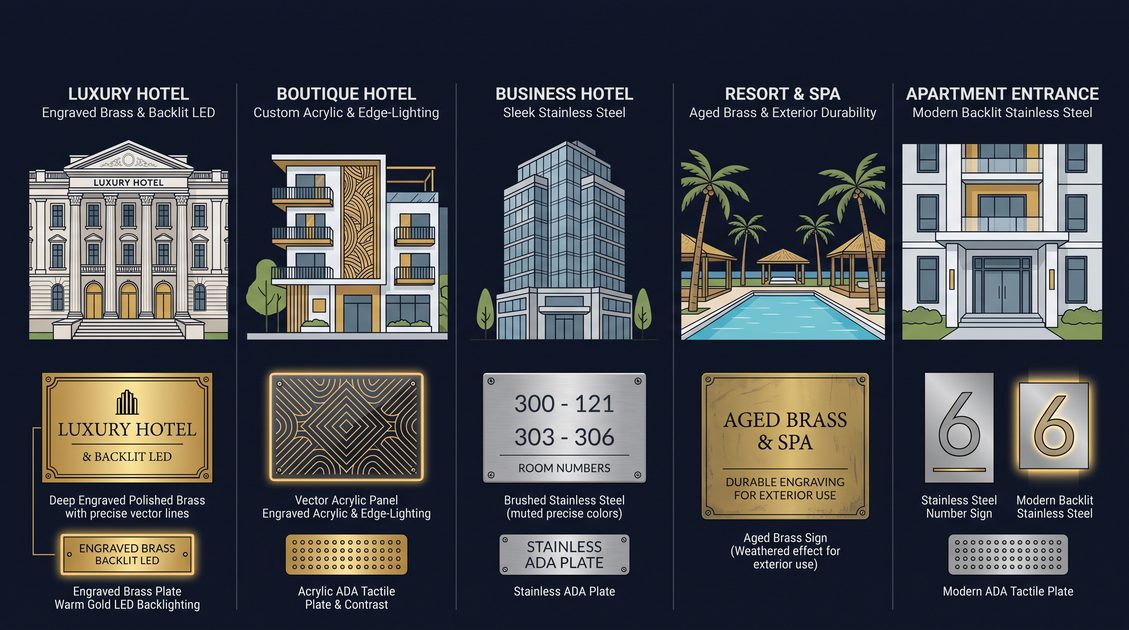
Hotel door number plate and signage is the identification system fixed to or beside every guest room entrance, combining a visible room numeral, an engraved or printed name line, a privacy slider, and often a tactile ADA face so that every traveler can confirm the correct room. A standard hotel door plate measures 100 by 250 mm to 150 by 300 mm, sized so the number reads from the corridor yet sits flush or slightly proud of the door or wall. Construction ranges from solid brass and stainless steel to acrylic and aluminum, with the numeral cut, engraved, or printed by budget. A complete hotel door plate often integrates a sliding privacy indicator and a holder for the room name card, plus a tactile ADA face for accessibility. In modern properties the hotel door plate may carry an NFC tag or QR code linking to service menus, though the permanent numeral remains the legally required identifier. HotelDoorPlate Technology Co., Ltd. in Shenzhen makes these plates at scale with CE, RoHS, and ISO 9001, exporting to the US, UK, Canada, Australia, Singapore, and Germany.
Why hotel door identification matters
Hotel door identification is the system of numbered plates, engraved room markers, and tactile signage that tells guests and staff exactly which room sits behind each entrance in a hospitality property. A clear hotel door marker pairs a visible room number with a nameplate, a do-not-disturb slide, and often an ADA-compliant tactile plaque so that every traveler, including those who are blind or low-vision, can confirm the correct room without asking at the front desk. Property operators rely on consistent hotel door signs because wayfinding breaks down the moment numbers are missing, faded, or inconsistent across floors, forcing guests to wander corridors and burdening staff with directions. Branded hotel door plates also reinforce the property's identity at the most personal touchpoint, the threshold of a paid night's rest, where polish reads as care. Beyond comfort, accessibility law in the US, UK, Canada, Australia, Singapore, and Germany requires permanent rooms to carry compliant tactile signage.
A hotel door that lacks a proper plate creates measurable operational cost. Front desk calls rise, housekeeping wastes minutes per floor finding rooms, and first-time guests form a negative impression before they unpack. Consistent hotel door signage also supports emergency response, because firefighters and medical teams locate a room faster when numbers are uniform and lit. For chains, a single hotel door specification across every property simplifies procurement, training, and audits, turning the plate from a decorator's afterthought into managed infrastructure.
What a hotel door number plate is
A hotel door number plate is a rigid identification marker fixed to or beside a guest room entrance, displaying the room number, floor, and sometimes the suite title through engraving, printing, or illumination. The classic hotel door plate measures 100 by 250 mm to 150 by 300 mm so the number reads from the corridor yet sits flush with the door. Construction ranges from solid brass and stainless steel to acrylic and aluminum, with the numeral cut, engraved, or printed by budget. A complete hotel door plate often integrates a sliding privacy indicator and a holder for the room name card, plus a tactile ADA face for accessibility. In modern properties the hotel door plate may carry an NFC tag or QR code linking to service menus, though the permanent numeral remains the legally required identifier. HotelDoorPlate Technology Co., Ltd. in Shenzhen makes these plates at scale with CE, RoHS, and ISO 9001, exporting to the US, UK, Canada, Australia, Singapore, and Germany.
The hotel door plate differs from a wall sign because it lives at the threshold where the guest's private space begins, so it must survive constant touching, luggage knocks, and cleaning chemicals for years. A good hotel door plate uses a matte or brushed finish to avoid glare, high contrast between numeral and background, and concealed or decorative fixings so the plate looks integral to the door. When the hotel door plate also serves as the ADA tactile marker, the raised characters and Braille must be permanent, not a printed sticker that peels.
Hotel door materials and finishes
Hotel door materials span brass, stainless steel, aluminum, and acrylic, each chosen for durability, cost, and the property's design language. A brass hotel door plate reads as warm and premium, favored by five-star and boutique properties, though it needs a lacquer near steam to slow tarnish and keep the engraved numeral crisp. Stainless steel hotel door plates resist humidity and disinfectant better than any alternative and suit both luxury and high-traffic corridors. Aluminum hotel door plates keep weight and price down for large portfolios while allowing anodized color, and acrylic hotel door plates enable backlit and LED builds with full-color numerals. The table below compares the substrates most used for hotel door programs across hospitality buildings, weighting daily contact and cleaning resistance since doors are the most handled surface in a room.
| Material | Relative cost | Contact resistance | Best finish | Typical use |
|---|---|---|---|---|
| Brass | High | Good (lacquered) | Brushed, lacquered | Boutique, luxury |
| Stainless steel | Medium-high | Excellent | Brushed, mirrored | All grades |
| Aluminum | Low-medium | Good | Anodized, etched | Chains, residences |
| Acrylic | Low-medium | Good (sealed) | Printed, backlit | LED, modern |
A hotel door finish must also meet non-glare rules where the plate doubles as an ADA marker, so polished mirror surfaces are avoided on tactile faces. Engraving the numeral into the substrate rather than printing on top preserves legibility after years of wiping, which is why a quality hotel door plate is cut or laser-engraved rather than screen-printed for the primary number.
Hotel door engraving and printing
Hotel door engraving is the process of cutting or lasering the room number into the plate so the numeral is permanently raised or recessed, while printing lays ink or film on the surface for color and detail. Engraved hotel door plates keep their number readable for eight to fifteen years even under daily cleaning, because the mark is part of the material rather than a coating that wears. Printed hotel door plates cost less and allow full-color logos, but the image can fade or scratch, so printing is best for secondary artwork rather than the primary numeral. Laser engraving on brass or stainless gives a crisp, tactile edge that also satisfies ADA raise requirements when paired with Braille. For acrylic hotel door plates, subsurface printing behind a protective layer combines color richness with surface durability. Matching the method to the zone protects the investment, since a hotel door at a busy corridor takes far more abuse than a plate in a quiet executive wing.
A hotel door that mixes engraved numerals with printed branding gets the best of both: permanent identification plus rich visual identity. Suppliers should provide a proof plate showing the actual engrave depth and print color before mass production, because screen calibration differs from finished metal. Confirm the hotel door artwork file is retained so later reorders match the original release exactly across years of expansion.
ADA and accessibility for hotel door signage
ADA accessibility for hotel door signage in the United States follows the 2010 ADA Standards for Accessible Design, which require permanent rooms to display signs with raised characters and Grade 2 Braille. Compliant hotel door signage uses uppercase sans-serif raised letters with a minimum 1/32-inch (0.8 mm) raise, a non-glare finish, and high contrast between characters and background. The sign mounts on the wall adjacent to the door latch side, centered 1400 to 1700 mm (55 to 67 inches) above the finished floor, never on the door itself because a moving door leaves the tactile reading zone. International equivalents broaden the duty: the UK Equality Act 2010 with BS 8300, the EU EN 301 549, and Australia's Disability standard each mandate tactile, high-contrast signage for permanent rooms. A hotel door program spanning the US, UK, Canada, Australia, Singapore, and Germany should adopt the strictest common baseline so one plate artwork satisfies audits everywhere the property operates.
A hotel door that serves as the ADA marker must keep its tactile face permanent and compliant regardless of any electronics behind it. The Braille translation must match the target market, because Grade 2 in the US differs from Unified English Braille in the UK and other regional codes. A supplier compliance declaration referencing the applicable standard is essential paperwork for the file and for any future audit of the hotel door installation.
Hotel door LED and backlit options
Hotel door LED options add a small illuminated numeral or a backlit acrylic face so the room number glows in dim corridors, helping guests find their room after dark without disturbing neighbors. A backlit hotel door plate uses an acrylic diffuser behind the engraved numeral, drawing under 1.5 watts per unit and connecting via low-voltage wire, PoE, or battery with a door sensor. LED hotel door plates are especially valuable in dimly lit boutique corridors, nightlife venues, and resorts where ambient light is weak, and they can pulse or change color to signal do-not-disturb status. Scale economics favor the approach in long corridors: a 200-room floor with always-on LED hotel door plates draws about 300 watts total. When specifying LED hotel door signage, verify the ingress rating, the low-light dimming behavior, and whether the illuminated module is sealed separately so the compliant tactile plate stays serviceable if the electronics fail.
A hotel door with integrated lighting must keep the tactile numeral readable even when the light is off, because accessibility cannot depend on a powered component. Choose a hotel door design where the LED is a discreet halo or edge glow rather than a glare that washes out the engraved number, and confirm the electronics are replaceable without removing the whole plate from the door.
Hotel door cost breakdown
Hotel door cost divides into design and tooling, substrate and decoration, electronics for LED units, hardware and mounting, and freight. Design and tooling usually run USD 80 to USD 300 for a custom brand or numeral template, often waived above a 500-piece order. Substrate and decoration are the largest recurring line: brass engraved hotel door plates cost USD 10 to USD 30 each, stainless USD 8 to USD 22, aluminum USD 5 to USD 14, and acrylic USD 4 to USD 12 at MOQ 50, with per-unit price dropping 15 to 30 percent above 1,000 units. LED electronics add USD 6 to USD 40 depending on display type and connectivity. Mounting hardware costs USD 0.30 to USD 2.00 per plate. Sea freight from Shenzhen adds about USD 0.10 to USD 0.30 per 250-gram plate to the US west coast. A realistic 300-plate stainless engraved hotel door program lands near USD 2,400 to USD 6,600 all-in, while a 1,000-plate acrylic LED program ranges USD 10,000 to USD 25,000.
| Component | Cost range (USD) | Notes |
|---|---|---|
| Design and tooling | 80 to 300 | Waived above 500 pcs |
| Substrate and decoration | 4 to 30 per plate | By material |
| LED electronics | 6 to 40 per plate | Display dependent |
| Mounting hardware | 0.30 to 2.00 per plate | Adhesive or screw |
| Freight | 0.10 to 0.30 per 250g | Shenzhen to US |
Budget 5 to 10 percent extra for spare hotel door plates covering fit-out damage and future renames, because a single missing plate can stall a floor's handover and force an expedited reorder at premium air freight cost.
Hotel door MOQ and production capacity
Hotel door minimum order quantity and production capacity shape how a signage program is phased across a property or portfolio. A standard MOQ of 50 pieces fits a single building pilot or a boutique hotel, letting facilities validate material and ADA detail before a portfolio-wide commitment. With monthly capacity of 100,000 pieces, a supplier can absorb a 10,000-plate multi-site deployment in one production month while serving other clients, which matters when several buildings renovate on overlapping schedules. Lead time splits into sampling (7 to 10 days for proof plates) and mass production (20 to 30 days for engraving, anodizing, and QA). For hotel door plates with integrated LED, add five to seven days for electronics assembly and functional testing. Procurement should sequence orders so guest-facing or highest-traffic hotel door plates receive plates first, then back-of-house and staff facilities, because the visible threshold matters most to guest perception.
Because room numbers and accessibility designations shift during fit-out, negotiate a 10 to 15 percent over-run of blank or easily re-engraved hotel door plates; acrylic and aluminum accept re-work more readily than lacquered brass. Confirm the supplier can retain your artwork and Braille translation on file so later reorders of the hotel door plates stay identical to the original release across years and phases of expansion.
Hotel door mounting methods
Hotel door mounting determines both compliance and longevity, so the method must match the door substrate and the ADA mounting zone. Adhesive mounting uses VHB or epoxide tape and fits smooth painted doors, metal, and glass where drilling is undesirable; it holds plates up to about 1.5 kg but needs surface cleaning and a 24-hour cure. Screw mounting with concealed or decorative caps is the most secure for heavy brass hotel door plates and high-touch public corridors. Standoff mounting floats acrylic or metal hotel door plates 12 to 25 mm off the surface, creating a premium shadow gap and simplifying any LED wire routing behind the plate. For ADA compliance, the sign must sit beside the door on the latch side, 1400 to 1700 mm to center, never on the door itself. Installers should use a laser level and jig to keep every plate on the same horizontal datum across a floor, since uneven height undermines aesthetics and the muscle memory of repeat visitors.
A 200-room hotel typically needs one to two installers for one to two days to fit all hotel door plates and wayfinding markers, with LED units taking longer due to wiring and sensor pairing. Proper mounting of the hotel door plate prevents the rattles and gaps that read as cheap and that let moisture behind the plate, so the fixing method is as important as the plate itself.
Hotel door for luxury and boutique hotels
Hotel door design for luxury and boutique properties leans on tactile richness and material warmth, because the threshold is where a premium guest judges the room before opening it. A five-star hotel door plate often uses brushed brass or bronze with deep engraving and a fingerprint-resistant lacquer, paired with a heavy feel and concealed fixings that make the plate appear cast into the door. Boutique hotels use the hotel door plate as a brand canvas, choosing custom numerals, patinas, or a small monogram that repeats in the lobby and key cards for a coherent identity. Lighting integration on a luxury hotel door is subtle: a warm low glow rather than a bright LED, preserving the calm of a corridor at night. Finish signals tier, and the hotel door plate is the single most-touched brand surface in the building, so skimping here undercuts the rest of the fit-out investment and the rate the property can command.
A boutique hotel door program should order proof plates in the actual finish before committing, because brass tone and engrave depth vary between batches. The hotel door plate at a luxury property also benefits from a name card holder so suites can be personalized for returning guests, a small touch that increases perceived service without recurring cost.
Hotel door readability and contrast
Hotel door readability and contrast decide whether a guest actually finds the room, especially in poor lighting or for low-vision users. Accessibility standards require a minimum 70 percent contrast between characters and background for tactile signs, which in practice means dark numerals on a light matte plate or light numerals on a dark matte plate, never glossy surfaces that create glare. A hotel door plate in brushed stainless with black engraved infill meets this easily, as does white acrylic with charcoal lettering. Font choice matters; use a clean sans-serif at a size readable from three meters in a corridor, typically 20 to 40 mm cap height for the room number on a hotel door plate. Avoid decorative scripts and thin strokes that vanish under corridor shadows. For bilingual estates, allocate vertical space so neither language is cramped, and keep the primary language's characters at least as large as the secondary on the hotel door face.
Color should encode status, not carry the only meaning: a red do-not-disturb slide is intuitive but must be reinforced by text because about 8 percent of men have color-vision deficiency. Testing a printed proof of the hotel door plate on the actual door under installed lighting catches most readability problems before mass production begins, particularly in corridors where ambient light is often weak.
Hotel door procurement checklist
A hotel door procurement checklist keeps a multi-building program on schedule and within budget while satisfying accessibility law. Start by auditing every guest room that needs a permanent marker, including standard rooms, suites, accessible variants, and staff rooms, because accessibility rules apply to permanent rooms. Record the required numeral style, the name line, capacity notes, and any accessibility symbol for each, then decide which need LED status versus static plates. Specify substrate by zone: stainless for humid public areas, brass for prestige, acrylic or aluminum for high-volume back-of-house. Require a compliance declaration referencing ADA 2010, BS 8300, EN 301 549, or the local equivalent, and request Braille translation for the target market. Confirm MOQ (commonly 50 pieces), lead time (20 to 30 days mass production), and monthly capacity (100,000 pieces) against your rollout dates for the hotel door order.
Request a single proof plate before full production, and negotiate a 10 percent spare over-run of hotel door plates. Finally, verify certifications (CE, RoHS, ISO 9001) and the supplier's ability to store your artwork for future reorders so the hotel door plates stay visually consistent across phases and years of the building program, avoiding the visual break that guests and inspectors both notice.
Common mistakes with hotel door plates
Mistakes with hotel door plates cost facilities teams time and budget and sometimes trigger compliance failures. The first is mounting plates on the door rather than the adjacent wall, which violates ADA tactile-height rules and forces users to open the door to read the number. The second is choosing glossy finishes that glare under corridor lighting and fail the non-glare requirement, making the hotel door plate unreadable for low-vision occupants. The third is printing rather than engraving tactile characters, yielding a plate with no raised profile and no legal standing as accessible signage. The fourth is inconsistent placement height across a floor, where one hotel door plate sits at 1500 mm and the next at 1650 mm, undermining aesthetics and the muscle memory of repeat visitors. The fifth is omitting Braille or using a non-Grade-2 code, a frequent error in cross-border programs. The sixth is under-ordering spares, so a single damaged hotel door plate during fit-out stalls a floor's handover and forces an expensive air-freight reorder.
The seventh mistake is neglecting LED ingress rating near splash zones, buying plates that fail within a year. Avoiding these pitfalls starts with a clear specification document and a proof plate reviewed by both facilities and accessibility staff before the full hotel door order is released to production and shipping, because correcting a plate after installation costs far more than correcting a proof.
Future of hotel door signage
The future of hotel door signage trends toward smarter status, sustainable materials, and connected service. E-ink and low-power LED hotel door plates will increasingly show room status and cleaning state pulled from building management platforms, reducing corridor confusion in large resorts and conference hotels. NFC and QR codes etched into the plate may let a guest request supplies or unlock a partnership offer, turning the static hotel door plate into an interaction point. Sustainable substrates such as recycled aluminum and bio-based acrylic are gaining traction as corporates pursue green-building certifications, and suppliers with ISO 14001 increasingly win enterprise bids. Modular hotel door plates with replaceable numeral or name inserts will dominate venues that rebrand, because they absorb changes at near-zero cost. Finally, AI-driven wayfinding may generate dynamic directional cues on shared screens near elevators, but the permanently mounted tactile hotel door plate will remain legally required for accessibility and as the guest's trusted locator.
Procurement teams should specify hotel door signage that is future-proof in mounting and connectivity while never compromising the engraved tactile core that accessibility law demands of every permanent room, because the plate must work for a blind guest even when the network is down.
Hotel door for apartments and residences
Hotel door identification for serviced apartments and branded residences faces heavier personalization and longer tenancies than transient hotel rooms, which raises both durability and identity stakes. A serviced apartment hotel door plate needs to survive years of daily contact, cleaning chemicals, and occasional moves while remaining fully compliant with ADA 2010, BS 8300, EN 301 549, and Australia's Disability standard wherever the unit is permanent. Residence estates often prefer stainless steel or anodized aluminum hotel door plates because these substrates resist moisture and disinfectant and shrug off rough treatment better than lacquered brass. LED hotel door plates are valuable in long corridors of mixed-use towers, where a warm glow at the door helps a resident find the unit after dark. Personalization matters more in residences because the plate may carry a unit name or owner monogram, so the hotel door plate should support easy name-card swaps. Procurement for apartments should standardize one compliant design language across the tower and confirm the supplier can deliver replacement hotel door plates quickly when one is damaged.
A residence hotel door program benefits from a higher spare over-run given the wear and the longer ownership horizon, and from artwork retention so a plate replaced five years later matches the original release exactly, preserving the building's coherent identity.
Hotel door sustainability and green credits
Hotel door sustainability and green building credits are increasingly part of procurement scoring as commercial buildings pursue LEED, BREEAM, and WELL certification. The material choice for a hotel door plate contributes to credit categories such as materials and resources: recycled-content aluminum and bio-based acrylic earn more points than virgin brass, though brass's long service life offsets its mining footprint through avoided replacement. Low-power LED hotel door plates draw under 1.5 watts per unit, so a floor-wide deployment adds negligible energy load while improving room finding, which indirectly supports energy credits by reducing wasted lighting searches. Suppliers with ISO 14001 environmental management certification and RoHS compliance simplify the documentation burden for green-building submissions, and a 100,000-piece monthly capacity from a single Shenzhen facility reduces per-unit shipping emissions compared with multiple regional suppliers. Specifiers should request a declaration of recycled content and a take-back or recyclability statement for end-of-life hotel door plates.
Choosing durable engraved hotel door plates over short-lived printed plates is itself a sustainability win, cutting waste and the carbon of repeat production runs across the facility's decades-long operating life and reducing the total cost of ownership for the owner who must keep the corridors compliant and presentable throughout.
Hotel door placement and wayfinding
Hotel door placement and wayfinding determine whether signage actually helps guests navigate a floor or merely labels a door. A strong strategy places the hotel door plate where it is visible from the main approach path, not tucked beside a recessed door, and reinforces it with directional signs at decision points such as elevator lobbies and corridor junctions. Consistent placement height across a floor matters enormously: ADA requires the tactile sign centered 1400 to 1700 mm above the finished floor on the latch side, and deviating between rooms forces blind and low-vision users to re-learn the pattern in every corridor. Use the numeral at a distance and the name up close, because the number carries meaning across language barriers while the name confirms it for literate readers. Color-coding by room type helps sighted wayfinding but must never be the sole differentiator because about 8 percent of men have color-vision deficiency.
When planning a rollout, document the full placement scheme in the specification so every hotel door plate is installed from one source of truth, preventing the drift where one floor mounts at 1500 mm and the next at 1650 mm with no apparent logic a guest could reasonably follow under pressure in an unfamiliar corridor at night.
Hotel door lifecycle and replacement
Hotel door lifecycle and replacement planning protects the fit-out investment and keeps accessibility compliance intact years after the initial install. Engraved stainless or brass hotel door plates typically last eight to fifteen years indoors even in humid conditions, while acrylic and printed plates wear in five to eight, so budget replacements on that curve rather than treating signage as permanent. A practical plan reserves 5 to 10 percent spares from the original order to cover fit-out damage and early renames, and stores the artwork and Braille translation with the supplier so reorders match visually across phases. When a floor is renamed or reconfigured, prefer modular hotel door plates with replaceable numeral inserts or re-engravable acrylic and aluminum, because lacquered brass is expensive to rework. LED electronics have a shorter life than the plate; specify a separate sealed indicator module so the compliant tactile face stays serviceable.
Audit hotel door plates annually for glare, contrast loss, loose mounts, and Braille legibility, because a plate that looked compliant at handover can degrade under cleaning chemicals and steam. A documented lifecycle plan turns the hotel door plate from a one-time purchase into a managed asset that sustains accessibility and brand consistency throughout the building's operating life and across every renovation that touches the guest rooms.
Hotel door standards and international variations
Hotel door standards and international variations matter because a single multinational estate often spans jurisdictions with different but overlapping accessibility codes, and specifying one compliant design language prevents costly rework. In the United States, the 2010 ADA Standards govern permanent hotel door signage with raised characters, Grade 2 Braille, non-glare finish, and wall-adjacent mounting at 1400 to 1700 mm. In the United Kingdom, the Equality Act 2010 together with BS 8300 sets similar tactile and high-contrast expectations, while the EU harmonizes through EN 301 549 referencing ISO 21542. Canada follows CSA B651-18, Australia applies AS 1428.1, and Singapore references the Building and Construction Authority code. Although core principles align, details differ: Braille code varies, pictogram clear-field sizes can differ by millimeters, and character height minima vary slightly. The safest hotel door procurement approach is to adopt the strictest common denominator across all markets served and keep the supplier's Braille translation per market on file.
This way a single hotel door plate artwork, with market-specific Braille, satisfies audits everywhere the estate operates, and reorders remain visually identical while meeting local law across every jurisdiction that inspects the rooms, avoiding the expense of redesigning the plate for each country the brand enters.
Choosing a supplier for hotel door programs
Choosing a supplier for hotel door programs determines not just unit price but the consistency, compliance, and scalability of the entire rollout across a property portfolio. A qualified manufacturer should hold ISO 9001 for quality management and provide CE and RoHS declarations for the materials and any electronics used in the hotel door plate, since these certifications are commonly required by US, UK, Canadian, Australian, Singaporean, and German buyers and customs. Production capacity is a practical gate: a supplier with a 100,000-piece monthly capacity can absorb a 10,000-plate multi-site deployment within a single production month while still serving concurrent clients, which matters when several buildings renovate on overlapping schedules. Ask for a single proof plate before full production, and verify the supplier can store your artwork and Braille translation on file so later reorders stay visually identical to the original release of the hotel door plates.
Evaluate the supplier's ability to support bulk provisioning of LED hotel door plates from a CSV namespace, because manual configuration per plate becomes a bottleneck during rapid expansion. Finally, confirm lead times (7 to 10 days sampling, 20 to 30 days mass production) and the flexibility of the MOQ, which is commonly 50 pieces for standard models, since a low pilot threshold lets facilities validate material and ADA detail before a portfolio-wide commitment that is hard to reverse once the doors are hung.
Hotel door budgeting and total cost of ownership
Hotel door budgeting and total cost of ownership extends well beyond the per-plate sticker price, and treating signage as a managed asset rather than a consumable pays back over the property's operating life. The upfront cost of a hotel door plate divides into design and tooling (USD 80 to USD 300, often waived above 500 pieces), substrate and decoration (the largest recurring line, USD 4 to USD 30 per plate by material), LED electronics (USD 6 to USD 40), hardware and mounting (USD 0.30 to USD 2.00 per plate), and freight (about USD 0.10 to USD 0.30 per 250 gram plate from Shenzhen to the US). But the ownership cost also includes spares (budget 5 to 10 percent over-run), periodic renames (modular plates lower this), and eventual replacement on the material's wear curve (engraved stainless and brass last eight to fifteen years, acrylic and printed five to eight). A durable engraved hotel door plate program therefore has a lower lifetime cost than a cheap printed one that must be replaced twice.
Energy for LED hotel door plates is negligible at under 1.5 watts per unit. Procurement teams should model the three-to-ten-year cost rather than the purchase order, and should favor suppliers who support re-engraving and artwork retention so future phases integrate seamlessly with the original hotel door estate without a visual break that guests and inspectors both notice immediately upon arrival at the corridor.
Glossary of hotel door terms
A glossary of hotel door terms helps procurement and facilities teams speak the same language and avoid specification errors that surface only at install. ADA (Americans with Disabilities Act) is the US law whose 2010 Standards govern tactile signage for permanent rooms. Braille is the raised dot code on compliant hotel door plates; Grade 2 is the contracted form required in the US. Tactile characters are raised letters you can read by touch, with a minimum 1/32-inch (0.8 mm) profile. Non-glare finish means a matte surface that does not reflect light into a low-vision user's eyes. Standoff mounting floats the hotel door plate off the wall on small posts, creating a shadow gap and hiding wires. VHB tape is a high-bond acrylic adhesive used for drill-free mounting on doors or walls. IP44 is an ingress rating that protects electronics from splash near a hotel door. E-ink is a low-power reflective display that shows status without a backlight. MOQ (minimum order quantity) is the smallest batch a supplier will produce, commonly 50 pieces for standard hotel door plates. Capacity is the monthly production volume, here 100,000 pieces, that determines how large a rollout can be absorbed in one month.
Knowing these terms lets a buyer write a specification that a manufacturer can quote accurately the first time, reducing change orders and delays across the hotel door project and ensuring the plates that arrive match what the architect and the accessibility consultant both approved before the walls were sealed.
Not sure which sensor fits your project?
Talk to our mmWave application engineers for a free consultation.
Specify your hotel project with our engineers
Send your room count, ceiling type, and protocol preference. We will return a sample plan and quote within 24 business hours.
- Move from general guidance into a product or application discussion.
- Use RFQ when pricing, drawings, MOQ, or launch timing needs structure.
- Keep a direct contact path visible for fast clarifications and handoff.