Hotel Room Signage: Complete Wayfinding System
Hotel room signage design guide covering room numbers, do not disturb, ADA tactile rules, materials, branding, wayfinding, and compliant procurement for hotels.
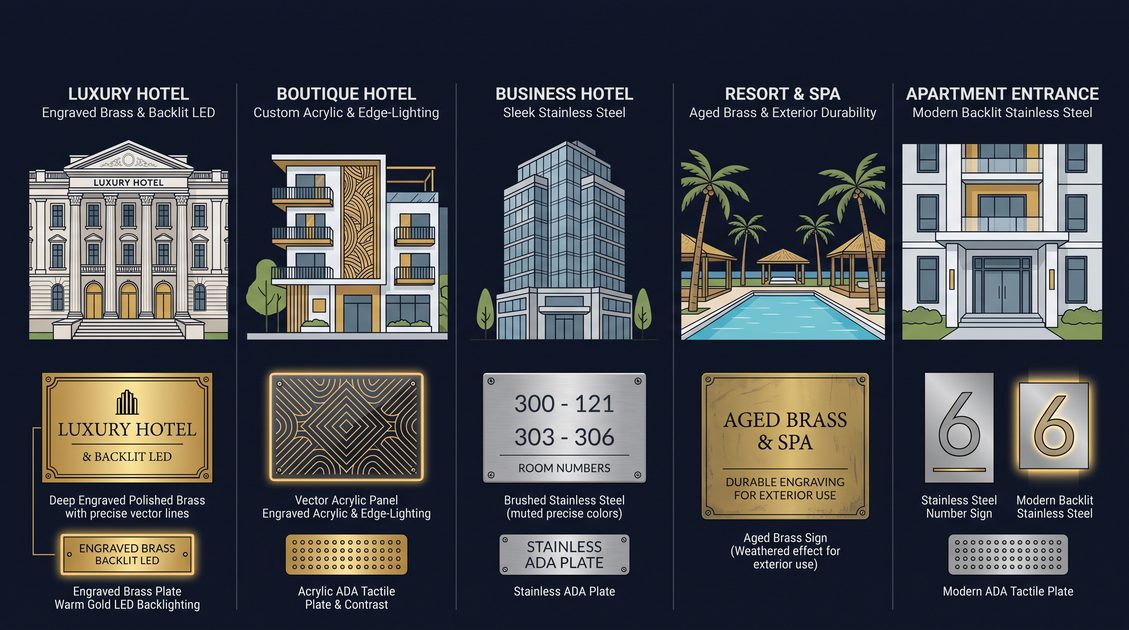
Hotel room signage is the complete interior wayfinding system of a hospitality property, spanning the door number at the guest room, the suite and connecting-room plates, the floor and wing directs in the corridor, the elevator-lobby directory, and the accessible markers that let every guest navigate from the front desk to the correct bed independently. A coherent hotel room signage program combines visible room numbers for sighted guests with optional tactile and braille elements for accessibility, brand-matched materials and finishes that signal the property's tier, and a consistent layout logic that repeats from the lobby to the furthest wing so a returning guest learns the visual language once and applies it everywhere. Unlike a single printed door sticker, hotel room signage must survive constant guest contact, housekeeping cart bumps, luggage scrapes and daily cleaning without numbers fading, edges lifting or finishes scratching, which is why the components are produced by laser engraving into two-tone acrylic, routing into solid brass or aluminum, or building into LED-illuminated acrylic. Modern hotel room signage serves three masters at once: wayfinding for the guest, brand expression for the operator, and accessibility compliance for the regulator, and the best programs satisfy all three across every component without one undermining the others.
Hospitality procurement teams specify hotel room signage across boutique hotels, resort complexes, extended-stay properties, serviced apartments and budget chains, and the diversity of those venues means one material and one finish cannot serve them all, because a luxury resort wants a backlit onyx-look acrylic that a budget chain would never justify, while both still need numbers a guest can read at the end of a long corridor. The room number on hotel room signage is the single most-touched and most-looked-at element in a guest's stay, because it is how they confirm the right door after a long flight, how housekeeping confirms the room to service, and how a blind guest confirms the suite with a fingertip, so its legibility and durability are non-negotiable. This guide examines the system architecture, the materials from acrylic through brass and LED, the accessibility overlay, the mounting geometry, brand and lighting customization, cost and MOQ structure, manufacturer selection, common failures and the technology roadmap for hotel room signage over the next five years as smart-room integration expands.
What Is Hotel Room Signage And Why It Is A System Not A Sign
Hotel room signage is the layered set of markers that moves a guest from the property entrance to the correct room, and it is a system rather than a single sign because no one marker can carry the whole journey, so the directory, the corridor directs, the floor plates and the door numbers must share one logic to feel like one property. A standard hotel room signage program begins at the lobby directory that lists wings and floors, flows through overhead corridor directs that name the room range ahead, terminates at the door with a numbered and named plate, and includes accessible markers wherever compliant rooms exist, with every component using the same type style, color logic and mounting discipline. The room number on hotel room signage is the element that works at distance down a dim corridor, which is why the type is usually a clean geometric style with generous stroke and often a contrasting inlay or backlight so it reads from ten meters away, and why the finish is chosen to catch the corridor sconce rather than to disappear into the wall. The tactile text and braille on hotel room signage exist to satisfy accessibility law in public accommodations, while the visible number exists to satisfy the guest's need to find the room, and a good system serves both without the compliant elements looking like an afterthought.
The durability framing for hotel room signage is that its components live in the highest-contact signage environment in hospitality after the restroom, because every guest touches or brushes the door and frame, every housekeeping cart bumps it, and every luggage trolley scrapes it, so a program that looks beautiful on install day but delaminates after months of alcohol wipes and cart impacts becomes a recurring replacement cost and a brand blemish. A hotel room signage component made from printed vinyl on foam will show edge lift within weeks of cleaning and will scratch as the first suitcase drags past, whereas an engraved acrylic or routed brass sign presents a monolithic face with the identifier in the material core, so the digit survives thousands of guest cycles. The number on engraved hotel room signage is revealed by removing the cap layer of a two-tone sheet, which means the digit cannot peel or fade because it is the substrate itself, not an applied film, and this physical integration is why compliant high-traffic venues specify engraved or metal rather than printed signs. When a property buys hotel room signage, the question is not only whether the number looks right on day one but whether it will still read correctly after years of real guest traffic, and the answer decides the total cost of ownership more than the headline price does.
| Component | Function | Brand Role |
|---|---|---|
| Lobby directory | Property overview | First impression |
| Corridor direct | Room range ahead | Navigation |
| Door number | Identify room | Primary cue |
| Suite plate | Room name or type | Tier signal |
| Accessible marker | Compliant room | ADA required |
Architecture Of A Hotel Room Signage Program
Hotel room signage architecture starts from the guest journey and works backward, mapping every decision point where a guest could hesitate and placing a marker there, so the system feels effortless rather than sparse, and the marker logic repeats so the guest learns it once. A coherent hotel room signage program assigns each room a permanent number from the property's space code, pairs that number with a type name drawn from a controlled vocabulary such as standard, deluxe, suite or accessible, and renders both in the identical type style and color logic across every door so the guest learns the visual language once and applies it everywhere. For a tower property this means rooms numbered by floor and position each receive a hotel room signage plate carrying the number in the same layout, while suite, connecting and accessible rooms each get their own named class with a distinct accent that staff and guests both learn to recognize at a glance. The numbering discipline also supports emergency response, because paramedics and fire crews calling for "the guest in room 1207" rely on the hotel room signage matching the number shouted over the radio, and a consistent system reduces the seconds that matter in a crisis.
Beyond static identification, modern hotel room signage increasingly integrates supplementary cues that do not compromise tactile compliance, such as a small printed pictogram band above the braille line showing a wheelchair for accessible rooms, a bed for suites, or an arrow for connecting rooms, provided the pictogram is decorative and the tactile number remains the legally sufficient identifier. Some hotel room signage adds a thin colored top stripe coded to floor so that a long corridor reads as a color gradient from lobby through mid-floors to penthouse, helping cognitive and low-vision guests navigate by hue as well as by number. For shared or re-purposed rooms, writable hotel room signage with a sealed dry-erase window lets staff update the occupant name without replacing the base sign, though the permanent tactile room number must stay fixed engraved elements to remain compliant. The systems view matters because a single beautiful hotel room signage plate in a sea of mismatched markers looks like an error, whereas a uniform program of hundreds reads as institutional competence and measurably reduces front-desk direction calls.
| Room Class | Sign Text Example | Accent Logic |
|---|---|---|
| Standard | ROOM 1207 | Neutral blue |
| Deluxe | DELUXE 1210 | Green |
| Suite | SUITE 1501 | Amber |
| Accessible | ROOM 1204 ACCESSIBLE | Contrast stripe |
| Connecting | ROOM 1208 CONNECTING | Purple |
Materials For Hotel Room Signage From Acrylic To Brass
Hotel room signage components are manufactured from a range of substrates that balance legibility, illumination potential, tactile quality and impact resistance, with the dominant families being cast acrylic with laser-engraved through-color core, solid brass with routed and infilled numerals, anodized aluminum with enamel infill, and LED-illuminated acrylic with edge or back diffusion. Cast acrylic hotel room signage is the volume workhorse because the material is supplied in two-tone sheet where a colored cap layer sits over a contrasting core, so a laser or rotary engraver removes the cap to reveal the second color as permanent raised or recessed identifiers that cannot delaminate under wiping or scraping. Solid brass hotel room signage delivers the premium hospitality look, with numerals routed then infilled with a wear-resistant enamel or left as bare brushed metal, and it signals luxury tiers where the property wants the door hardware and the number to read as one crafted ensemble. Anodized aluminum hotel room signage gives a lighter, modern alternative to brass with the same routing-and-infill durability, suited to contemporary and boutique properties, and LED acrylic hotel room signage embeds a diffused light source behind or around the identifier so it glows softly down a dim corridor, a signature of upscale and design-led hotels.
The illumination question decides material for many properties, because only acrylic and certain resin systems diffuse LED evenly without hot spots, whereas metal identifiers require a separate halo or under-glow fixture to achieve the backlit look, which changes both the fabrication and the mounting. A hotel room signage LED component must manage heat and wiring so the light source lasts as long as the sign face, and the best designs run the cable through a concealed channel to a low-voltage driver mounted behind the wall, avoiding the exposed wire that cheap backlit signs suffer. Brass and aluminum hotel room signage win on impact resistance and patina potential, because a metal identifier shrugs off a luggage scrape that would gouge acrylic, and brass develops a living finish many luxury operators consider part of the brand rather than a defect. The material decision for hotel room signage should start from the property tier and the corridor lighting, because a glow number in a dark resort corridor solves a real wayfinding problem, while the same glow in a bright budget hallway is wasted spend a simple engraved acrylic would deliver more cheaply.
| Material | Look | Best Tier |
|---|---|---|
| Two-tone acrylic | Clean, versatile | Budget to mid |
| Solid brass | Luxury, warm | Upscale |
| Anodized aluminum | Modern, light | Boutique |
| LED acrylic | Glowing, signature | Design-led |
Accessibility Overlay On Hotel Room Signage
Hotel room signage in public accommodations must satisfy the same tactile and braille rules as any ADA room sign wherever the property is a place of lodging covered by the statute, and that means a raised tactile room number with Grade 2 braille beneath it, mounted within the 48 to 60 inch center-height envelope on the latch side of the door or the nearest adjacent wall. The tactile number on hotel room signage uses characters between 5/8 and 2 inches tall with stroke width 10 to 30 percent of cap height and a matte non-glare finish, and the number sits in the stable reading zone so a finger sweeping the latch-side wall encounters it at the expected height. Braille on hotel room signage is domed Grade 2 with base diameter 0.059 to 0.063 inch, height 0.025 to 0.037 inch and spacing 0.090 to 0.100 inch, positioned directly beneath the corresponding tactile number and left-aligned, so a blind guest confirms the room in braille immediately below the felt digit. The visible number on hotel room signage is not a substitute for braille, because a blind person cannot perceive a visual figure, so the tactile and braille identifiers are the legally sufficient elements and the glow or print is the supplementary cue, a hierarchy the layout must respect.
Contrast on hotel room signage follows the same 70 percent luminance minimum as every other tactile sign, and the large identifiers make contrast easy with a dark digit on a light field or a light digit on a dark field, but the mistake of a tasteful mid-tone on mid-tone still occurs when a designer prioritizes a muted palette over the measurable threshold. The braille on hotel room signage must survive the guest-traffic cleaning regimen, which means the dots must be physically integrated into the substrate through engraving or casting rather than applied as a separate bead that could detach under wiping, because a flattened or missing braille dome is a direct non-conformance. A hotel room signage supplier should provide a conformance declaration naming character height, stroke, contrast, braille geometry and mounting envelope, and should retain the validated artwork so re-orders reproduce the exact same compliant file, because consistency across a floor's signs is what an auditor perceives as institutional competence. When the visible number, tactile number and braille on hotel room signage all meet standard, the sign serves every guest class and passes inspection without remediation, and the brand expression rides on top without compromising access.
| Requirement | Value | Tool |
|---|---|---|
| Tactile height | 5/8 to 2 inch | Ruler |
| Stroke width | 10 to 30 percent | Caliper |
| Braille dots | Domed Grade 2 | Braille gauge |
| Contrast | 70 percent min | Luminance meter |
| Finish | Matte under 15 gloss | Gloss meter |
Mounting Geometry For Hotel Room Signage
Hotel room signage tactile components must follow the mounting envelope wherever tactile elements are present, with the tactile sign center between 48 and 60 inches above the finished floor and placement on the latch side of the door or the nearest adjacent wall, because a number mounted at eye level or on the door panel puts the reading zone in the wrong place and fails inspection. The instinct to center the hotel room signage at roughly 64 inches feels natural but exceeds the 60 inch ceiling, and a sign even slightly above that line is a measurable non-conformance a complainant can verify with a tape measure, so the specification must state the exact center height and the installer must measure post-bond. Mounting the hotel room signage tactile element on the swinging door instead of the wall moves the reading zone every time the door opens, which is why wall mounting beside the latch is the conforming permanent approach, while a purely decorative visible number may sit higher on the door itself as a brand choice. For a row of hotel room signage down a corridor, every sign should share the identical center height and horizontal alignment so the floor reads as a deliberate system rather than as mismatched markers, which is also the look luxury brands insist on.
Security mounting for hotel room signage in busy urban properties uses tamper-resistant screws or through-bolts because the signs sit in spaces where removal is a real risk, and a flush plate with countersunk heads leaves no edge to grip, whereas a foam-tape sign in such a venue will eventually be pulled off. The hotel room signage in a renovation should reuse existing wall anchors where possible to avoid patching, but only if the anchor height already falls in the compliant band, because moving a sign down to hit the band is cheaper than re-patching a wall drilled too high. Channel-rail systems let properties swap hotel room signage when a room is re-numbered, preserving the wall finish and the conforming height while letting the label change in seconds, which is the pragmatic answer to rebrands and re-floorings. Whatever the method, the installer verifies final center height with a tape measure, because a hotel room signage component that reads perfectly but sits too high is still a failed inspection, and the brand damage of a non-compliant luxury corridor is disproportionate to the small effort of measuring.
| Parameter | Required | Common Error |
|---|---|---|
| Center height | 48 to 60 inch | 64 inch eye level |
| Side | Latch side wall | Hinge side |
| Door mount | Tactile not allowed | On door panel |
| Security | Screw or bolt | Foam tape only |
| Row alignment | Matched height | Uneven set |
Brand And Lighting Customization Of Hotel Room Signage
Hotel room signage accepts deep brand customization because it is a primary brand touchpoint, and the compliant levers are material, finish, illumination color, logo header, size format and optional bilingual visual line, while the fixed elements where tactile is present remain raised number height, braille, contrast and mounting envelope. A luxury resort might specify hotel room signage in solid brass with a routed logo header and a warm LED under-glow, provided the logo sits above the number and the tactile elements keep their 70 percent contrast, because a logo that intrudes into the character zone creates a reading obstruction. A boutique property might choose two-tone acrylic hotel room signage with a brand-color core and a small engraved mark, helping guests learn the visual language of the brand at the room door, and a budget chain might match a standard acrylic number to the corporate palette while keeping the digit in compliant contrast. The illumination on hotel room signage can be tuned to the brand's light temperature, warm 2700K for cozy resorts or cool 4000K for modern business hotels, as long as the glow does not wash out the tactile contrast required by statute.
Bilingual customization for hotel room signage serves international properties where guests read Arabic, Chinese, Japanese or Cyrillic better than Latin, and the compliant approach renders the tactile number with braille beneath, then adds a visual-only translated floor or wing label printed flat below the braille, so the fingertip reader encounters only the required tactile while the sighted multilingual guest gains the extra cue. Hotel room signage in large resorts often adds a floor or wing sub-text or a small pictogram indicating a suite, connecting room or accessible layout, provided the extra element is decorative and the numeral stays dominant. Color-coded logic, where the floor determines the acrylic core color, is the most operationally useful customization because it lets a returning guest recognize their floor by hue as well as by number, and suppliers offering hotel room signage with matched wayfinding panels extend that logic from the door to the elevator lobby directional. The customization discipline is that brand and lighting additions never compromise the tactile core, because a beautiful non-compliant hotel room signage is a liability that a single accessibility complaint can turn into a public remediation.
| Customization | Compliant Use | Risk |
|---|---|---|
| Logo header | Above number | Shrinks zone |
| LED glow | Brand temperature | Washes contrast |
| Bilingual line | Visual-only below braille | Braille only on number |
| Color core | Floor coding | Low contrast combo |
| Size format | Scale with door | Proportion loss |
Cost And MOQ For Hotel Room Signage
Hotel room signage is priced per unit with setup, engraving, braille transcription and any LED assembly as the dominant costs rather than raw material, so volume drives the price down steeply and a property ordering a full floor or tower pays far less per sign than one buying a single room. A typical OEM quote for hotel room signage separates the one-time artwork and braille fee from per-sign production, with that fee amortized across the run so larger orders carry a lower effective setup, and with MOQ commonly set at fifty pieces to cover a minimum efficient laser and transcription batch. Standardization is the cost lever for hotel room signage, because a property that picks one size, one material and one finish lets the entire order flow through production without setup changes, whereas every deviation adds a slot and a QA check that raises the unit price, and LED signs in particular reward standardization because the driver and diffuser are shared across the run. Shipping, tariffs and certification add line items for export orders, but the base hotel room signage price is governed by volume and customization breadth, and a supplier with monthly capacity in the hundreds of thousands can absorb rush re-orders when a fit-out slips.
Budgeting for hotel room signage should treat the first order as the anchor that defines the reusable artwork library, because re-orders drawn from validated files cost less and ship faster than net-new designs, and a multi-property operator can consolidate purchases to clear MOQ together and capture volume pricing, then replenish individual signs from the stored file. The hidden cost in hotel room signage is remediation and brand damage, because a cheap printed number that fails inspection or looks worn in six months carries removal, redesign and re-installation expense that dwarfs the savings, so verified compliance and guest-traffic durability should outweigh the lowest headline price. Suppliers publishing CE, RoHS and ISO 9001 documentation for their hotel room signage let the buyer evidence quality management during tender and audit, and a replacement commitment for any sign failing tactile or impact testing within warranty converts the compliance risk from the buyer to the factory. Over a property's life the hotel room signage that costs least per guest-encounter is the engraved, compliant, standardized kind bought in volume from a certified factory, with LED reserved for the tiers where glow earns its cost.
| Order Size | Setup Amortized | Unit Trend |
|---|---|---|
| 50 MOQ | Highest per unit | Baseline |
| 500 | Lower | Better |
| 5,000 | Minimal | Best |
| Framework | Per release | Volume locked |
Selecting A Hotel Room Signage Manufacturer
Hotel room signage should come from a manufacturer controlling engraving, braille transcription, metal routing, LED assembly and QA in house rather than from a decor reseller dropping unknown substrates, because only a vertically integrated factory can guarantee the delivered sign matches the brand specification and the audit standard. The first due-diligence question for any hotel room signage supplier is whether they hold ISO 9001 and can produce CE and RoHS documentation, since those certificates evidence a controlled process and matter during tender and inspection, and for LED signs the electrical certification is especially relevant. The second is braille competence: does the supplier use a certified Grade 2 transcriber or a validated library, and can they show a sample measured against ADA dot geometry with a braille gauge, because braille is the parameter most likely physically verified by a complainant. The third is durability validation: can the supplier name the cleaning and impact tests performed on the quoted material, since a sign that fails guest traffic fails the property regardless of its glow. A supplier with hospitality reference projects proves they understand the brand and impact demands beyond office decor.
A capable hotel room signage manufacturer demonstrates capacity and lead-time credibility, with monthly output in the hundreds of thousands and the ability to absorb rush re-orders, and publishes a transparent MOQ so small properties and large chains both buy without minimum-order games. Export experience to the United States, United Kingdom, Canada, Australia, Singapore and Germany shows the supplier understands differing accessibility statutes, and the contract should specify a conformance declaration covering character height, stroke, contrast, braille geometry and mounting envelope, with artwork and braille files retained for re-order. Finally, a replacement commitment for any hotel room signage failing tactile or impact testing within warranty shifts compliance risk to the factory, and automation with machine-vision braille QA pushes defect rates toward zero while lowering unit cost, which is why high-volume hospitality brands increasingly specify factory-direct rather than local print shops for their hotel room signage.
| Criterion | Verify | Red Flag |
|---|---|---|
| Certification | ISO 9001, CE, RoHS | No docs |
| Braille | Certified transcription | Auto-translated |
| Durability | Cleaning and impact tests | No data |
| Capacity | Monthly volume | Vague lead |
| Files | Retained | Re-setup fee |
Common Failures Of Hotel Room Signage
Hotel room signage fails inspection and brand review for a repeating list of errors, and knowing it lets a property avoid every one during design, with the leaders being wrong mounting height, missing or painted braille, low contrast, glossy finish that hides the number, decorative thin fonts, door-mounted tactile placement and peeled printed numbers. The height error is most common because centering the hotel room signage at eye level around 64 inches feels right but exceeds the 60 inch ceiling, so the spec must state exact center height and the installer measures post-bond. Painted braille is the second frequent failure, where a designer adds flat ink braille thinking it satisfies the rule, but braille must be raised domes a finger feels, and flat ink is zero compliance. Low-contrast combinations measure below the 70 percent luminance threshold and fail the meter even when they look readable, so contrast must be verified numerically not visually on hotel room signage. Glossy panels can blind low-vision guests and cap finish gloss, so the sign must be matte where tactile is present; thin decorative fonts render as unreadable relief when engraved because stroke falls below minimum, so the type must be compliant from the start.
Printed hotel room signage peels and scratches under guest traffic and cart impacts, which is why engraved or routed substrates are specified for real volume, and a peeled number reads as a blurred digit that no longer communicates the room, creating both a wayfinding and a compliance failure. Mounting the tactile hotel room signage on the door panel instead of the latch-side wall moves the reading zone with every swing and is a clear non-conformance, so wall mounting is mandatory, and mixing materials and layouts across a floor makes even compliant signs look inconsistent, so standardization preven
| Failure | Why | Fix |
|---|---|---|
| 64 inch height | Above ceiling | 48 to 60 center |
| Painted braille | Not tactile | Domed Grade 2 |
| Gray on gray | Low contrast | Measure 70 percent |
| Glossy | Glare | Matte |
| Printed number | Peels on impact | Engrave |
The Future Of Hotel Room Signage With Smart-Room Integration
Hotel room signage is evolving from static numerals into smart identifiers that link to the room's digital systems, and the near-term trends are antimicrobial substrates, standardized bilingual tactile layouts, NFC and QR augmentation, color-coded floor systems, and manufacturing automation that pushes compliant signs to lower price points without sacrificing braille fidelity. Antimicrobial hotel room signage incorporates silver-ion or copper-infused acrylic and brass surfaces moving from specialty to mainstream as infection-control teams seek every touchpoint reduction, and because the antimicrobial agent is in the material rather than a coating it survives the same wipes that would strip a surface treatment. Bilingual tactile layouts are being standardized by forward suppliers so that a multilingual sighted guest and an English-reading blind guest both get correct information from one hotel room signage, with the translated line held in a controlled vocabulary to avoid transcription drift. NFC and QR augmentation lets a hotel room signage open a mobile key, a room-service menu or a wayfinding map on the guest's phone, extending the sign's value without disturbing the compliant tactile core, and the code sits in a visual-only footer clear of the braille.
Automation is the trend with the largest commercial impact, because laser engraving and robotic braille placement now let a factory produce thousands of conforming hotel room signage per shift with consistent dot geometry measured by machine vision, driving defect rates toward zero and unit costs down for the buyer. A supplier running automated QA on every hotel room signage can guarantee the braille dome height and spacing within tight tolerances and reject out-of-spec units before shipping, which is a level of consistency hand production cannot match, and it is why high-volume hospitality brands increasingly specify factory-direct rather than local shops. Color-coded floor systems are being formalized into design standards so the hotel room signage, the corridor wayfinding and the elevator lobby directs share one hue logic guests learn once, and sustainability pressure is pushing suppliers toward recycled acrylic cores and low-energy engraving that still meet the tactile and impact bars. Over the next five years the hotel room signage that wins contracts will be the ones that combine verified compliance, guest-traffic durability, brand expression and digital augmentation in a single standardized, automatable product family.
| Trend | Guest Benefit | Supplier Requirement |
|---|---|---|
| Antimicrobial substrate | Fewer pathogens | Material not coating |
| Bilingual tactile | Language access | Controlled vocabulary |
| NFC-QR augmentation | Mobile key, menu | Footer clear of braille |
| Automated braille QA | Zero defect rate | Machine vision |
| Color-coded floor | Easier navigation | Shared hue logic |
Not sure which sensor fits your project?
Talk to our mmWave application engineers for a free consultation.
Specify your hotel project with our engineers
Send your room count, ceiling type, and protocol preference. We will return a sample plan and quote within 24 business hours.
- Move from general guidance into a product or application discussion.
- Use RFQ when pricing, drawings, MOQ, or launch timing needs structure.
- Keep a direct contact path visible for fast clarifications and handoff.