Hotel Signage Companies: OEM Guide for Hotels
Hotel signage companies guide covering how to vet makers for ADA tactile plates, materials, MOQ 50, certifications, and bulk sourcing from a Shenzhen base.
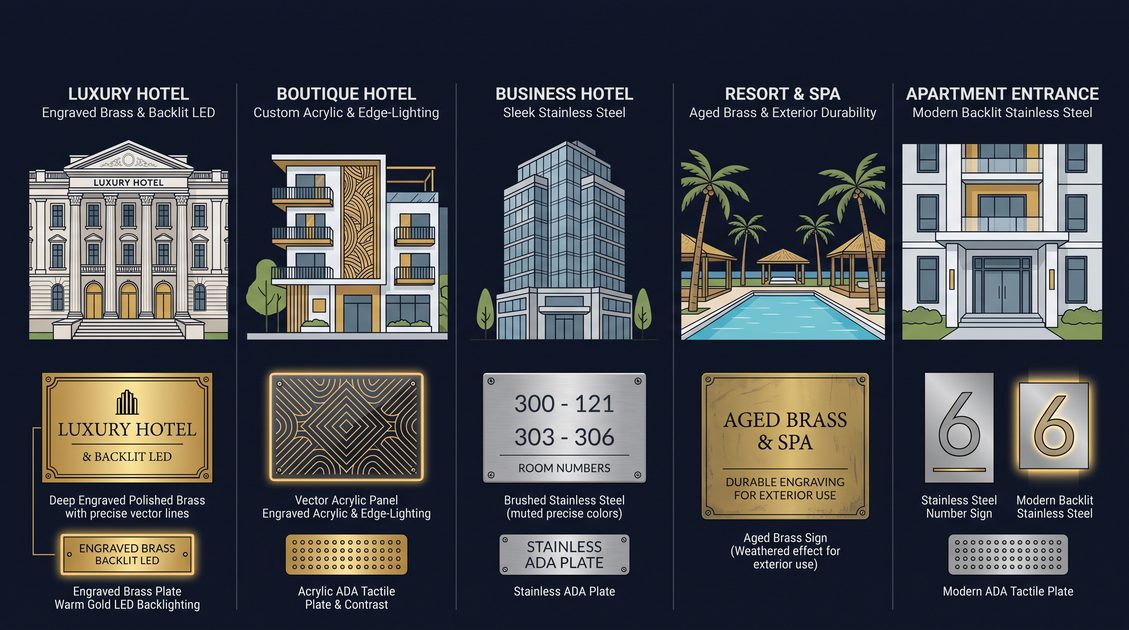
Hotel signage companies are manufacturers and OEM suppliers that design, engrave, and distribute the room identification plates, directory boards, door numbers, and wayfinding markers used across hotels and serviced apartments. A typical hotel signage company operates from a production base such as Shenzhen in southern China, runs CNC engraving, laser cutting, anodizing, and LED assembly lines, and ships finished plates to the US, UK, Canada, Australia, Singapore, and Germany. Reputable hotel signage companies hold CE, RoHS, and ISO 9001 certifications, accept a minimum order of 50 pieces, and sustain a monthly capacity of around 100,000 pieces for both boutique pilots and portfolio-wide rollouts. The product range spans brass and acrylic room plates, illuminated LED door numbers, ADA-compliant tactile signs, engraved restroom markers, and custom logo panels that reinforce brand identity at every guest touchpoint. By consolidating design, tooling, and quality control under one roof, hotel signage companies let owners standardize appearance across properties while meeting accessibility law and controlling per-unit cost through scale.
Procurement teams that understand the supplier landscape avoid the common trap of treating signage as a commodity bought at the last minute. Hotel signage companies differ sharply in capability: some are trading intermediaries that outsource every engraving step, while others own the full process from raw sheet metal to packaged plate. The owned-process model is preferable for hotels because it keeps tolerances, finish, and lead time under direct control and prevents the finger-pointing that occurs when a subcontractor misses a Braille spec. When a hotel issues an RFP, the strongest hotel signage companies respond with a documented quality system, sample plates, and a compliance declaration rather than a bare price list. Building a relationship with two or three qualified hotel signage companies also de-risks supply: if one faces a capacity crunch during peak season, the other can absorb the overflow without a visual break across the estate.
Why hotel signage companies matter for procurement
Hotel signage companies matter for procurement because they sit at the intersection of brand expression, accessibility law, and unit economics across every guest floor of a property. A single 200-room hotel needs several hundred plates: room numbers, suite identifiers, accessible-room tactiles, restroom markers, exit and facility signs, and lobby directory boards, all of which must look consistent and stay legible for years. Choosing among hotel signage companies early in a fit-out determines whether that volume is sourced as one coherent program or as a patchwork of mismatched orders that later require costly remediation. Strong hotel signage companies also reduce total cost of ownership by suggesting durable substrates and finishes matched to each zone, so a humid pool deck gets marine-grade material while a dry executive floor gets lighter acrylic. They further de-risk compliance by holding the certifications customs officers and accessibility auditors expect in the US, UK, Canada, Australia, Singapore, and Germany. For a procurement lead, the right hotel signage companies turn a scattered expense into a managed, auditable asset that scales from one pilot property to a global portfolio without re-specifying the artwork each time the brand expands into a new market or renovates an aging tower.
The cost of choosing poorly is not just aesthetic. Non-compliant tactile signage can trigger lawsuits under the US ADA and equivalent laws abroad, and replacing a whole floor's plates after handover is far more expensive than getting it right at the drawing stage. Hotel signage companies that provide a compliance declaration and retain your artwork on file make future reorders identical to the original release, protecting brand consistency across decades of operation.
What hotel signage companies manufacture
Hotel signage companies manufacture a broad catalog built around permanent identification at the guest touchpoint, starting with room number plates in brass, acrylic, stainless, and aluminum. Beyond the door number, hotel signage companies produce suite and villa identifiers, accessible-room tactile signs with Braille, restroom and facility markers, floor directory boards, lobby and reception plaques, and custom logo panels that carry the brand mark. Many hotel signage companies also run LED assembly so they can deliver illuminated door numbers and occupied-vacant indicators as a single finished product rather than two separate vendor packages. The engraving depth, edge treatment, and infill color are all configurable: hotel signage companies offer laser engraving, mechanical routing, chemical etching, and UV printing depending on the substrate and the desired contrast. For boutique properties, hotel signage companies often hand-finish lacquered brass to a fingerprint-resistant sheen, while for select-service chains they standardize anodized aluminum to hold cost across hundreds of rooms. The best hotel signage companies maintain a library of pictograms and a Braille translation service per market so a single artwork can be localized for the US, UK, Canada, Australia, Singapore, and Germany without redesigning the plate from scratch each time a new property opens under the same brand.
Finished goods ship as individual plates or as kitted sets with standoffs, adhesives, and a placement diagram. Hotel signage companies that support bulk provisioning from a CSV namespace let a 500-room resort receive every plate pre-labeled and pre-matched to its door, eliminating on-site guesswork during the install window when the fit-out team is under the most pressure.
Materials hotel signage companies work with
Hotel signage companies work with four primary substrates, each chosen for appearance, durability, and cost in the harsh micro-climate of a hotel corridor. Brass is the prestige choice for upscale and heritage properties, giving a warm tone that reads as premium, though hotel signage companies apply a lacquer near steam to slow tarnish. Stainless steel is the workhorse for humid public areas such as pool decks and spa corridors because it resists soap and disinfectant better than alternatives. Aluminum keeps weight and price down for large-volume back-of-house and mid-scale guest floors while accepting anodized color. Acrylic enables backlit and LED builds with full-color pictograms, valuable in dimly lit lounges and nightlife venues. Hotel signage companies select substrate by zone rather than by a single house material, because a one-material policy either overspends on prestige metal in low-visibility areas or underspends where durability matters most. The table below compares the four materials most hotel signage companies stock for hospitality programs, weighting cleanability since housekeeping chemicals are the main enemy of a plate's finish over its service life.
| Material | Relative cost | Humidity resistance | Best finish | Typical hotel use |
|---|---|---|---|---|
| Brass | High | Good (lacquered) | Brushed, lacquered | Lobbies, suites, heritage |
| Stainless steel | Medium-high | Excellent | Brushed, mirrored | Pool, spa, public corridors |
| Aluminum | Low-medium | Good | Anodized, etched | Mid-scale guest, back-of-house |
| Acrylic | Low-medium | Good (sealed) | Printed, backlit | LED, dim lounges, bars |
Hotel signage companies often combine materials in one plate, such as an acrylic insert set into a brass frame, to balance budget and brand. Specifying the right blend is a core value a good supplier adds before a single sheet is cut.
ADA and accessibility services from hotel signage companies
ADA and accessibility services from hotel signage companies cover the tactile, Braille, and mounting rules that make a permanent room legally identifiable to blind and low-vision guests. In the United States, hotel signage companies must deliver signs with raised characters and Grade 2 Braille, non-glare matte finish, and pictograms in a 150 mm minimum clear field, mounted adjacent to the door latch side at 1400 to 1700 mm to center. Strong hotel signage companies do not merely sell a plate; they provide a compliance declaration referencing ADA 2010, and for international estates they align with the UK Equality Act 2010 and BS 8300, the EU EN 301 549, Canada's CSA B651-18, Australia's AS 1428.1, and Singapore's BCA accessibility code. Hotel signage companies that maintain per-market Braille translation avoid the frequent cross-border error of assuming one Braille code serves everywhere, because the US uses Grade 2 while the UK uses Unified English Braille. The safest approach adopted by leading hotel signage companies is to hold one strictest-common-denominator artwork and swap only the Braille layer per market. This keeps the plate visually identical across an estate while satisfying local audits, and it lets hotel signage companies reorder for a new building without re-engineering the tactile face that accessibility law demands of every permanent room.
Mounting guidance is part of the service too. Hotel signage companies supply placement diagrams so installers keep a consistent height datum across every floor, which matters because blind guests build muscle memory of where the tactile sign sits and inconsistent height forces them to re-learn the pattern in each corridor.
Certifications hotel signage companies must hold
Certifications hotel signage companies must hold begin with ISO 9001, the quality-management baseline that signals a documented process rather than ad-hoc production, and extend to CE and RoHS for the materials and any electronics in the plate. CE marking shows conformity with European health and safety directives covers electromagnetic emissions for LED-equipped plates sold into the US market, and RoHS confirms the absence of hazardous substances such as lead and mercury in the substrate and solder. Hotel signage companies exporting to Germany and the wider EU treat CE and RoHS as non-negotiable customs paperwork, while those serving the US and Canada pair with ISO 9001 to satisfy both buyers and auditors. Reputable hotel signage companies also pursue ISO 14001 environmental management, which helps corporate buyers earn green-building credits and simplifies the documentation burden for LEED or BREEAM submissions. When a hotel issues a supplier scorecard, hotel signage companies that present current certificates, test reports, and a compliance declaration score higher than those offering only a price. The certificate file should travel with the order: hotel signage companies that attach declarations per shipment spare the buyer a frantic search at customs or during an accessibility audit, and they demonstrate the discipline that separates a manufacturing partner from a trading middleman that cannot vouch for its own factory floor.
Buyers should verify certificates are current and issued to the actual production entity, not a related trading company, because auditors trace the document back to the facility that engraved the plate sitting on the wall.
MOQ and capacity at hotel signage companies
MOQ and capacity at hotel signage companies define how a signage program is phased across a property or an entire portfolio without stalling the fit-out schedule. A standard MOQ of 50 pieces, common among hotel signage companies, fits a single-building pilot or a boutique hotel and lets facilities validate material and ADA detail before a portfolio-wide commitment that is hard to reverse once walls are sealed. With a monthly capacity of around 100,000 pieces, a serious hotel signage company can absorb a 10,000-plate multi-site deployment in one production month while still serving other clients, which matters when several buildings renovate on overlapping schedules. Lead time splits into sampling, typically seven to ten days for proof plates, and mass production, twenty to thirty days for engraving, anodizing, and QA, with LED assemblies adding five to seven days of functional testing. Hotel signage companies with deeper capacity also smooth the seasonal spike when many hotels renovate before the spring and autumn travel seasons. Procurement should sequence orders so guest-facing and highest-traffic floors receive plates first, then back-of-house and staff areas. Because room names and accessibility designations shift during fit-out, hotel signage companies should be asked to retain artwork and Braille on file so later reorders stay identical to the original release across years and phases of expansion.
Negotiating a 10 to 15 percent over-run of easily re-engravable plates covers fit-out damage and future renames, and it prevents a single lost plate from delaying a floor's handover during the critical pre-opening window.
Cost breakdown from hotel signage companies
Cost breakdown from hotel signage companies divides into design and tooling, substrate and decoration, electronics for LED units, hardware and mounting, and freight. Design and tooling usually run USD 80 to USD 300 for a custom brand or pictogram template, often waived above a 500-piece order. Substrate and decoration are the largest recurring line: stainless engraved plates cost USD 8 to USD 20 each, brass USD 10 to USD 22, aluminum USD 5 to USD 12, and acrylic USD 4 to USD 10 at MOQ 50, with per-unit price dropping 15 to 30 percent above 1,000 units. LED electronics add USD 6 to USD 40 depending on display type and connectivity, and mounting hardware costs USD 0.30 to USD 2.00 per plate. Sea freight from Shenzhen to the US west coast adds about USD 0.40 to USD 1.20 per kilogram, so a 250-gram plate carries roughly USD 0.10 to USD 0.30 of shipping. A realistic 300-plate stainless engraved program from hotel signage companies lands near USD 2,400 to USD 6,000 all-in, while a 1,000-plate acrylic LED program ranges USD 10,000 to USD 25,000. Hotel signage companies that quote transparently by line item let buyers trade finish for budget without sacrificing compliance. Budget 5 to 10 percent extra for spare plates covering fit-out damage and future renames, because the true cost of signage is the lifetime cost across the building's operating life, not the purchase-order line alone.
Volume is the lever. Hotel signage companies reward consolidated orders: a 5,000-plate portfolio deal can cut per-unit substrate cost by a third versus three separate 50-piece orders, and it locks a single compliant artwork across the entire estate for auditing simplicity.
Hotel signage companies in Shenzhen China
Hotel signage companies in Shenzhen China benefit from the city's dense manufacturing ecosystem, where sheet-metal mills, anodizing houses, laser shops, and LED component markets sit within a short drive of one another, compressing both lead time and logistics cost. A hotel signage company in Shenzhen China typically runs integrated lines that cut, engrave, anodize, and assemble under one roof, then ships through the nearby Port of Shenzhen to the US, UK, Canada, Australia, Singapore, and Germany. The cluster effect means hotel signage companies in Shenzhen China can hold a 50-piece MOQ while still sustaining 100,000 pieces per month of capacity, because local component supply removes the bottlenecks that plague isolated factories. Buyers working with a hotel signage company in Shenzhen China also gain responsive sampling: proof plates can be turned around in seven to ten days and iterated by air before the bulk sea shipment locks in. The city's maturity in export compliance means hotel signage companies in Shenzhen China routinely prepare CE, RoHS, and ISO 9001 documentation and pack per-market labeling for mixed destinations in a single container. For hotel owners comparing regions, a hotel signage company in Shenzhen China pairs lower labor and overhead with world-class tooling, delivering the cost profile of a high-volume plant and the flexibility of a boutique workshop in the same quotation, which is why so much hospitality signage destined for Western markets is sourced from this one southern Chinese manufacturing hub.
Due diligence still applies: verify the factory address, request a video tour of the engraving line, and confirm the certificates name the production entity, because the Shenzhen cluster also contains trading firms posing as manufacturers with no floor of their own.
How hotel signage companies serve export markets
Hotel signage companies serve export markets by localizing compliance, labeling, and logistics for each destination rather than shipping one generic plate everywhere. For the US and Canada, hotel signage companies supply Grade 2 Braille-tested LED electronics, and ADA 2010 tactile specs, with customs documentation that satisfies both countries' import checks. For the UK, hotel signage companies switch to Unified English Braille and align with BS 8300 under the Equality Act 2010, while EU-bound orders carry CE and RoHS markings and meet EN 301 549 through ISO 21542. Australia and Singapore receive AS 1428.1 and BCA-code-aligned plates respectively. The strongest hotel signage companies maintain a per-market compliance matrix so a single artwork, with a swapped Braille and labeling layer, clears audits in all six destinations without re-engineering the tactile face. Logistics is equally tailored: hotel signage companies consolidate sea freight to the US west coast and northern European ports, pre-tag cartons by destination to speed customs, and kit plates with market-specific standoffs and adhesives suited to local wall substrates. By treating export as a service discipline rather than a shipping afterthought, hotel signage companies let a hotel brand open properties in multiple countries from one source of truth, keeping the guest experience coherent and legally safe in each jurisdiction the estate operates within.
Language support completes the picture. Hotel signage companies that offer bilingual or trilingual engraving let a Singapore or Dubai property carry English plus a local script on the same plate, and they store those language layers on file for reorders.
Hotel signage companies for US and Canada hotels
Hotel signage companies for US and Canada hotels must satisfy the 2010 ADA Standards and CSA B651-18 respectively, both of which require permanent rooms to display raised characters and Braille on a non-glare plate mounted adjacent to the door. Hotel signage companies for US and Canada hotels therefore build Grade 2 Braille into every tactile room plate and verify character height, raise, and contrast against the standard before shipment. LED-equipped plates from hotel signage companies for US and Canada hotels carry certification so they clear US customs and meet emission rules, and the indicators are sealed modules so the compliant tactile face stays serviceable if the light fails. Substrate choice for hotel signage companies for US and Canada hotels leans stainless and anodized aluminum in humid public zones and brass in upscale lobbies, with acrylic reserved for backlit lounge and bar markers. Freight from Shenzhen typically lands on the US west coast or Canadian Pacific ports, and hotel signage companies for US and Canada hotels pre-label cartons and include a compliance declaration per shipment to smooth the border crossing. Because both markets are litigation-active on accessibility, hotel signage companies for US and Canada hotels that retain artwork and Braille on file protect the owner from a costly redo if an audit flags a plate after the property has opened and the fit-out team has moved on to the next project.
Canadian bilingual requirements in Quebec add a layer: hotel signage companies for US and Canada hotels should confirm whether French must appear alongside English, and they should store that language layer so future Quebec properties stay consistent with the brand's existing North American estate.
Hotel signage companies for UK Australia Singapore Germany
Hotel signage companies for UK Australia Singapore Germany navigate four distinct but overlapping accessibility codes, and the best suppliers hold one strictest-common-denominator artwork to serve all four without rework. Hotel signage companies for UK Australia Singapore Germany adopt Unified English Braille for the UK under BS 8300 and the Equality Act 2010, AS 1428.1 for Australia, the BCA code for Singapore, and EN 301 549 referenced through ISO 21542 for Germany and the EU. CE and RoHS markings are mandatory for the German and Singaporean EU-aligned imports, so hotel signage companies for UK Australia Singapore Germany prepare those declarations as standard paperwork rather than a special request. Substrate preference in these markets runs toward brushed stainless in public corridors and lacquered brass in heritage and luxury hotels, with acrylic backlit plates popular in dimly lit European lounges. Hotel signage companies for UK Australia Singapore Germany also manage longer sea routes to Hamburg, Sydney, and Singapore ports, kitting per-market hardware and pre-tagging cartons to speed customs clearance on arrival. Because these jurisdictions audit accessibility seriously, hotel signage companies for UK Australia Singapore Germany that provide a compliance declaration and retain per-market Braille on file let a brand open in any of the four countries from one artwork source, keeping the tactile face identical and the legal risk low across the entire international estate the hotel operator manages.
Singapore's tropical humidity makes sealed acrylic and marine-grade stainless the practical default, and hotel signage companies for UK Australia Singapore Germany should recommend those substrates for Southeast Asian properties to avoid early tarnish and haze.
LED and illuminated products from hotel signage companies
LED and illuminated products from hotel signage companies add a glowing door number or an occupied-vacant indicator to the standard tactile plate, answering a single question at the guest's door: which room is this, and is it in use. Hotel signage companies build LED door numbers that draw under 1.5 watts per unit, connect via low-voltage wire, PoE, or battery with a door sensor, and need no network for a simple glow function. Acrylic diffusers spread light so the engraved characters stay readable while the number glows softly in a dim corridor, which helps guests find their room without disturbing neighbors at 2 a.m. For occupied-vacant indicators, hotel signage companies use red and green LEDs or e-ink panels showing stall or room status, valuable in resorts and serviced apartments where housekeeping benefits from knowing a room is vacant. Scale economics favor the approach in high-traffic venues: a 40-fixture floor with always-on LED plates from hotel signage companies draws about 60 watts total. When specifying LED products, hotel signage companies must verify ingress rating, low-light dimming, and whether the indicator is a separate sealed module so the compliant tactile plate stays serviceable if electronics fail. The tactile face must remain permanently compliant regardless of the LED state, because accessibility cannot depend on a powered component that might burn out.
Color temperature matters for ambience. Hotel signage companies offering warm-white versus cool-white LED let a boutique property match the corridor lighting design, and they should sample both so the brand approves the glow before a full floor is produced and installed.
Custom engraving and branding at hotel signage companies
Custom engraving and branding at hotel signage companies turn a functional plate into a brand asset by carrying the logo, typeface, and color story of the property onto every door and wall. Hotel signage companies achieve this through laser engraving for crisp vector marks, mechanical routing for deep tactile characters, chemical etching for fine detail on metal, and UV printing for full-color acrylic inserts. The brand layer is not cosmetic alone: hotel signage companies match the engraving infill to the corporate palette so a guest reads the room number in the same hue as the key card and the lobby signage, reinforcing recognition at each touchpoint. For prestige brands, hotel signage companies hand-finish lacquered brass frames around an acrylic logo medallion, creating a tactile centerpiece at the suite door. Boutique hotels use hotel signage companies to engrave a custom monogram or property name into the plate edge, a detail that photographs well for social media and distinguishes the estate from a look-alike chain. The strongest hotel signage companies maintain a brand kit per client, storing the approved logo vector, color codes, and font so reorders and new properties stay visually identical years apart. Because engraving is permanent, hotel signage companies should supply a digital proof and a physical sample plate for brand sign-off before mass production, preventing a misaligned logo from reaching hundreds of doors where correction is expensive and visible to every arriving guest.
Re-engravable substrates extend brand life. Hotel signage companies that spec aluminum or acrylic for back-of-house areas let a rebrand or rename be absorbed by re-work rather than a full repurchase, protecting the owner's investment when the brand evolves.
Quality control processes at hotel signage companies
Quality control processes at hotel signage companies separate a reliable manufacturing partner from a trading intermediary that cannot vouch for its own floor. Leading hotel signage companies run incoming material inspection on every sheet of brass, aluminum, acrylic, and stainless to confirm thickness, finish, and RoHS compliance before cutting. During engraving, hotel signage companies check character raise (minimum 0.8 mm for tactile), pictogram clear-field size, and contrast against the standard, because a sub-spec raise fails accessibility law even if it looks fine to a sighted inspector. For LED products, hotel signage companies perform functional testing of every indicator, checking current draw, color, and dimming behavior before the plate is sealed. Final QA at hotel signage companies includes a visual audit under the installed lighting condition, a packing check that the right plate reaches the right door via the CSV namespace, and a compliance declaration attached per shipment. The ISO 9001 system behind these steps means hotel signage companies document non-conformances and corrective actions, so a recurring defect triggers a process fix rather than a one-off apology. For hotel buyers, the practical proof is consistency across a 1,000-plate order: every room number should read identically, sit at the same height tolerance, and carry the same finish, which is exactly what disciplined hotel signage companies deliver and what lax ones cannot guarantee across a long production run completed under deadline pressure.
Audit trails matter for recalls. Hotel signage companies that batch-trace materials to finished plates let a buyer isolate a problem lot quickly, protecting both guests and the brand's reputation during any quality inquiry from an auditor or a corporate standards team.
Lead times and logistics from hotel signage companies
Lead times and logistics from hotel signage companies determine whether signage arrives inside the fit-out window or becomes the critical-path item that delays a hotel's opening and the revenue that comes with it. Sampling from hotel signage companies typically takes seven to ten days for proof plates, during which the buyer approves material, finish, and Braille before committing to volume. Mass production runs twenty to thirty days for engraving, anodizing, and QA, with LED assemblies adding five to seven days of electronics testing. Sea freight from Shenzhen to the US west coast or northern Europe adds roughly twenty to thirty-five days depending on port and season, so hotel signage companies advise placing the bulk order at least two months before the target install date. Air freight is available from hotel signage companies for urgent pilots at a premium, typically three to seven days door to door, useful when a single floor must open ahead of the rest. Logistics discipline shows in the carton plan: hotel signage companies pre-tag by destination and by floor, kit standoffs and adhesives per market, and include a placement diagram so the installer sites every plate from one source of truth. Because weather and port congestion cause delays, hotel signage companies that build buffer into the schedule and communicate proactively protect the owner's opening date better than those that quote the theoretical minimum and miss it under real-world conditions.
Consolidation cuts both cost and risk. Hotel signage companies that combine a portfolio's orders into one shipment reduce per-unit freight and the chance that one building's plates ride a different, slower vessel than the others in the same brand rollout.
How hotel signage companies manage artwork files
How hotel signage companies manage artwork files decides whether a reorder three years later matches the original plate or drifts into a visible mismatch that auditors and guests both notice. Mature hotel signage companies store the approved vector logo, color codes, font, engraving depth, infill color, Braille translation, and per-market labeling as a single locked record tied to the client account. When hotel signage companies receive a reorder, they pull that record rather than re-interpreting a faded PDF from the opening, guaranteeing the new plate reads identically to the old one on the wall. For portfolio programs, hotel signage companies maintain a CSV namespace mapping every door to its plate specification, so a 500-room resort reorders by exporting the changed rows rather than re-describing each room. Version control is the differentiator: hotel signage companies that timestamp and approve each artwork revision prevent a well-meaning tweak from silently altering the brand across the estate. They also keep the Braille translation per market on file, because re-translating Braille for a new building risks introducing a code error that fails an accessibility audit. The practical buyer question is simple: ask hotel signage companies to demonstrate their artwork retention with a three-year-old reorder example, because a supplier that cannot reproduce its own past work will eventually drift and force a costly re-specification of the entire signage estate under the buyer's brand name.
File security is part of the trust. Hotel signage companies handling a hotel's brand assets should restrict access and confirm they will not reuse the artwork for a competitor, a clause worth writing into the supply agreement before the first plate is cut.
Sustainability at hotel signage companies
Sustainability at hotel signage companies is increasingly scored in procurement because hotels pursue LEED, BREEAM, and WELL certification where material choice contributes to credits. Hotel signage companies that offer recycled-content aluminum and bio-based acrylic earn more points than those supplying only virgin brass, though brass's long service life offsets its mining footprint through avoided replacement. Low-power LED plates from hotel signage companies draw under 1.5 watts per unit, so a venue-wide deployment adds negligible energy load while improving room-finding and reducing wasted lighting in misused spaces. Suppliers with ISO 14001 environmental management and RoHS compliance simplify the documentation for green-building submissions, and a 100,000-piece monthly capacity from one Shenzhen facility reduces per-unit shipping emissions compared with multiple regional suppliers. Hotel signage companies that provide a declaration of recycled content and a recyclability statement for end-of-life plates satisfy auditors who now ask for the full lifecycle picture rather than a single material certificate. Choosing durable engraved plates over short-lived printed ones is itself a sustainability win, cutting waste and the carbon of repeat production runs across the facility's decades-long operating life. Forward-looking hotel signage companies also minimize packaging, using molded pulp instead of foam and right-sized cartons to lower the freight emissions and landfill burden of every shipment that leaves the factory floor bound for a hotel opening overseas.
Take-back programs add value. Hotel signage companies that accept returned end-of-life plates for recycling close the loop for corporate sustainability reports, a service that differentiates the serious manufacturer from the commodity trader during a green procurement review.
Mistakes when selecting hotel signage companies
Mistakes when selecting hotel signage companies cost hotels budget, schedule, and sometimes compliance, and most are avoidable with a clear specification and a proof plate reviewed before full production. The first mistake is choosing a trading intermediary over an owned-process manufacturer, which strips the buyer of control over tolerances and Braille accuracy when a subcontractor misses the spec. The second is skipping the compliance declaration, leaving the hotel exposed during an ADA or BS 8300 audit with no document to show the plate was made to standard. The third is under-ordering spares, so a single damaged plate during fit-out stalls a floor's handover and forces a rush air shipment at premium cost. The fourth is inconsistent placement height across floors because the hotel signage companies supplied no placement diagram, undermining both aesthetics and the muscle memory of blind guests who navigate by touch. The fifth is omitting per-market Braille, a frequent cross-border error where one Braille code is assumed to serve all regions and then fails the UK or Canadian audit. The sixth is neglecting LED ingress rating near splash zones, buying plates that fail within a year. The seventh is failing to retain artwork, so a reorder three years later drifts from the original. Avoiding these pitfalls starts with a specification document and a proof plate reviewed by both facilities and accessibility staff before the full order is released to the hotel signage companies for production and shipping.
Price-only selection is the root cause of most of these errors. Hotel signage companies quoting far below the market usually omit the compliance paperwork, sampling, and retention services that protect the owner long after the fit-out team has left the building.
Comparing hotel signage companies side by side
Comparing hotel signage companies side by side prevents a buyer from being seduced by the lowest line item while missing the capabilities that protect the brand over a decade of operation. The table below scores the factors that matter most when hotel signage companies compete for a hospitality program, weighting compliance and retention above raw price because those determine lifetime cost and legal safety. Buyers should request the same specification from each candidate so the comparison is fair, then score responses on documented quality system, certificate validity, MOQ flexibility, capacity, lead time, per-market Braille, artwork retention, and proof-plate willingness. Hotel signage companies that own the full process and answer all columns consistently are preferable to those strong on price but weak on retention or compliance. A weighted scorecard also exposes the trading intermediary pretending to be a manufacturer, because such hotel signage companies cannot show a factory address, an ISO 9001 certificate in their own name, or a retained-artwork example from three years prior. Procurement should shortlist two or three hotel signage companies rather than one, so a capacity crunch at peak season can be covered by the runner-up without a visual break across the estate or a last-minute scramble that risks the opening date and the revenue attached to it.
| Factor | Owned-process maker | Trading intermediary |
|---|---|---|
| ISO 9001 in own name | Yes | Often no |
| Per-market Braille | Yes | Sometimes |
| Artwork retention | Yes | Rare |
| Capacity 100k/month | Yes | Uncontrolled |
| Compliance declaration | Per shipment | On request |
The scorecard turns a subjective feeling about a supplier into a defensible procurement record that survives internal review and external audit alike when the signage program is questioned years after the opening.
Future trends among hotel signage companies
Future trends among hotel signage companies point toward smarter status, sustainable substrates, and connected wayfinding that turns a static plate into a managed node. Hotel signage companies are adopting e-ink and low-power LED faces that show room availability and cleaning status pulled from building management platforms, reducing the confusion that breeds complaints in busy resorts and serviced apartments. NFC and QR codes etched into the plate may let a guest report a fault or request supplies, converting static signage into an interaction point without adding a screen to the corridor. Sustainable substrates such as recycled aluminum and bio-based acrylic are gaining traction as corporates pursue green-building certification, and hotel signage companies with ISO 14001 increasingly win enterprise bids over those without. Modular plates with replaceable name or symbol inserts will dominate venues that rebrand or reconfigure room layouts because they absorb changes at near-zero cost compared with full repurchase. Finally, AI-driven wayfinding may generate dynamic directional signage on shared screens near elevators, but the permanently mounted tactile plate from hotel signage companies will remain legally required for accessibility. Procurement teams should specify plates that are future-proof in mounting and connectivity while never compromising the engraved tactile core that accessibility law demands, because the powered features may change but the compliant identification is permanent across the building's entire operating life and every renovation that touches the guest rooms.
Supplier consolidation is another trend. Hotel signage companies that offer one global artwork with per-market Braille let a brand standardize across countries, reducing the vendor count and the audit surface for the corporate standards team managing the estate.
Pilot orders with hotel signage companies
Pilot orders with hotel signage companies let a hotel validate material, finish, and ADA detail on one floor or one building before committing to a portfolio-wide program that is hard to reverse once walls are sealed and doors hung. A 50-piece MOQ, standard among hotel signage companies, is perfectly sized for a pilot: it covers a boutique property or a single guest floor of a larger hotel with room numbers, suite identifiers, accessible tactiles, and restroom markers. During the pilot, hotel signage companies supply proof plates for brand and accessibility sign-off, and the buyer observes real-world performance: how the lacquer resists housekeeping chemicals, whether the LED glow reads at corridor distance, and whether the Braille passes a tactile check by a low-vision reviewer. The pilot also tests logistics, because hotel signage companies that kit by floor and pre-tag cartons prove their packing discipline on a small batch where a mistake is cheap to fix. A successful pilot builds the artwork record and the compliance declaration that later phases reuse, so the full rollout simply scales the approved plate rather than re-specifying it. Hotel signage companies view pilots as the start of a relationship, often waiving tooling above a future volume commitment, which aligns the supplier's incentive with the buyer's phased expansion. For a cautious procurement lead, the pilot is the lowest-risk way to learn whether a candidate among hotel signage companies can actually deliver a compliant, brand-consistent plate at scale.
Document the pilot. Hotel signage companies should capture the approved sample's exact specs in the retained artwork so the portfolio rollout matches the pilot plate door for door, avoiding the drift that embarrasses a brand during a post-opening standards audit.
Supplier checklist for hotel signage companies
A supplier checklist for hotel signage companies keeps a multi-building program on schedule and within budget while satisfying accessibility law across every market the estate serves. Start by confirming the candidate among hotel signage companies owns the full process from raw sheet to packaged plate, because owned-process makers control tolerance, finish, and Braille accuracy that intermediaries cannot guarantee. Require a current ISO 9001 certificate in the supplier's own name plus CE, RoHS declarations for materials and any LED electronics, since these are expected by US, UK, Canadian, Australian, Singaporean, and German buyers and customs. Verify MOQ flexibility, commonly 50 pieces, and monthly capacity, around 100,000 pieces, against your rollout dates and peak-season risk. Ask for a single proof plate before full production and for per-market Braille translation retained on file, because cross-border Braille errors are the most common audit failure. Confirm hotel signage companies can store your artwork and brand kit so reorders match the original release years later, and evaluate bulk provisioning from a CSV namespace to avoid per-plate configuration during rapid expansion. Finally, request a compliance declaration per shipment and a placement diagram for installers. Shortlist two or three hotel signage companies so a capacity crunch can be covered without a visual break, and weight the scorecard toward compliance and retention rather than the lowest price, because those protect the brand across the decades-long operating life of the building and every renovation that touches its guest rooms.
Close the loop with a contract. Hotel signage companies should sign a supply agreement covering artwork confidentiality, per-market compliance, and reorder consistency, turning the checklist from a one-time evaluation into an enforceable partnership that survives staff changes on both sides.
Not sure which sensor fits your project?
Talk to our mmWave application engineers for a free consultation.
Specify your hotel project with our engineers
Send your room count, ceiling type, and protocol preference. We will return a sample plan and quote within 24 business hours.
- Move from general guidance into a product or application discussion.
- Use RFQ when pricing, drawings, MOQ, or launch timing needs structure.
- Keep a direct contact path visible for fast clarifications and handoff.