Hotel Signs and Symbols Meaning Guide for Guests
Hotel signs and symbols meaning guide covers pictograms, international icons, ADA and ISO 7001, color meanings, multilingual wayfinding, and compliant signage.
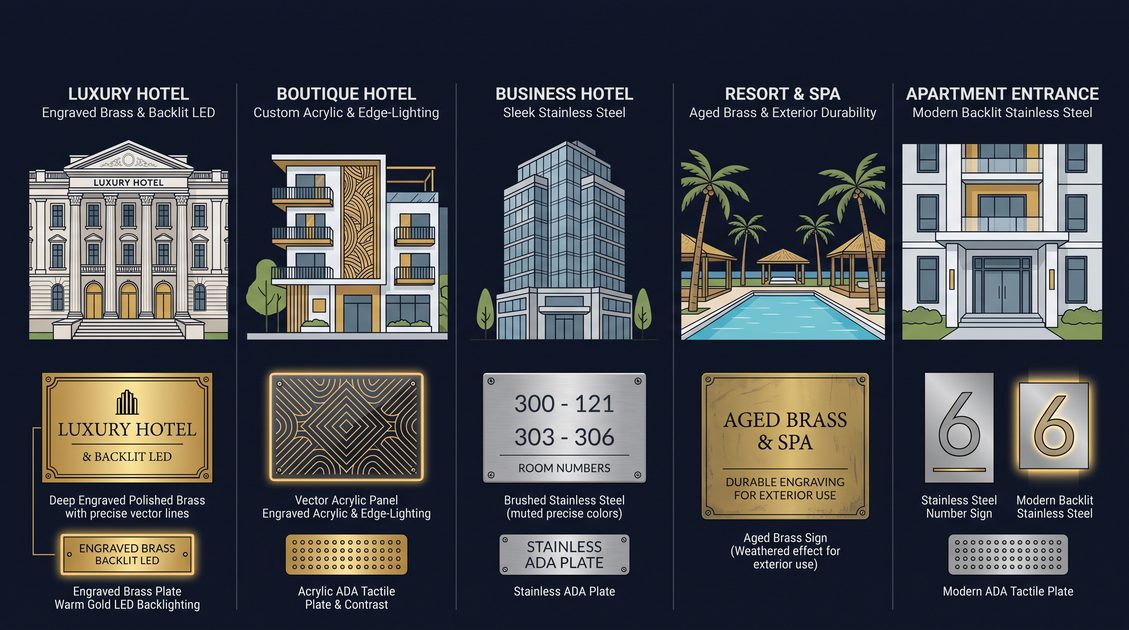
Hotel signs and symbols are the pictograms, icons, and coded markers a property uses to communicate function, direction, and safety to guests who may not share the hotel's language, including the elevator, exit, restroom, wifi, restaurant, and pool symbols mounted in corridors, lobbies, and door heads. A complete hotel signs and symbols program pairs internationally recognized pictograms (governed by ISO 7001 and reinforced by ADA and local accessibility codes) with text in the property's primary languages and a consistent color logic so meaning survives translation. Hotel signs and symbols are specified by pictogram set, substrate (acrylic, aluminum, or stainless), size (commonly 150 to 300 mm for corridor markers), and contrast (minimum 70 percent for tactile signs). Standard symbol plates cost USD 3.00 to USD 14.00 per piece at MOQ 50, while illuminated or electronic units reach USD 18 to USD 50. Reputable manufacturers supply CE, RoHS, and ISO 9001 certification, and a 100,000-piece monthly capacity supports floor-by-floor and multi-property rollouts for hotels across the US, UK, Canada, Australia, Singapore, and Germany. Hotel signs and symbols are the backbone of guest wayfinding.
Why hotel signs and symbols matter for guests
Why hotel signs and symbols matter for guests is the question every procurement team should answer before the plate is ordered, because a traveler who does not read the local language must still find the elevator, the restroom, the exit, and the breakfast room, and pictograms are the only messages that cross the language barrier at a glance without a translation app. When a property uses consistent hotel signs and symbols, a first-time guest navigates from the lobby to the pool without asking the desk, and the front desk stops functioning as a human directory that wastes minutes per interaction across hundreds of arrivals a day. Facilities studies on full-service hotels indicate that clear symbol wayfinding reduces average guest inquiry time by two to four minutes per request, a small number that scales into thousands of recovered front-desk hours per property annually. Hotel signs and symbols also serve accessibility when paired with a tactile wall identifier, because the pictogram gives sighted wayfinding while the wall sign carries Braille for low-vision guests. Beyond wayfinding, durable hotel signs and symbols resist cleaning chemicals and sunlight for five to ten years. Procurement leaders who specify hotel signs and symbols as infrastructure rather than decor report higher guest satisfaction and smoother accessibility audits, making the signage a quiet but measurable contributor to the stay that a traveler judges by the mark above the door they approach with a reservation that only names the room, not how to reach it across the corridor they have never walked before in a city whose language they do not speak at all during the visit they booked with the property that labels its rooms clearly enough to trust with the guests who depend on the pictograms on the walls that guided them home to the room and the exit beyond it safely.
Core pictograms in hotel signs and symbols
The core pictograms in hotel signs and symbols are the small set of internationally recognized icons that a guest learns in airports and malls across the world, and the same icons appear in nearly every property: the elevator, the exit, the restroom (male, female, accessible, all-gender), the wifi, the restaurant or dining room, the pool, the stairs, the reception or concierge, and the no-smoking sign. These pictograms form the shared visual vocabulary that lets a traveler who speaks no local language still find the restroom and the fire exit at a glance, because the shape of the symbol carries the meaning that the word cannot. A property that adopts the ISO 7001 register for its hotel signs and symbols gets a library of silhouettes already accepted by auditors from California to Singapore, so the artwork needs no redesign per market. The elevator pictogram is a person between two vertical arrows, the restroom is a stylized figure, the wifi is a rising fan of arcs, and the pool is a swimmer or wave mark, each drawn to a precise geometry that a first-time guest recognizes from a hundred hotels before this one. When a hotel adds a boutique symbol not in the ISO set, it risks a guest who does not understand the custom icon and an auditor who fails the plate on the spot, so the safe specification keeps the core pictograms exactly as the standard draws them and reserves custom marks for the brand border only.
| Pictogram | Meaning | Governing standard |
|---|---|---|
| Elevator | Lift access | ISO 7001 PI AC 001 |
| Exit | Emergency egress | ISO 7010 E001 |
| Restroom | Toilet facility | ISO 7001, local code |
| Wifi | Wireless internet | ISO 7001 PI IF 003 |
| Restaurant | Dining room | ISO 7001 PI CF 001 |
| Pool | Swimming pool | ISO 7001, local code |
International standards for hotel signs and symbols
International standards for hotel signs and symbols give the pictograms their legal and cross-border authority, so one artwork satisfies audits from Tokyo to Toronto without a redesign per market. The two anchors are ISO 7001 for general information symbols and ISO 7010 for safety signs, both maintained so a guest meets the same icon from Tokyo to Toronto. ISO 7001 defines the public information pictograms such as elevator, restroom, wifi, restaurant, and pool, with precise silhouettes and a 150 mm minimum clear field when the symbol sits beside tactile text. ISO 7010 governs safety symbols such as exit, fire extinguisher, and first aid, using a red or green color code that overrides brand palette because safety meaning must never yield to decor. A hotel signs and symbols program that cites both registers arrives at the inspection with the declaration already on file, and the returning guest who steps onto any floor reads the same pictogram in the same place at the same height, which is the quiet win of a wayfinding system the brand operates for travelers in a dozen languages who arrive in cities whose words they do not speak at all during the stay they book with the property.
| Register | Scope | Color rule |
|---|---|---|
| ISO 7001 | Information symbols | Monochrome on contrast |
| ISO 7010 | Safety symbols | Red or green prescribed |
ADA and accessibility in hotel signs and symbols
ADA and accessibility in hotel signs and symbols require that pictograms sit on compliant tactile signs that a low-vision guest reads by touch at the latch side, and these are not optional decor but the legal floor every permanent room must meet before the plate ships. US ADA rules require the pictogram to have a 150 mm (6 inch) minimum clear field with the symbol centered, and the tactile sign must mount on the wall beside the door latch side, centered 1400 to 1700 mm above the floor, with a non-glare finish and at least 70 percent contrast. The tactile companion carries raised characters and Grade 2 Braille so a guest who cannot see the pictogram still reads the room by touch at the height the standard requires. A hotel signs and symbols program that hangs a suspended plate without the wall tactile sign is non-compliant and exposes the property to a lawsuit a brand-standard team cannot explain away at the audit. Equivalent rules exist abroad: the UK Equality Act 2010 with BS 8300, the EU EN 301 549, and Australia's Disability (Access to Premises) standard each mandate tactile, high-contrast signage for permanent spaces, so the prudent specification adopts the strictest common denominator across all markets the hotel serves.
Color meanings in hotel signs and symbols
Color meanings in hotel signs and symbols decide whether a guest reads a symbol as safe, caution, or open, and these meanings are prescribed by ISO 7010, so the brand palette yields to safety color wherever the two would collide on a plate. Safety colors are prescribed, not optional: green marks safe egress and first aid, red marks prohibition and fire equipment, blue marks mandatory instruction, and yellow or amber marks caution, all drawn from ISO 7010 and mirrored in local fire codes. Wayfinding colors are the property's choice but must never collide with safety meaning; a hotel that paints its restaurant symbol red risks a guest reading it as off-limits or dangerous. Brand palette should sit on the plate border or header, leaving the pictogram in its standard color so the icon's legal meaning survives the decor. A hotel signs and symbols program that tints a green exit red or a red extinguisher blue sends a guest the wrong way during an emergency, which is a code violation rather than a branding lapse the brand team can explain at the audit.
| Color | Meaning | ISO clause |
|---|---|---|
| Green | Safe egress, first aid | ISO 7010 (safe condition) |
| Red | Prohibition, fire equipment | ISO 7010 (prohibition) |
| Blue | Mandatory instruction | ISO 7010 (mandatory) |
| Yellow | Caution | ISO 7010 (warning) |
Multilingual hotel signs and symbols
Multilingual hotel signs and symbols let a property serve guests from the US, UK, Canada, Australia, Singapore, Germany, and beyond without printing a plate in every language on earth, and the approach works best when the pictogram leads and the text confirms, because the icon is the only message that needs no translation at all. A property pairs an ISO pictogram with the two or three languages the estate actually sees, so the elevator symbol carries "Elevator" in English, "Ascenseur" in French for the Quebec market, and "Aufzug" for the German guest, while the icon itself needs no word at all. Hotel signs and symbols that pile ten languages onto one plate shrink the pictogram to a stamp and confuse the very guest the text was meant to help, so the disciplined specification caps the text at the primary language plus one or two secondaries and keeps the symbol the largest element. For a property with guests from many scripts, the pictogram alone carries the meaning across the language barrier, and the text is a confirmation the literate guest reads after the icon has already told them where to go.
Wayfinding using hotel signs and symbols
Wayfinding using hotel signs and symbols is the art of placing the right pictogram at the right decision point so a guest never has to guess which way to walk, and the system lives or dies on consistency from the lobby to the top floor. Effective wayfinding pairs permanent hotel signs and symbols with corridor directories, floor identity markers, and directional arrows that all share one pictogram set, one color logic, and one placement height. The elevator lobby map is the anchor: it shows the floor's facilities, the wing color, and the direction to each, so a guest internalizes the layout before walking. Mid-corridor hotel signs and symbols should repeat the wing color and the facility pictogram on each wall face so a guest never loses orientation at a junction. The table below shows how the wayfinding chain maps to the guest's path, with the symbol element that closes each gap so the traveler reaches the door without asking the desk for directions in a language the front-of-house team may not share with the arriving visitor who walks the corridor with a key card and a room number printed on the reservation they carried from the airport to the hotel they chose for the night.
| Decision point | Marker | Symbol role |
|---|---|---|
| Elevator lobby | Directory map | Shows wing and direction |
| Floor entry | Wing color and icon | Confirms floor |
| Mid-corridor | Repeat icon | Prevents wrong turn |
| Door | Room pictogram | Final identification |
Materials for hotel signs and symbols
The principal materials for hotel signs and symbols are acrylic (PMMA), aluminum, stainless steel, and PVC foam board, each chosen for contrast, durability, and how well it renders an ISO pictogram. Acrylic hotel signs and symbols are the most flexible for backlit and illuminated builds, transmitting light evenly so a green exit pictogram glows in a darkened corridor and guides a guest during a power dip. Aluminum carries the pictogram by engraving or applied label, resists cart bumps, and permits anodized color on the border while leaving the symbol in its standard tone. Stainless steel reads clean and clinical, ideal for spa and pool precincts that are sanitized often, and it holds its line without flex. PVC foam board is the lightest and cheapest for temporary or high-volume wayfinding, but it warps in humidity and should not carry safety symbols in a wet area. Brass conveys premium warmth for boutique lobbies but adds weight and cost that most symbol programs avoid.
| Material | Relative cost | Indoor lifespan | Best for | Pictogram method |
|---|---|---|---|---|
| Acrylic | Low-medium | 5 to 8 years | Backlit, lit | Printed, engraved |
| Aluminum | Low-medium | 7 to 10 years | Corridors | Engraved, label |
| Stainless steel | Medium-high | 10 to 15 years | Spa, pool | Engraved, etched |
| PVC foam | Low | 4 to 6 years | Temporary | Printed matte |
Exit and safety symbols in hotel signs and symbols
Exit and safety symbols in hotel signs and symbols are the most regulated marks in the property, and they override brand for a reason: a guest follows the green mark out of a burning floor without a thought about the logo. The exit symbol is a running figure through a door with a chevron, rendered in green on a contrasting field, and a hotel signs and symbols program must keep that green because ISO 7010 prescribes it and the auditor measures the color during the inspection that decides whether the floor opens. The exit pictogram must appear at every egress decision point from the guest room floor to the street, so a multilingual traveler follows the icon rather than the local word for "exit" on a plate they pass at a glance during the alarm that no one expects but every floor must be ready for with the signs that guide them safely to the room and the exit beyond it. Fire extinguisher, alarm, and assembly-point symbols follow the same ISO 7010 discipline, each in its prescribed color and placed where the equipment actually is, because a symbol on a pretty panel that hides an empty wall fails the inspection and sends the guest the wrong way.
Restroom and amenity symbols in hotel signs and symbols
Restroom and amenity symbols in hotel signs and symbols are among the most consulted marks in any hotel, because every guest eventually seeks a restroom, a pool, a gym, or a business center, and the pictogram is what they scan for first after the directional arrow. Restroom hotel signs and symbols must carry the international figures for male, female, accessible, and family or all-gender where local code requires, and they should be double-sided so the symbol reads from both ends of a shared corridor. The plate should resist moisture and cleaning chemicals, so acrylic with sealed edges or anodized aluminum outperforms printed paper-faced foam that stains near a sink leak. Amenity symbols (gym, pool, business center, prayer room) follow the same logic and should share one bracket family with the restroom plates so the floor looks coherent. In hotels, resorts, and cruise-style venues, restroom hotel signs and symbols often add a subtle brand motif without distracting from the symbol, because a guest in a hurry reads the pictogram first and the logo second.
Wifi and service symbols in hotel signs and symbols
Wifi and service symbols in hotel signs and symbols tell a guest where connectivity and help live, and the wifi pictogram (rising fan of arcs per ISO 7001 PI IF 003) is now as expected in a lobby as the restroom icon is on a floor. Hotel signs and symbols for connectivity should place the wifi mark at the reception, the business center, and any lounge where the property advertises coverage, and should pair it with a small text note of the network name where space allows so a guest connects without asking the desk. Service symbols extend to concierge, luggage, shuttle, and breakfast, each with its own ISO-aligned pictogram so a multilingual guest reads function at a glance. A connected guest judges the property by the mark they find, so the wifi symbol must be present and legible wherever the hotel promises coverage, and a missing or faded icon reads as a broken promise the front-of-house team must explain at the desk that is already busy with the next arrival.
Readability and contrast in hotel signs and symbols
Readability and contrast in hotel signs and symbols decide whether the plate actually informs anyone, especially in low light or for low-vision users who approach from a distance. Accessibility and good practice require a minimum 70 percent contrast between the pictogram and its background, which in practice means a dark symbol on a light matte plate or a light symbol on a dark matte plate, never a glossy surface that glares under corridor lighting. Hotel signs and symbols in brushed aluminum with black engraved pictograms meet this easily, as does white acrylic with charcoal symbols. Color carries safety meaning but must never be the only differentiator: green for exit and red for fire is intuitive but must be reinforced by the symbol shape because about 8 percent of men have color-vision deficiency. Font choice matters for the text companion; use a clean sans-serif such as Helvetica, Arial, or a humanist equivalent, and avoid decorative scripts and thin strokes that disappear under corridor shadows. For bilingual estates, allocate vertical space so neither language is cramped, and keep the primary language's characters at least as large as the secondary.
Cost of hotel signs and symbols
The cost of hotel signs and symbols divides into design and tooling, substrate, electronics, and freight, and the compliance declaration is the line item that actually protects the brand at audit when the fire marshal measures the plate. Design and tooling usually run USD 80 to USD 300 for a custom brand template that wraps an ISO pictogram set, often waived above a 500-piece order. Substrate and decoration are the largest recurring line: acrylic symbol plates cost USD 4 to USD 10 each, aluminum USD 5 to USD 12, stainless USD 8 to USD 16, and PVC foam USD 3 to USD 7 at MOQ 50, with per-unit price dropping 15 to 30 percent above 1,000 units. Illuminated exit and wifi electronics add USD 6 to USD 30 depending on display type and connectivity. Mounting hardware (adhesive, standoffs, or concealed screws) costs USD 0.30 to USD 2.00 per plate. Sea freight from Shenzhen to the US west coast adds about USD 0.40 to USD 1.20 per kilogram, so a 250-gram plate carries roughly USD 0.10 to USD 0.30 of shipping. A realistic 500-room acrylic hotel signs and symbols program lands near USD 3,000 to USD 8,000 all-in, while a 2,000-room stainless illuminated safety program ranges USD 16,000 to USD 40,000.
| Cost element | Low estimate | High estimate | Notes |
|---|---|---|---|
| Design and tooling | USD 80 | USD 300 | Often waived above 500 pcs |
| Substrate and decoration | USD 3 | USD 16 per plate | By material |
| Electronics (lit) | USD 6 | USD 30 per unit | Exit, wifi, status |
| Mounting hardware | USD 0.30 | USD 2.00 per plate | Adhesive to standoff |
| Freight | USD 0.10 | USD 0.25 per plate | Shenzhen to US west |
MOQ and capacity for hotel signs and symbols
MOQ and capacity for hotel signs and symbols shape how a program is phased across a portfolio, and a 100,000-piece monthly capacity absorbs a multinational rollout in a single production month without stalling the handover. A standard MOQ of 50 pieces fits single-floor pilots and boutique hotels, letting facilities validate the pictogram set and ADA detail before a tower-wide commitment. For hotel signs and symbols with integrated illumination, add five to seven days for assembly and functional testing. Procurement should sequence orders so guest-facing or highest-traffic floors get plates first, then back-of-house and storage. Because facility names shift during fit-out, negotiate a 10 to 15 percent over-run of blank or easily re-labeled plates; acrylic and aluminum accept re-work more readily than lacquered brass.
Procurement checklist for hotel signs and symbols
A procurement checklist for hotel signs and symbols keeps a multi-tower program on schedule and on budget while satisfying accessibility and fire-safety law. Begin by auditing every space needing a symbol: elevators, exits, restrooms, stairs, reception, restaurant, pool, gym, business center, and any fixed-function space, because each needs both a pictogram and a compliant wall tactile sign. Record the facility, the ISO pictogram code, and the required languages for each, then decide which need illumination for safety. Specify substrate by zone: acrylic or aluminum for corridors, stainless for wet precincts, and require a non-glare finish with at least 70 percent contrast. Require a compliance declaration referencing ADA 2010, BS 8300, EN 301 549, or the local equivalent, and request Braille translation for the target market. Confirm MOQ (commonly 50 pieces), lead time (20 to 30 days mass production), and monthly capacity (100,000 pieces) against your rollout dates. Request a single proof plate before full production, and negotiate a 10 percent spare over-run.
Mistakes to avoid with hotel signs and symbols
Mistakes to avoid with hotel signs and symbols cost hotels time and budget and sometimes trigger compliance or fire-code failures that reach the audit. The first is inventing a custom pictogram instead of using the ISO 7001 or ISO 7010 symbol, which a guest may not recognize and an auditor will fail on the spot. The second is tinting a safety symbol to match the brand palette, turning a green exit red or a red extinguisher blue and sending a guest the wrong way in an emergency. The third is choosing glossy finishes that glare under corridor lighting and fail the non-glare expectation, making the hotel signs and symbols unreadable for low-vision occupants approaching from a distance. The fourth is omitting the tactile wall companion and relying on the suspended plate alone, which breaks ADA height rules. The fifth is inconsistent placement height across a floor, where one plate sits at 1500 mm and the next at 1650 mm, undermining the muscle memory of repeat guests. The sixth is under-ordering spares, so a single damaged plate during fit-out stalls a floor's handover to the arriving guests. The seventh is neglecting illumination standards for safety symbols, buying plates that cannot glow during a power dip and become decorative only.
Future of hotel signs and symbols
The future of hotel signs and symbols trends toward deeper building-system integration, dynamic pictograms, and sustainable materials. E-ink and low-power illuminated hotel signs and symbols will increasingly connect to the property management system, showing not just a static pictogram but live state such as a pool closed for cleaning or a restaurant switched to brunch, all without a battery change for years. NFC and QR codes etched beside the pictogram let a guest tap a phone to navigate to the correct floor or read the symbol in their own language, turning static hotel signs and symbols into a doorway to the digital stay. Sustainable substrates such as recycled aluminum and bio-based acrylic are gaining traction as hotels pursue green-building certifications, and suppliers with ISO 14001 increasingly win enterprise bids. Modular hotel signs and symbols with replaceable pictogram inserts will dominate renovating properties because they absorb function changes at near-zero cost. Finally, AI-driven wayfinding may generate dynamic directional cues on shared screens near elevators, but the ISO icon and the tactile companion stay because the law and the low-vision guest both require them on every permanent room.
Sustainability and green building credits for hotel signs and symbols
Sustainability and green building credits for hotel signs and symbols are increasingly part of procurement scoring as hotels pursue LEED, BREEAM, and WELL certification. The material choice for hotel signs and symbols contributes to credit categories such as materials and resources and indoor environmental quality: recycled-content aluminum and bio-based acrylic earn more points than virgin PVC foam, though aluminum's long service life offsets its footprint through avoided replacement. Low-power illuminated hotel signs and symbols draws under 1.5 watts per unit, so a floor-wide deployment adds negligible energy load while improving wayfinding and safety, which indirectly supports energy credits by reducing staff walkbacks in unused areas. Suppliers with ISO 14001 environmental management certification and RoHS compliance simplify the documentation burden for green-building submissions, and a 100,000-piece monthly capacity from a single Shenzhen facility reduces per-unit shipping emissions compared with multiple regional suppliers. Specifiers should request a declaration of recycled content and a take-back or recyclability statement for end-of-life hotel signs and symbols, because auditors increasingly ask for the full lifecycle picture.
Lifecycle and replacement planning for hotel signs and symbols
Lifecycle and replacement planning for hotel signs and symbols protects the fit-out investment and keeps accessibility and fire-safety compliance intact years after the initial install. Engraved aluminum or stainless hotel signs and symbols typically lasts eight to fifteen years indoors, while acrylic and printed plates wear in five to eight, so budget replacements on that curve rather than treating signage as permanent. A practical plan reserves 5 to 10 percent spares from the original order to cover fit-out damage and early renames, and stores the artwork and Braille translation with the supplier so reorders match visually across phases. When a facility is renamed or its function changes, prefer modular hotel signs and symbols with replaceable pictogram inserts or re-labelable acrylic and aluminum, because lacquered brass is expensive to rework. Illuminated electronics have a shorter life than the plate; specify a separate sealed module so the compliant symbol stays serviceable if the light fails, and keep a small stock of replacement modules. Audit hotel signs and symbols annually for glare, contrast loss, loose mounts, and pictogram legibility, because a plate that looked compliant at handover can degrade under cleaning and sunlight.
Hotel signs and symbols standards and international variations
Hotel signs and symbols standards and international variations matter because a multinational estate spans jurisdictions, and one strict common denominator satisfies audits from Los Angeles to Singapore without a per-market redesign of the artwork. The pictograms themselves are harmonized through ISO 7001 and ISO 7010, which most markets adopt, but the tactile companion differs: in the United States the 2010 ADA Standards govern raised characters, Grade 2 Braille, non-glare finish, and wall-adjacent mounting at 1400 to 1700 mm; in the United Kingdom the Equality Act 2010 with BS 8300 sets similar expectations; the EU harmonizes through EN 301 549 referencing ISO 21542; Canada follows CSA B651-18; Australia applies the Disability (Access to Premises) standard and AS 1428.1; and Singapore references the Building and Construction Authority code. Although the core principles align, details differ: Braille code varies (Grade 2 in the US, Unified English Braille in the UK), pictogram clear-field sizes can differ by a few millimeters, and character height minima vary slightly.
Choosing a supplier for hotel signs and symbols programs
Choosing a supplier for hotel signs and symbols programs determines not just unit price but the consistency, compliance, and scalability of the entire rollout across a hotel portfolio. A qualified manufacturer should hold ISO 9001 for quality management and provide CE and RoHS declarations for the materials and any electronics used in the hotel signs and symbols, since these certifications are commonly required by US, UK, Canadian, Australian, Singaporean, and German buyers and customs. Production capacity is a practical gate: a supplier with a 100,000-piece monthly capacity can absorb a 5,000-plate multinational deployment within a single production month while still serving concurrent clients, which matters when several properties renovate on overlapping schedules. Ask for a single proof plate before full production, and verify the supplier can store your artwork and Braille translation on file so later reorders stay visually identical to the original release. Evaluate the supplier's ability to support bulk provisioning of illuminated hotel signs and symbols from a CSV namespace, because manual configuration per plate becomes a bottleneck during rapid expansion.
Budgeting and total cost of ownership for hotel signs and symbols
Budgeting and total cost of ownership for hotel signs and symbols extends well beyond the per-plate sticker price, and treating signage as a managed asset rather than a consumable pays back over the building's operating life. The upfront cost of hotel signs and symbols divides into design and tooling (USD 80 to USD 300, often waived above 500 pieces), substrate and decoration (the largest recurring line, USD 3 to USD 16 per plate by material), electronics (USD 6 to USD 30), hardware and mounting (USD 0.30 to USD 2.00 per plate), and freight (about USD 0.10 to USD 0.30 per 250-gram plate from Shenzhen to the US). But the ownership cost also includes spares (budget 5 to 10 percent over-run), periodic renames (modular plates lower this), and eventual replacement on the material's wear curve (engraved aluminum and stainless last eight to fifteen years, acrylic and printed five to eight). A durable engraved aluminum hotel signs and symbols program therefore has a lower lifetime cost than a cheap printed one that must be replaced twice, even though the initial invoice is higher. Energy for illuminated hotel signs and symbols is negligible at under 1.5 watts per unit.
Hotel signs and symbols for elevators and stairs
Hotel signs and symbols for elevators and stairs are the vertical-wayfinding backbone of any multi-floor property, because a guest who cannot find the lift or the stair cannot reach the room, the pool, or the exit regardless of how good the rest of the signage is. The elevator pictogram per ISO 7001 PI AC 001 is a person between two vertical arrows, and it must appear at every elevator bank, at the lobby, and at each floor's arrival so a multilingual guest follows the icon without reading the word "elevator" in a language they do not know. The stairs pictogram pairs with the elevator as the alternative vertical route, and in an emergency the stair symbol becomes the egress path that overrides every other direction on the floor. Hotel signs and symbols for stairs also carry the safety weight of the egress system, because the stair is the fire escape and the symbol must lead a guest there even when the power is out and the corridor is dark. The stair pictogram should be photoluminescent or illuminated per ISO 7010, and it must point to the actual stair door rather than a decorative panel, or a guest follows the mark to an empty wall while the real stair sits unlabeled elsewhere and the fire marshal fails the floor.
Hotel signs and symbols rollout and phasing
Hotel signs and symbols rollout and phasing decide whether a multi-tower program lands on schedule or stalls floor by floor because one batch was mis-specified or under-ordered against the fit-out calendar. A phased hotel signs and symbols plan starts with a single-floor pilot at MOQ 50 pieces, letting facilities validate the pictogram set and ADA detail before committing the whole tower, then scales to floor-by-floor releases that track the construction handover sequence. Because facility names shift during fit-out, the procurement team should negotiate a 10 to 15 percent over-run of blank or easily re-labeled plates; acrylic and aluminum accept re-work more readily than lacquered brass, so the spare strategy should favor those substrates for the pilot floors. Lead time splits into sampling (7 to 10 days for proof plates) and mass production (20 to 30 days for printing, anodizing, and QA), with illuminated safety units adding five to seven days for assembly.
Hotel signs and symbols phasing should sequence guest-facing and highest-traffic floors first, then back-of-house and storage, because the visible floors drive the brand impression and the audit, while service areas can follow without guest impact. The supplier should retain the artwork and Braille translation on file so later reorders stay identical to the original hotel signs and symbols release, protecting consistency when a second tower or sister property joins months later. For illuminated hotel signs and symbols, bulk provisioning from a CSV namespace turns a one-afternoon rollout into the alternative of a week of per-plate configuration, so the phased plan should include the namespace handoff before the first floor's install.
Hotel signs and symbols for dining and leisure facilities
Hotel signs and symbols for dining and leisure facilities guide a guest from the lobby to the restaurant and the pool, and these are the marks a relaxed traveler studies most because they are choosing where to spend the evening rather than just finding the room. The restaurant pictogram per ISO 7001 PI CF 001, the pool symbol, the spa symbol, and the gym symbol should form one coherent set on the corridor and the door head, so a guest reads function by icon without translating the local word for "breakfast" or "massage" on a plate they pass at a glance. Hotel signs and symbols for dining should pair the pictogram with the primary language beneath it and one secondary where the estate sees two scripts, keeping the symbol the largest element because it is the only message that needs no translation at all.
Hotel signs and symbols for safety and security
Hotel signs and symbols for safety and security sit at the intersection of guest protection and legal compliance, because the fire-alarm, first-aid, and assembly-point marks are the ones a guest follows during the event no one plans for but every floor must be ready for with the signs that guide the way out safely. The fire-alarm symbol, the first-aid cross, and the assembly-point arrow each follow ISO 7010 in its prescribed color, and the plate must sit where the equipment actually is, because a symbol on a pretty panel that hides an empty wall fails the inspection and sends the guest the wrong way during the alarm that no one expects but every floor must be ready for with the hotel signs and symbols that guide them safely to the room and the exit beyond it. A disciplined hotel signs and symbols program starts with the safety set, because a wrong fire mark is a code violation rather than a branding lapse the brand team can explain at the audit. The safety symbols must be photoluminescent or illuminated so they read in a darkened corridor during a power dip, and the auditor measures the luminance and the color during the inspection that decides whether the floor opens.
Hotel signs and symbols quality control and inspection
Hotel signs and symbols quality control and inspection protects the rollout from the two failures that surface only after install: a plate that is compliant on paper but wrong on the wall, and a batch that drifted from the approved ISO pictogram during production. Hotel signs and symbols QC starts with a single proof plate reviewed by facilities, accessibility, and fire-safety staff before the full order releases, and the proof should be checked under the actual corridor light for glare and contrast, not under office fluorescents that flatter the finish and hide a symbol that fails the 70 percent contrast rule. Production hotel signs and symbols should arrive with a compliance note that the tactile companion meets ADA 2010, BS 8300, EN 301 549, or the local equivalent, and with the Braille translation per market confirmed by a reader who knows the code. Incoming inspection of hotel signs and symbols should verify plate level within tolerance, pictogram clear field of at least 150 mm, and that any illuminated unit operates smoothly on every electronic face in the carton before the install crew mounts it on the wall where a loose bracket would sag within a season. A 10 percent spare over-run of plates covers the units that fail inspection or break during fit-out, so the floor opens without a missing hotel signs and symbols that a guest photographs and a reviewer flags.
Hotel signs and symbols for lobby and arrival experience
Hotel signs and symbols for lobby and arrival experience are the first marks a guest meets after the revolving door, and they set the tone for the whole stay because the lobby plate above the concierge and the directory by the elevator tell the traveler whether this property thought about wayfinding or merely printed labels when the building was finished and the guests started to arrive in a dozen languages at once. The lobby directory should show the floor's wings, the color logic, and the direction to each facility, so a multilingual traveler follows the pictogram rather than the local word for "restaurant" on a plate they pass at a glance during the busy hour that no one expects to end in an alarm but every floor must be ready for with the hotel signs and symbols that guide them safely to the room and the exit beyond it. A strong lobby hotel signs and symbols set pairs the elevator pictogram, the reception mark, and the wing map into one coherent panel, so the guest internalizes the layout before walking and never has to ask the desk for the direction the front-of-house team is too busy to give during the arrival rush.
Hotel signs and symbols for event and conference levels
Hotel signs and symbols for event and conference levels must read clearly from a distance, because the attendees walking those floors are strangers to the building who arrive in groups and look up at the door head rather than down at a directory they have no time to study between sessions. The conference pictogram, the screen symbol, the fork symbol, and the ballroom mark should form one coherent set on the corridor and the door head, so a multilingual delegate follows the symbols to the right room without asking the events desk that is already busy with the next arrival. A delegate who finds the ballroom by hotel signs and symbols rather than a desk call is a delegate the venue earns for the next conference, because the wayfinding proved the property thought about the guest who speaks no local language and arrived in a group during the rush between sessions.
Hotel signs and symbols for airport and transit hotels
Hotel signs and symbols for airport and transit hotels face the most multilingual crowd of any property, because the guests arrive from every continent at every hour and many of them have not slept in a day, so the pictogram above the door is the only message they can read without a translator app. The elevator pictogram, the restroom symbol, the wifi mark, and the restaurant icon should form one coherent set at the arrival point, so a tired traveler follows the symbols to the room without a desk call that wastes the front-of-house minutes the property needs for the next arrival in the queue that forms behind the one who cannot read the local word for lift on a plate they pass at a glance. A disciplined hotel signs and symbols program for transit hotels keeps the symbol the largest element and the text a confirmation beneath it, because the icon is the only message that survives the language barrier at 2 a.m.
Hotel signs and symbols frequently asked questions
Hotel signs and symbols frequently asked questions usually start with which pictogram set to specify, and the answer is always the ISO 7001 and ISO 7010 registers because they are the only sets auditors recognize across markets. A hotel signs and symbols program that invents a custom icon fails the audit even if the icon looks clever to the designer who drew it. The second frequent question is whether the pictogram alone is enough, and the answer is no because the tactile wall identifier with raised characters and Braille is legally required for every permanent room under ADA 2010, BS 8300, EN 301 549, and the local equivalent. A hotel signs and symbols program that hangs a suspended plate without the wall tactile sign is non-compliant and exposes the property to a lawsuit a brand-standard team cannot explain away at the inspection that decides whether the floor opens. The third frequent question is whether safety color can follow the brand palette, and the answer is no because ISO 7010 prescribes green for egress and red for prohibition, and a tinted symbol sends a guest the wrong way during an emergency.
Hotel signs and symbols compliance checklist by market
Hotel signs and symbols compliance checklist by market starts with the United States, where ADA 2010 requires the tactile wall identifier with raised characters and Grade 2 Braille beside the latch side at 1400 to 1700 mm, and a hotel signs and symbols program that meets this passes the audit in California and every other state the brand operates guests in. Hotel signs and symbols compliance in the United Kingdom follows the Equality Act 2010 with BS 8300, and a hotel signs and symbols program that adopts the ISO 7001 pictogram set satisfies both the UK and the US because the icon library is shared across the markets the property serves travelers from. Hotel signs and symbols compliance in the European Union follows EN 301 549 referencing ISO 21542, and a hotel signs and symbols program that keeps the strictest common denominator satisfies audits from Berlin to Singapore without a per-country redesign of the artwork the supplier stores on file.
Glossary of hotel signs and symbols terms
A glossary of hotel signs and symbols terms helps procurement and facilities teams speak the same language and avoid specification errors that surface only at install. ISO 7001 is the international standard for public information pictograms such as elevator, restroom, wifi, and restaurant. ISO 7010 is the standard for safety signs such as exit and fire equipment, using prescribed colors. ADA (Americans with Disabilities Act) is the US law whose 2010 Standards govern the hotel signs and symbols tactile companion for permanent rooms. Braille is the raised dot code; Grade 2 is the contracted form required in the US. Tactile characters are raised letters readable by touch, with a minimum 1/32-inch (0.8 mm) profile. Non-glare finish means a matte surface that does not reflect light into a low-vision user's eyes. Pictogram is the symbol that carries meaning across languages. Clear field is the minimum blank area around a pictogram, commonly 150 mm. MOQ (minimum order quantity) is the smallest batch a supplier will produce, commonly 50 pieces for standard hotel signs and symbols. Capacity is the monthly production volume, here 100,000 pieces, that determines how large a rollout can be absorbed in one month.
Not sure which sensor fits your project?
Talk to our mmWave application engineers for a free consultation.
Specify your hotel project with our engineers
Send your room count, ceiling type, and protocol preference. We will return a sample plan and quote within 24 business hours.
- Move from general guidance into a product or application discussion.
- Use RFQ when pricing, drawings, MOQ, or launch timing needs structure.
- Keep a direct contact path visible for fast clarifications and handoff.