Papan Penanda Hotel Mewah: Material, Biaya & Sumber
Panduan papan penanda hotel mewah: pelat kuningan, akrilik, dan LED premium, kepatuhan ADA, biaya, MOQ, dan cara menyumber papan sesuai standar hotel mewah.
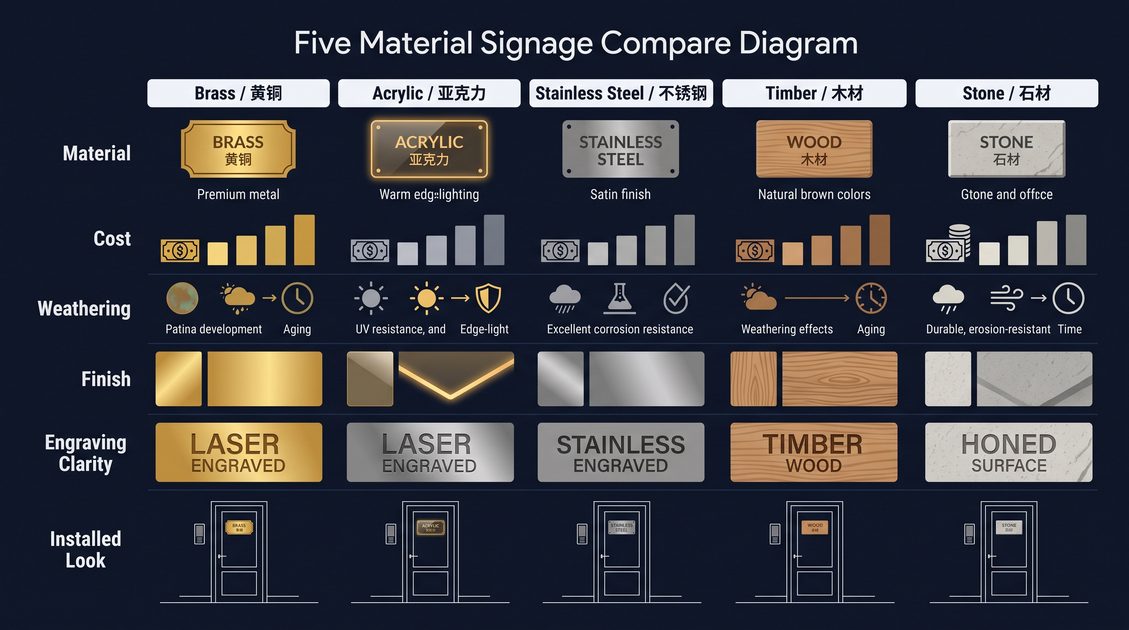
Papan penanda hotel mewah adalah sistem terkoordinasi dari pelat nomor kamar premium, penunjuk arah koridor, penanda pintu, dan identifikasi terukir yang mengomunikasikan tingkatan merek sejak tamu melangkah dari lift ke lantai. Program papan penanda hotel mewah yang lengkap memadukan kuningan disikat, perunggu berlapis, akrilik solid, atau pelat LED bercahaya dengan ukiran dalam, Braille di tempat yang diwajibkan hukum, dan lapisan tahan sidik jari yang menjaga kilauannya meski sentuhan terus-menerus. Biaya per unit untuk papan penanda hotel mewah terukir dimulai sekitar USD 12 pada MOQ 50 keping dan mencapai USD 80 atau lebih untuk unit bercahaya atau corak khusus, sementara kapasitas bulanan 100.000 keping mendukung peluncuran di seluruh portofolio. Produsen bersertifikat menyediakan dokumentasi CE, RoHS, dan ISO 9001, serta ekspor menjangkau AS, Inggris, Kanada, Australia, Singapura, dan Jerman. Papan penanda hotel mewah yang dispesifikasi dengan baik bertahan delapan hingga lima belas tahun di ruang dalam, melindungi investasi fit-out, dan menandakan niat bintang lima di setiap pintu, koridor, dan kamar mandi di seluruh properti dan di seluruh aset merek.
Mengapa papan penanda hotel mewah penting bagi properti
Papan penanda hotel mewah penting bagi properti karena menjalankan tiga peran sekaligus: penunjuk arah bagi setiap tamu, penceritaan merek pada permukaan yang paling sering disentuh di gedung, dan jaminan kualitas yang senyap yang membenarkan tarif premium. Program papan penanda hotel mewah yang koheren memungkinkan tamu yang baru tiba menemukan kamar tanpa bertanya pada staf, mengurangi kepadatan lobi dan persepsi friksi operasional yang merusak janji bintang lima. Bagi pelancong internasional yang membaca lewat simbol lebih dari teks, penanda terukir dan bercahaya membawa makna lintas bahasa, sementara materialnya sendiri, kuningan versus akrilik versus LED, menetapkan ekspektasi tingkatan secara langsung. Papan penanda hotel mewah yang dibuat baik juga bertahan terhadap kelembapan, bahan kimia pembersih, dan ribuan sentuhan selama delapan hingga lima belas tahun, melindungi biaya fit-out jauh lebih baik daripada sisipan kertas cetak. Pelat yang tidak patuh atau tampak murah terbaca sebagai penurunan kelas dan mengundang ulasan negatif yang mengikis ADR. Karena itu, menentukan spesifikasi papan penanda hotel mewah dengan benar sejak awal adalah kewajiban merek sekaligus efisiensi yang melindungi pendapatan dan terbayar melalui kepuasan tamu lebih tinggi, biaya penggantian lebih rendah, dan bahasa visual yang konsisten di setiap lantai dan setiap properti dalam portofolio.
Sinyal merek dimulai di pintu kamar tamu, tempat pelat nomor menjadi permukaan yang paling banyak difoto selama menginap. Stiker laser cetak yang datar terbaca sebagai kelas budget tanpa memandang jumlah benang linen di dalam, sementara pelat logam solid terukir terbaca sebagai kemewahan yang disengaja. Penanda arah koridor, pelat identitas lantai, dan identitas kamar mandi semuanya berbagi satu tata bahasa visual dalam program papan penanda hotel mewah yang matang, sehingga properti terasa dirancang, bukan dirakit. Tim pengadaan harus memperlakukan spesifikasi papan penanda sebagai bagian dari kitab merek, bukan pelengkap fasilitas, karena pelat di pintu adalah hal terakhir yang disentuh tamu sebelum membentuk opini akhir tentang menginap dan hal pertama yang mereka foto untuk ulasan.
Material yang digunakan dalam papan penanda hotel mewah
Material utama yang digunakan dalam papan penanda hotel mewah adalah kuningan, baja tahan karat, aluminium, dan akrilik (PMMA), masing-masing dipilih karena ketahanan terhadap kelembapan, kualitas taktil, dan nada premium spesifik yang ingin diproyeksikan suatu properti. Papan penanda hotel mewah dari kuningan memberikan nuansa bintang lima paling hangat dan paling tradisional serta menjadi pilihan default untuk hotel warisan dan palace, meski memerlukan lakuer di dekat uap untuk memperlambat korosi. Papan penanda hotel mewah dari baja tahan karat tampak modern dan higienis serta lebih tahan kelembapan daripada alternatif apa pun, menjadikannya pilihan kuat untuk koridor spa dan kolam renang. Papan penanda hotel mewah akrilik memungkinkan konstruksi menyala dan LED dengan branding penuh warna, ideal untuk lobi redup dan venue malam. Aluminium menjaga berat dan harga tetap rendah untuk portofolio besar sambil tetap memungkinkan warna anodisasi. Tabel di bawah membandingkan substrat yang paling banyak digunakan dalam program papan penanda hotel mewah produksi di properti butik dan flagship, dengan menimbang tingkatan yang dirasakan dan masa pakai di lingkungan perhotelan yang lembap.
| Material | Biaya relatif | Tingkatan yang dirasakan | Finis terbaik | Penggunaan tipikal |
|---|---|---|---|---|
| Kuningan | Tinggi | Sangat tinggi | Disikat atau dilakuer | Hotel warisan, palace |
| Baja tahan karat | Menengah-tinggi | Tinggi | Disikat, cermin | Spa, kolam, modern |
| Akrilik | Rendah-menengah | Menengah-tinggi | Dicetak, nyala belakang | LED, venue redup |
| Aluminium | Rendah-menengah | Menengah | Anodisasi, etsa | Portofolio besar |
Di luar empat substrat inti, papan penanda hotel mewah hibrida memadukan permukaan logam dengan pandu cahaya akrilik untuk mendapatkan bobot premium kuningan sekaligus cahaya LED. Pemilihan substrat harus mengikuti zona: kuningan di pintu kamar tamu dan suite, baja tahan karat di zona spa yang lembap, akrilik untuk direktori lobi bercahaya, dan aluminium untuk ratusan penanda sekunder yang dibutuhkan properti besar. Satu pemasok yang menjalankan keempat material di bawah satu sistem ISO 9001 menjaga finis tetap konsisten di seluruh aset, detail yang diperhatikan tamu saat berpindah dari pintu kuningan ke direktori akrilik di lantai yang sama dalam peluncuran papan penanda hotel mewah yang dieksekusi dengan baik.
Papan penanda kuningan hotel mewah untuk properti premium
Papan penanda hotel mewah dari kuningan untuk properti premium adalah material yang paling identik dengan perhotelan bintang lima, karena nada hangat dan patina alaminya terbaca sebagai buatan tangan, bukan pabrikan. Pelat papan penanda hotel mewah dari kuningan solid biasanya setebal 1,5 hingga 3 mm, diukir dalam dengan nomor kamar dan tanda merek, lalu dilakuer untuk menolak sidik jari dan memperlambat korosi di udara koridor yang lembap. Isian ukiran bisa hitam, enamel, atau dibiarkan mentah untuk relief dua warna yang memantulkan cahaya pada sudut menyamping, detail yang memisahkan papan penanda hotel mewah asli dari substitusi cetak tipis. Kuningan cocok untuk bangunan warisan, konversi palace, dan hotel kota flagship tempat pelat pintu menjadi bagian dari cerita arsitektur, serta berpaduan alami dengan pintu walnut, koridor marmer, dan pencahayaan hangat. Biayanya berada di puncak rentang, sekitar USD 18 hingga USD 45 per pelat terukir pada MOQ 50, naik untuk bentuk cor atau khusus. Dengan kapasitas bulanan 100.000 keping dan sertifikasi CE, RoHS, dan ISO 9001, produsen Shenzhen dapat memasok papan penanda kuningan hotel mewah ke AS, Inggris, Kanada, Australia, Singapura, dan Jerman dengan kualitas konsisten di seluruh aset merek global yang menuntut satu finis di mana pun.
Kuningan memang memerlukan perawatan lebih daripada baja atau akrilik, itulah mengapa lakuer di dekat uap dan pelapukan lembut berkala menjaga kilau yang mendefinisikan papan penanda hotel mewah. Kuningan tanpa lakuer kadang dipilih secara sengaja untuk patina hidup, tetapi keputusan itu harus diambil per properti karena sebagian tamu membaca patina sebagai kelalaian, bukan keahlian. Untuk portofolio campuran, spesifikasikan kuningan berlakuer di pintu kamar tamu dan pertimbangkan varian tersegel di koridor spa dan kolam renang tempat kelembapan tertinggi. Perkakas molding dan ukiran untuk papan penanda kuningan hotel mewah dapat dipakai ulang untuk pemesanan ulang, sehingga fase kedua peluncuran berbiaya sama per pelat dengan fase pertama dan finisnya tetap identik bertahun-tahun kemudian, persis seperti yang dibutuhkan merek global dari pemasok papan penanda hotel mewahnya saat berekspansi dari satu flagship ke belasan properti.
Papan penanda akrilik dan LED hotel mewah
Papan penanda akrilik dan LED hotel mewah memadukan bodi PMMA transparan dengan iluminasi tepi atau nyala belakang untuk menghasilkan nomor kamar dan penanda koridor menyala yang mendefinisikan koridor bintang lima kontemporer. Gaya papan penanda hotel mewah ini menggunakan pandu cahaya untuk menyebarkan cahaya merata di seluruh pelat, sehingga nomor terukir terbaca jelas sementara seluruh permukaan memancarkan halo lembut yang terfoto indah di malam hari. Akrilik lebih ringan dan sering lebih murah daripada logam, sekitar USD 8 hingga USD 30 per pelat bercahaya pada MOQ 50, serta menerima branding penuh warna dan citra fotografis yang tidak bisa dilakukan kuningan. Papan penanda LED hotel mewah menyerap di bawah 2 watt per unit, terhubung lewat kabel tegangan rendah atau PoE, dan tidak membutuhkan jaringan untuk fungsi cahaya sederhana. Satu lantai 200 kamar dengan papan penanda LED hotel mewah yang selalu menyala menyerap sekitar 150 watt total, dapat diabaikan dibanding pencahayaan koridor. Saat menentukan spesifikasi papan penanda akrilik dan LED hotel mewah, verifikasi rating proteksi di dekat area cipratan, perilaku peredupan di bawah kontrol gedung, dan apakah modul cahaya adalah unit tersegel yang dapat diganti sehingga permukaan terukir tetap bisa diservis jika elektronik gagal, karena aksesibilitas dan merek tidak boleh bergantung pada komponen bertenaga dalam program papan penanda hotel mewah sungguhan.
Kebebasan desain papan penanda akrilik dan LED hotel mewah menjadikannya favorit untuk properti yang dipimpin merek dan flagship bangunan baru tempat koridor itu sendiri menjadi permukaan pemasaran. Reproduksi logo penuh warna, nyala belakang gradien, bahkan pesan sambutan animasi menjadi mungkin ketika pelat adalah kotak cahaya, bukan tag logam. Untuk resor dan hotel hiburan, fleksibilitas ini memungkinkan papan penanda hotel mewah mengubah suasana per zona, sejuk dan minimalis di spa, hangat dan menyala di bar, tanpa mengubah substrat. Pengadaan harus memastikan pemasok mampu menjaga konsistensi warna di ribuan pelat akrilik, karena pergeseran nyala belakang yang terlihat antar lantai terbaca sebagai cacat kualitas pada properti yang menggantungkan reputasinya pada detail tanpa cela dan bahasa papan penanda hotel mewah yang koheren sepanjang perjalanan tamu dari kedatangan hingga keberangkatan.
Papan penanda hotel mewah sesuai ADA
Papan penanda hotel mewah yang sesuai ADA di Amerika Serikat mengikuti 2010 ADA Standards for Accessible Design, yang mewajibkan kamar permanen menampilkan tanda dengan huruf timbul dan Braille Grade 2 bahkan di properti paling mewah. Papan penanda hotel mewah yang patuh menggunakan huruf timbul sans-serif huruf besar dengan ketinggian timbul minimum 1/32 inci (0,8 mm), finis non-silau, dan kontras tinggi antara karakter dan latar, semuanya dapat dicapai dalam kuningan solid atau akrilik tanpa mengorbankan tampilan premium. Piktogram dan karakter taktil harus berada di bidang bersih, dan tanda dipasang di dinding bersebelahan dengan sisi pengunci pintu, terpusat 1400 hingga 1700 mm di atas lantai jadi, tidak pernah di pintu yang bergerak. Padanan internasional memperluas kewajiban: UK Equality Act 2010 dengan BS 8300, EU EN 301 549, dan standar disabilitas Australia masing-masing mewajibkan tanda taktil berkontras tinggi untuk kamar permanen. Untuk papan penanda hotel mewah yang mencakup AS, Inggris, Kanada, Australia, Singapura, dan Jerman, spesifikasi teraman mengadopsi dasar bersama yang paling ketat, karakter taktil timbul, Braille, permukaan mat non-silau, dan pemasangan bersebelahan dinding, dengan deklarasi kepatuhan pemasok yang merujuk standar yang berlaku diajukan untuk setiap audit di seluruh aset merek.
Banyak perencana keliru menganggap papan penanda hotel mewah dapat melewati aturan taktil karena propertinya high-end, tetapi hukum aksesibilitas berlaku untuk setiap kamar permanen tanpa memandang tarif. Suite bintang lima tetap membutuhkan identifikasi kamar yang patuh, dan pelat akrilik menyala bukan alasan untuk menghilangkan Braille. Solusi elegan memadukan permukaan menyala dengan sub-pelat taktil dan Braille statis atau mengintegrasikan karakter timbul langsung ke logam atau akrilik sehingga papan penanda hotel mewah indah sekaligus sah. Tentukan terjemahan Braille per pasar dan simpan bersama pemasok, karena satu karya global dengan Braille spesifik pasar memenuhi audit di mana pun aset beroperasi. Memilih manufaktur bersertifikat CE, RoHS, dan ISO 9001 semakin menyederhanakan dokumentasi untuk properti yang mengejar kredensial hijau dan aksesibilitas bersama investasi papan penanda hotel mewahnya di berbagai yurisdiksi.
Biaya papan penanda hotel mewah
Biaya papan penanda hotel mewah terbagi menjadi desain dan perkakas, substrat dan dekorasi, elektronik untuk unit LED, perangkat keras dan pemasangan, serta pengiriman, dengan lini substrat mendominasi pengeluaran berulang. Desain dan perkakas biasanya berjalan USD 120 hingga USD 400 untuk templat merek atau piktogram khusus, sering dihapus di atas pesanan 500 keping. Substrat dan dekorasi adalah lini berulang terbesar: pelat kuningan terukir berbiaya USD 18 hingga USD 45 per keping, baja tahan karat USD 12 hingga USD 30, aluminium USD 7 hingga USD 18, dan akrilik USD 8 hingga USD 30 pada MOQ 50, dengan harga per unit turun 15 hingga 30 persen di atas 1.000 unit. Elektronik LED menambah USD 8 hingga USD 45 tergantung jenis tampilan dan konektivitas. Perangkat keras pemasangan berbiaya USD 0,40 hingga USD 2,50 per pelat. Pengiriman laut dari Shenzhen ke pantai barat AS menambah sekitar USD 0,40 hingga USD 1,20 per kilogram, sehingga pelat 300 gram membawa sekitar USD 0,12 hingga USD 0,36 biaya pengiriman. Program papan penanda kuningan terukir realistis 300 pelat berada di sekitar USD 6.000 hingga USD 15.000 keseluruhan, sementara program akrilik LED 1.000 pelat berkisar USD 12.000 hingga USD 35.000. Anggarkan tambahan 5 hingga 10 persen untuk pelat cadangan yang menutupi kerusakan fit-out dan rebranding masa depan di seluruh aset.
Nilai yang dirasakan dari papan penanda hotel mewah jauh melampaui fakturanya, karena satu pelat yang dibuat baik mendukung premi tarif sepanjang masa pakai delapan hingga lima belas tahun kamar. Properti yang menagih USD 400 per malam atas 200 kamar menghasilkan jutaan pendapatan kamar tahunan tempat pelat pintu menjadi bagian dari pembenaran yang dikutip tamu dalam ulasan, sehingga beberapa dolar selisih antara sisipan cetak dan penanda kuningan terukir sepele dibanding pengembalian itu. Pengadaan harus memodelkan biaya tiga hingga sepuluh tahun, bukan pesanan pembelian, karena pelat murah yang harus diganti dua kali berbiaya lebih besar daripada yang terukir tahan lama. Energi untuk papan penanda LED hotel mewah dapat diabaikan di bawah 2 watt per unit, dan kapasitas bulanan 100.000 keping dari satu fasilitas mengurangi emisi pengiriman per unit dibanding beberapa pemasok regional, poin yang mendukung tujuan anggaran dan keberlanjutan untuk setiap program papan penanda hotel mewah serius yang melayani AS, Inggris, Kanada, Australia, Singapura, dan Jerman.
MOQ dan kapasitas untuk papan penanda hotel mewah
Jumlah pesanan minimum dan kapasitas produksi membentuk cara program papan penanda hotel mewah difasekan di seluruh properti atau portofolio global. MOQ standar 50 keping cocok untuk uji coba satu lantai atau hotel butik, memungkinkan merek memvalidasi material dan detail ukiran sebelum komitmen portofolio luas yang sulit dibatalkan begitu pintu dipasang. Dengan kapasitas bulanan 100.000 keping, pemasok dapat menyerap penyebaran multi-lokasi 10.000 pelat dalam satu bulan produksi sambil melayani klien lain, hal yang penting ketika beberapa flagship merenovasi dengan jadwal yang tumpang tindih. Waktu tunggu terbagi menjadi sampel (7 hingga 12 hari untuk pelat bukti) dan produksi massal (20 hingga 35 hari untuk ukiran, anodisasi, dan QA). Untuk papan penanda hotel mewah dengan LED terintegrasi, tambahkan lima hingga tujuh hari untuk perakitan elektronik dan pengujian fungsional. Pengadaan harus mengurutkan pesanan agar lantai yang menghadap tamu atau tingkat tertinggi menerima pelat lebih dulu, lalu area belakang dan area staf. Karena nomor kamar dan tanda merek bergeser selama fit-out, negosiasikan over-run 10 hingga 15 persen pelat kosong atau yang mudah diukir ulang, karena akrilik dan aluminium lebih mudah dikerjakan ulang daripada kuningan berlakuer dalam peluncuran papan penanda hotel mewah yang bergerak cepat.
Perencanaan kapasitas juga melindungi konsistensi merek ketika portofolio tumbuh melalui akuisisi, bukan pembangunan baru. Pemasok dengan kapasitas bulanan 100.000 keping dapat memenuhi kebutuhan mendadak 5.000 pelat pengganti setelah rebranding tanpa menggeser jadwal awal, perbedaan antara peluncuran mulus dan koridor penuh penanda yang hilang. Pastikan produsen dapat menyimpan karya Anda, terjemahan Braille, dan spesifikasi finis dalam arsip sehingga pemesanan ulang berikutnya tetap identik dengan rilis papan penanda hotel mewah awal lintas tahun dan fase ekspansi. Untuk AS, Inggris, Kanada, Australia, Singapura, dan Jerman, konsistensi satu sumber inilah yang memungkinkan merek global menyajikan satu finis dari townhouse London hingga menara Singapura, dan menjadi alasan inti manufaktur Shenzhen bersertifikat CE, RoHS, dan ISO 9001 menjadi default untuk program papan penanda hotel mewah yang dapat diskalakan di seluruh dunia.
Tren desain dalam papan penanda hotel mewah
Tren desain papan penanda hotel mewah saat ini menggemari tipografi terukir minimalis, logam hangat di atas lakuer gelap, nyala belakang tersembunyi, dan aksen biofilik yang menggemakan skema interior properti. Gerakan dominan menjauh dari pelat ramai menuju satu nomor terukir dalam serif halus atau sans humanis, membiarkan material membawa kemewahan alih-alih ornamen. Kuningan disikat di atas dinding arang tetap menjadi tampilan bintang lima yang paling banyak dikutip, sementara pencahayaan tepi LED tersembunyi yang memperlihatkan nomor hanya saat didekati berkembang cepat karena terbaca sebagai keajaiban, bukan papan penanda. Papan penanda akrilik hotel mewah kini menggunakan nyala belakang gradien yang disetel ke warna merek, dan beberapa flagship menanamkan watermark logo halus yang hanya terlihat dari sudut. Keberlanjutan memengaruhi pilihan finis, dengan aluminium daur ulang dan lakuer rendah VOC muncul di properti bangunan hijau. Untuk tren mana pun, konstannya adalah kualitas taktil: pelat papan penanda hotel mewah yang mengikuti tren tetap harus terbaca, tahan lama, dan patuh, karena penanda yang indah namun tak terbaca menggagalkan tamu pada saat kedatangan dan merusak kemewahan yang hendak diekspresikan desain di seluruh properti.
Tren lain adalah penyatuan papan penanda hotel mewah dengan pengalaman kunci digital dan aplikasi, tempat pelat fisik dan layar ponsel berbagi tipografi dan nada sehingga merek terasa berkelanjutan dari pemesanan hingga waktu tidur. Properti menggunakan pelat pintu sebagai momen foto, mengukir garis merek kecil atau nama lokasi yang ditandai tamu di media sosial, mengubah papan penanda hotel mewah menjadi pemasaran hasil. Pencampuran material juga meningkat, nomor kuningan pada latar menyala akrilik, untuk mendapatkan kehangatan dan cahaya dari satu pelat. Apa pun trennya, pengadaan harus menentukan spesifikasi finis dan kedalaman ukiran yang bertahan delapan hingga lima belas tahun, karena pelat modis yang menua dengan buruk menjadi liabilitas ketinggalan zaman lebih cepat daripada yang klasik. Manufaktur bersertifikat CE, RoHS, dan ISO 9001 mendukung semua arah ini, dan kapasitas bulanan 100.000 keping memastikan program papan penanda hotel mewah berbasis tren dapat diskalakan dari lantai uji ke aset global penuh tanpa penyimpangan kualitas.
Papan penanda hotel mewah untuk pintu kamar tamu
Papan penanda hotel mewah untuk pintu kamar tamu adalah titik sentuh paling penting dalam menginap, karena pelat pintu adalah permukaan terakhir yang disentuh tamu sebelum menilai kamar dan yang pertama mereka foto untuk ulasan. Pelat papan penanda hotel mewah solid terukir di pintu, biasanya kuningan atau akrilik dengan nomor kamar dan tanda merek, terbaca sebagai keahlian yang disengaja dan membenarkan tarif, sementara stiker cetak terbaca sebagai budget tanpa memandang suite di baliknya. Pelat harus berada di ketinggian konsisten di seluruh lantai, umumnya 1400 hingga 1700 mm terpusat pada sisi pengunci, dengan nomor cukup besar untuk dibaca dari koridor dan tanda merek cukup halus untuk tidak berteriak. Papan penanda akrilik bercahaya hotel mewah di pintu menciptakan cahaya menyambut yang membantu tamu menemukan kamar setelah gelap tanpa menyipitkan mata, kenyamanan kecil namun berkesan. Untuk suite dan vila, pelat lebih besar atau cor menandakan peningkatan tingkatan dalam properti yang sama. Dengan MOQ 50 dan kapasitas bulanan 100.000 keping, merek dapat melengkapi penginapan butik atau menara 1.000 kamar dengan papan penanda hotel mewah identik, dan sertifikasi CE, RoHS, dan ISO 9001 memuaskan pembeli dan bea cukai di AS, Inggris, Kanada, Australia, Singapura, dan Jerman tanpa perkakas regional terpisah atau kompromi finis.
Pelat pintu juga membawa informasi praktis di luar nomor: lantai, sayap, dan kadang indikator aksesibilitas dwibahasa atau berbasis simbol yang harus tetap taktil dan patuh. Penanda pintu papan penanda hotel mewah yang dirancang baik memadukan simbol gambar dengan kata dan ikon aksesibilitas opsional, sehingga pelancong internasional multibahasa bernavigasi lewat simbol sementara pembaca terliterasi mengonfirmasi lewat teks. Finis menandakan tingkatan dalam properti: suite bintang lima condong ke kuningan disikat dengan ukiran dalam dan lakuer tahan sidik jari, sementara lantai select-service menggunakan aluminium anodisasi atau akrilik cetak untuk mengendalikan biaya di ratusan pintu. Integrasi pencahayaan bernilai di koridor redup, tempat pelat papan penanda hotel mewah menyala membantu tamu menemukan kamar tanpa bantuan staf, mengurangi panggilan ke meja depan dan mendukung janji kedatangan tanpa hambatan yang mendefinisikan perhotelan sejati serta bahasa papan penanda hotel mewah yang koheren dari lobi hingga kamar tidur.
Pemasangan papan penanda hotel mewah
Pemasangan papan penanda hotel mewah menentukan kepatuhan dan umur panjang, sehingga metode harus cocok dengan substrat dinding dan zona pemasangan ADA. Pemasangan perekat menggunakan pita VHB atau epoksi dan cocok untuk ubin halus, drywall cat, kaca, dan pintu logam tempat pengeboran tidak diinginkan; menahan pelat hingga sekitar 1,5 kg tetapi memerlukan pembersihan permukaan dan kurasi 24 jam, dan ubin memerlukan primer untuk ikatan andal. Pemasangan sekrup dengan penutup tersembunyi atau dekoratif paling aman untuk papan penanda kuningan hotel mewah yang berat dan koridor publik yang banyak disentuh. Pemasangan standoff mengapungkan pelat akrilik atau logam 12 hingga 25 mm dari dinding, menciptakan celah bayang premium dan menyederhanakan jalur kabel LED di belakang pelat. Untuk kepatuhan ADA, tanda harus berada di samping pintu pada sisi pengunci, 1400 hingga 1700 mm ke pusat, tidak pernah di pintu itu sendiri. Pemasang harus menggunakan waterpass laser dan jig agar setiap pelat berada pada datum horizontal yang sama di seluruh lantai, karena ketinggian tidak rata merusak estetika dan memori otot tamu berulang yang bernavigasi lewat sentuhan. Hotel 200 kamar biasanya membutuhkan satu hingga dua pemasang selama satu hingga dua hari untuk memasang semua papan penanda hotel mewah dan penunjuk arah, dengan unit LED memakan waktu lebih lama karena pengkabelan dan pemasangan sensor yang harus diuji sebelum serah terima.
Pemasangan standoff layak mendapat perhatian khusus dalam papan penanda hotel mewah karena celah bayang mengapung itu sendiri adalah isyarat premium yang terbaca sebagai dirancang, bukan ditempel. Celah juga menyembunyikan kabel untuk akrilik nyala belakang dan membuat pengukiran ulang atau penggantian masa depan lebih bersih, karena pelat terangkat dari tiang tanpa perbaikan dinding. Untuk kuningan di pintu berlakuer, sekrup tersembunyi di belakang pelat menjaga permukaan bersih, sementara akrilik sering menggunakan sistem klip tersembunyi yang tidak meninggalkan pengikat terlihat sama sekali. Apa pun metodenya, pemasok harus menyediakan templat pemasangan dengan setiap pesanan agar pemasang di AS, Inggris, Kanada, Australia, Singapura, dan Jerman memasang papan penanda hotel mewah pada satu datum tanpa menebak di lokasi. Skema penempatan terdokumentasi mencegah penyimpangan di mana satu lantai memasang di 1500 mm dan berikutnya di 1650 mm tanpa logika yang bisa diikuti tamu, dan melindungi konsistensi merek yang hendak dihadirkan manufaktur bersertifikat CE, RoHS, dan ISO 9001 dalam skala besar.
Keterbacaan dan kontras dalam papan penanda hotel mewah
Keterbacaan dan kontras menentukan apakah papan penanda hotel mewah benar-benar memberi informasi, terutama dalam pencahayaan koridor buruk atau bagi tamu penglihatan rendah yang mengandalkan pelat di pintu. Standar aksesibilitas memerlukan kontras minimum 70 persen antara karakter dan latar untuk tanda taktil, yang dalam praktik berarti karakter gelap pada pelat mat terang atau karakter terang pada pelat mat gelap, tidak pernah permukaan mengkilap yang menciptakan silau. Papan penanda hotel mewah kuningan disikat dengan isian ukiran hitam memenuhi ini dengan mudah, begitu juga akrilik putih dengan huruf arang untuk konstruksi menyala. Warna harus mengodekan status, bukan membawa satu-satunya makna, karena sekitar 8 persen pria memiliki defisiensi penglihatan warna dan nomor yang menghilang dalam skala abu gagal melayani mereka. Pilihan font penting; gunakan serif bersih atau sans humanis dengan ukuran terbaca dari tiga meter di koridor, biasanya tinggi kapital 20 hingga 40 mm untuk nomor kamar pada papan penanda hotel mewah level pintu. Hindari skrip dekoratif dan goresan tipis yang menghilang di bawah bayangan koridor atau uap. Untuk aset dwibahasa, alokasikan ruang vertikal agar tidak ada bahasa yang sesak, dan pertahankan karakter bahasa utama setidaknya sebesar bahasa sekunder, karena pelat yang tampak elegan namun terbaca buruk mengkhianati kemewahan yang hendak diekspresikan di seluruh properti.
Menguji bukti cetak di dinding sebenarnya di bawah pencahayaan terpasang menangkap sebagian besar masalah keterbacaan sebelum produksi massal papan penanda hotel mewah dimulai, terutama di koridor tempat cahaya sekitar sering lemah dan tamu tiba dalam keadaan lelah. Pelat akrilik menyala harus menjaga nomornya tetap terbaca bahkan saat nyala belakang diredupkan untuk suasana malam, jadi tentukan rasio kontras minimum untuk kondisi menyala dan profil taktil terpisah untuk kepatuhan. Kedalaman ukiran kuningan harus cukup sehingga nomor timbul atau cekung terbaca lewat sentuhan dan mata, bukan etsa permukaan yang rata di bawah pembersihan. Di AS, Inggris, Kanada, Australia, Singapura, dan Jerman, aturan keterbacaan bertemu pada kontras tinggi dan non-silau, sehingga mengadopsi dasar bersama paling ketat menjaga satu karya papan penanda hotel mewah patuh di mana pun. Sertifikasi CE, RoHS, dan ISO 9001 mencakup material dan elektronik, tetapi hanya spesifikasi kontras dan font yang benar yang membuat pelat benar-benar dapat digunakan setiap tamu yang meraih pintu dalam gelap.
Ukiran khusus untuk papan penanda hotel mewah
Ukiran khusus untuk papan penanda hotel mewah adalah tempat pelat generik menjadi aset merek, karena kedalaman, font, dan isian nomor terukir adalah detail yang diperhatikan dan difoto tamu. Ukiran papan penanda hotel mewah berkualitas memotong 0,3 hingga 0,8 mm ke kuningan, baja tahan karat, atau akrilik, meninggalkan tepi tajam yang menangkap cahaya dan tahan aus selama delapan hingga lima belas tahun sentuhan. Isian bisa enamel hitam, logam mentah untuk relief dua warna, atau dicocokkan warna dengan merek, dan tanda merek atau nama lokasi dapat diukir di samping nomor kamar untuk memperluas identitas ke pintu. Ukiran laser dan CNC keduanya menghasilkan konsistensi dalam skala, dan kapasitas bulanan 100.000 keping berarti merek global mendapatkan ukiran identik pada setiap pelat dari townhouse London hingga menara Singapura. Ukiran khusus juga mendukung Braille dan karakter taktil yang dipersyaratkan untuk kepatuhan, terintegrasi dalam pelat yang sama alih-alih stiker terpisah. Dengan MOQ 50, bahkan properti butik dapat memesan papan penanda hotel mewah khusus, dan manufaktur bersertifikat CE, RoHS, dan ISO 9001 memastikan finis terukir memenuhi ekspektasi estetika dan regulasi di AS, Inggris, Kanada, Australia, Singapura, dan Jerman tanpa kompromi atau variasi regional dalam kualitas.
Ekonomi ukiran khusus menguntungkan daya tahan dari waktu ke waktu, karena pelat papan penanda hotel mewah terukir dalam bertahan lebih lama daripada alternatif cetak atau etsa permukaan dan tidak perlu retouching sepanjang masa pakai properti. Perkakas untuk font dan tanda merek dapat dipakai ulang lintas pemesanan ulang, sehingga fase kedua peluncuran berbiaya sama per pelat dengan fase pertama dan finis tetap identik bertahun-tahun kemudian, persis yang dibutuhkan merek global. Tentukan kedalaman ukiran dan isian dalam berkas karya dan minta satu pelat bukti sebelum produksi massal, karena potongan dangkal yang tampak baik dalam sampel bisa rata di bawah bahan kimia pembersih komersial. Untuk akrilik, ukiran dapat diisi dengan lapisan pandu cahaya sehingga nomor menyala dari dalam, memadukan ukiran khusus dengan papan penanda LED hotel mewah dalam satu produk premium. Pengadaan harus menyimpan spesifikasi ukiran bersama pemasok agar setiap pemesanan ulang papan penanda hotel mewah di masa depan cocok dengan rilis awal di setiap properti dan setiap tahun ekspansi merek.
Daftar periksa pengadaan untuk papan penanda hotel mewah
Daftar periksa pengadaan untuk papan penanda hotel mewah menjaga program multi-properti tetap sesuai jadwal dan anggaran sambil memenuhi hukum merek dan aksesibilitas. Mulailah dengan mengaudit setiap kamar dan koridor yang membutuhkan penanda permanen, termasuk kamar tamu, suite, varian aksesibel, area staf, dan kamar mandi, karena aturan aksesibilitas berlaku untuk ruang permanen. Catat piktogram yang diperlukan, bentuk kata, catatan kapasitas, dan simbol aksesibilitas apa pun untuk masing-masing, lalu putuskan mana yang membutuhkan status LED versus pelat statis. Tentukan substrat per zona: kuningan untuk pintu prestisius, baja tahan karat untuk area spa lembap, akrilik atau aluminium untuk belakang panggung volume tinggi. Minta deklarasi kepatuhan yang merujuk ADA 2010, BS 8300, EN 301 549, atau padanan lokal, dan minta terjemahan Braille untuk pasar target. Konfirmasikan MOQ (umumnya 50 keping), waktu tunggu (20 hingga 35 hari produksi massal), dan kapasitas bulanan (100.000 keping) terhadap tanggal peluncuran Anda. Minta satu pelat bukti sebelum produksi penuh, dan negosiasikan over-run cadangan 10 persen. Terakhir, verifikasi sertifikasi (CE, RoHS, ISO 9001) dan kemampuan pemasok menyimpan karya Anda untuk pemesanan ulang masa depan sehingga papan penanda hotel mewah tetap konsisten secara visual lintas fase dan tahun program merek yang melayani AS, Inggris, Kanada, Australia, Singapura, dan Jerman tanpa penyimpangan.
Daftar periksa juga harus menangkap standar finis dan pemasangan agar pemasang di mana pun memasang papan penanda hotel mewah pada satu datum dan satu tampilan. Dokumentasikan ketinggian penempatan, celah standoff, metode perekat atau sekrup, dan perilaku peredupan pencahayaan untuk unit LED, lalu distribusikan sumber kebenaran tunggal itu ke setiap properti dan setiap kontraktor. Negosiasikan retensi karya agar pemesanan ulang tiga tahun kemudian cocok persis dengan rilis awal, yang melindungi merek jauh lebih baik daripada harga unit sedikit lebih rendah. Evaluasi kemampuan pemasok mendukung penyediaan massal papan penanda LED hotel mewah dari namespace CSV, karena konfigurasi manual per pelat menjadi hambatan selama ekspansi cepat aset global. Memilih pemasok dan material papan penanda hotel mewah di bawah satu sistem bersertifikat, dengan kapasitas 100.000 keping bulanan dan ekspor ke keenam pasar inti, mengubah pembelian tersebar menjadi aset merek terkelola yang menjaga konsistensi dan kepatuhan sepanjang masa operasi properti dan setiap renovasi yang menyentuh perjalanan tamu.
Kesalahan dalam papan penanda hotel mewah
Kesalahan dalam papan penanda hotel mewah merugikan merek baik anggaran maupun reputasi, dan kesalahan terburuk baru muncul setelah tamu tiba. Yang pertama adalah memasang pelat di pintu alih-alih dinding bersebelahan, yang melanggar aturan ketinggian taktil ADA dan memaksa tamu membuka pintu untuk membaca nomor. Kedua, memilih finis mengkilap yang silau di bawah pencahayaan koridor dan gagal memenuhi persyaratan non-silau, membuat papan penanda hotel mewah tak terbaca bagi penghuni penglihatan rendah. Ketiga, mencetak alih-alih mengukir karakter taktil, menghasilkan tanda tanpa profil timbul dan tanpa kedudukan hukum sebagai tanda aksesibel. Keempat, ketinggian penempatan tidak konsisten di satu lantai, di mana satu pelat berada di 1500 mm dan berikutnya di 1650 mm, merusak estetika dan memori otot tamu berulang. Kelima, menghilangkan Braille atau menggunakan kode non-Grade-2, kesalahan umum dalam program lintas batas yang menganggap satu Braille melayani semua pasar. Keenam, kurang memesan cadangan, sehingga satu pelat rusak selama fit-out menghentikan serah terima lantai. Ketujuh, mengabaikan rating proteksi LED di dekat area cipratan, membeli pelat yang gagal dalam setahun. Menghindari jebakan ini dimulai dengan dokumen spesifikasi yang jelas dan pelat bukti yang ditinjau staf merek dan aksesibilitas sebelum pesanan papan penanda hotel mewah penuh dirilis ke produksi dan pengiriman ke AS, Inggris, Kanada, Australia, Singapura, dan Jerman.
Kesalahan kedelapan adalah memperlakukan papan penanda hotel mewah sebagai komoditas dan membagi pesanan ke beberapa pemasok demi harga unit lebih rendah, yang hampir selalu menghasilkan penyimpangan finis antar lantai dan properti. Kesembilan, lupa retensi karya, sehingga pemesanan ulang dua tahun kemudian kembali dengan nada kuningan sedikit berbeda yang diperhatikan tamu dan inspektur. Kesepuluh, merancang pelat berlebihan yang tidak bisa bertahan delapan hingga lima belas tahun bahan kimia pembersih dan sentuhan, finis modis yang menua menjadi liabilitas. Kesebelas, mengabaikan templat pemasangan, membiarkan pemasang menebak ketinggian dan celah di lokasi. Keduabelas, melewatkan pelat bukti demi menghemat satu minggu, hanya untuk menemukan kedalaman ukiran dangkal atau warna nyala belakang salah di ribuan unit. Spesifikasi terdokumentasi, satu pemasok bersertifikat dengan kapasitas bulanan 100.000 keping, dan kepatuhan CE, RoHS, dan ISO 9001 mencegah setiap kegagalan ini dan menjaga program papan penanda hotel mewah koheren, sah, dan indah dari lantai pertama hingga terakhir di seluruh aset global dan setiap pasar yang dilayani.
Papan penanda hotel mewah untuk resor dan hotel butik
Papan penanda hotel mewah untuk resor dan hotel butik menghadapi rentang lingkungan lebih luas daripada menara kota, dari dek kolam lembap hingga jalur vila redup, yang menaikkan taruhan daya tahan dan atmosfer. Resor membutuhkan papan penanda hotel mewah yang bertahan terhadap udara asin, klorin, dan pemasangan luar ruangan sambil tetap terbaca sebagai buatan di pintu suite, sehingga baja tahan karat dan akrilik tersegel mendominasi eksterior dan zona spa sementara kuningan menandai interior prestisius. Hotel butik menggunakan papan penanda hotel mewah untuk mengekspresikan sudut pandang tunggal, nomor terukir tangan di kayu reclaimed atau tanda akrilik nyala belakang yang disetel ke warna khas properti, karena pelat adalah bagian dari cerita yang dicari tamu. Baik resor maupun butik harus memenuhi hukum aksesibilitas lokal di setiap pasar, dan properti yang beroperasi di California, London, dan Singapura sebaiknya mengadopsi satu desain papan penanda hotel mewah yang patuh daripada tiga, menyederhanakan pengadaan dan audit. MOQ 50 sangat cocok untuk uji coba butik, dan kapasitas bulanan 100.000 keping menskalakan desain yang sama ke ekspansi resor tanpa penyimpangan kualitas. Sertifikasi CE, RoHS, dan ISO 9001 memuaskan pembeli dan bea cukai di AS, Inggris, Kanada, Australia, Singapura, dan Jerman, memungkinkan properti kecil menyumber papan penanda hotel mewah bersertifikat yang sama seperti flagship global.
Peran atmosfer papan penanda hotel mewah paling kuat di resor dan butik, tempat urutan kedatangan, dari plakat gerbang hingga nomor vila, dikoreografikan seperti film. Jalur redup berisi penanda akrilik menyala rendah terasa magis dan aman, sementara pelat kuningan di pintu vila menjangkar rasa tempat yang membenarkan tarif premium. Untuk properti ini, papan penanda bukan sekadar penunjuk arah tetapi bagian dari narasi tamu, sehingga pilihan material dan cahaya harus menggemakan arsitektur dan lanskap alih-alih mengikuti templat korporat. Pengadaan harus menstandarkan satu bahasa desain patuh di seluruh aset, menegosiasikan over-run cadangan lebih tinggi mengingat keausan luar ruangan, dan memastikan pemasok dapat mengirim pengganti papan penanda hotel mewah dengan cepat saat pelat rusak di musim sibuk. Dengan kapasitas 100.000 keping bulanan dan ekspor ke keenam pasar inti, bahkan resor terpencil dapat menjaga program papan penanda hotel mewah tanpa cela yang terasa khusus namun memenuhi setiap ekspektasi regulasi dan kualitas tanpa kompromi.
Keberlanjutan dalam papan penanda hotel mewah
Keberlanjutan dalam papan penanda hotel mewah semakin menjadi bagian dari penilaian pengadaan saat hotel mengejar sertifikasi LEED, BREEAM, dan WELL serta menjawab permintaan tamu akan kemewahan bertanggung jawab. Pilihan material papan penanda hotel mewah berkontribusi pada kategori kredit seperti material dan sumber daya: aluminium kandungan daur ulang dan akrilik berbasis bio menghasilkan lebih banyak poin daripada kuningan murni, meski masa pakai panjang kuningan mengimbangi jejak pertambangannya melalui penggantian yang terhindarkan. Papan penanda LED hotel mewah daya rendah menyerap di bawah 2 watt per unit, sehingga penyebaran seluruh properti menambah beban energi dapat diabaikan sambil memperbaiki penunjukan arah, yang secara tidak langsung mendukung kredit energi dengan mengurangi pencarian pencahayaan terbuang. Pemasok dengan manajemen lingkungan ISO 14001 dan kepatuhan RoHS menyederhanakan beban dokumentasi untuk pengajuan bangunan hijau, dan kapasitas bulanan 100.000 keping dari satu fasilitas Shenzhen mengurangi emisi pengiriman per unit dibanding beberapa pemasok regional. Penentu spesifikasi harus meminta deklarasi kandungan daur ulang dan pernyataan ambil kembali atau daur ulang untuk papan penanda hotel mewah akhir masa pakai, karena auditor semakin meminta gambaran siklus hidup penuh. Memilih papan penanda hotel mewah terukir tahan lama daripada pelat cetak berumur pendek itu sendiri adalah kemenangan keberlanjutan, memangkas limbah dan karbon produksi berulang sepanjang masa operasi puluhan tahun fasilitas dan mengurangi total biaya kepemilikan bagi merek pemilik aset.
Segmen mewah memiliki tuas khusus di sini, karena tamu yang membayar tarif premium semakin mengkaji apakah keberlanjutan yang diklaim properti nyata atau pemasaran. Menentukan spesifikasi papan penanda hotel mewah dengan kandungan daur ulang terdokumentasi dan sistem manajemen lingkungan bersertifikat mengubah lini pengadaan kecil menjadi cerita kredibel yang dapat diceritakan merek tanpa greenwashing. Pelat kuningan yang bertahan lima belas tahun lalu dapat didaur ulang mengalahkan sisipan cetak murah yang diganti setiap dua tahun baik pada biaya maupun karbon, dan matematika itu memperkuat kasus untuk papan penanda hotel mewah terukir tahan lama di seluruh portofolio. Sertifikasi CE, RoHS, dan ISO 9001 sudah mencakup kontrol zat berbahaya, dan menambahkan ISO 14001 menutup lingkaran untuk auditor bangunan hijau di AS, Inggris, Kanada, Australia, Singapura, dan Jerman. Pengadaan harus menyimpan deklarasi keberlanjutan bersama berkas karya agar setiap pemesanan ulang papan penanda hotel mewah membawa kredensial yang sama, melindungi merek dan planet di sepanjang siklus hidup penuh aset papan penanda dari pemasangan pertama hingga daur ulang akhir.
Strategi penunjukan arah dengan papan penanda hotel mewah
Strategi penunjukan arah dengan papan penanda hotel mewah menentukan apakah properti benar-benar membantu tamu bernavigasi atau sekadar memberi label pintu. Strategi kuat menempatkan papan penanda hotel mewah di tempat terlihat dari jalur pendekatan utama, bukan tersembunyi di samping pintu reses, dan memperkuatnya dengan penanda arah di titik keputusan seperti lobi lift dan persimpangan koridor. Ketinggian penempatan konsisten di satu lantai sangat penting: ADA memerlukan tanda taktil terpusat 1400 hingga 1700 mm di atas lantai jadi pada sisi pengunci, dan menyimpang bahkan beberapa sentimeter antar kamar memaksa tamu penglihatan rendah mempelajari ulang pola di setiap koridor. Gunakan piktogram dari jauh dan kata dari dekat, karena simbol gambar membawa makna lintas hambatan bahasa sementara kata mengonfirmasinya bagi pembaca terliterasi. Pengodean warna berdasarkan jenis fasilitas membantu penunjukan arah bagi penglihatan normal tetapi tidak boleh menjadi pembeda tunggal karena sekitar 8 persen pria memiliki defisiensi penglihatan warna. Saat merencanakan peluncuran, dokumentasikan skema penempatan penuh dalam spesifikasi agar setiap pelat papan penanda hotel mewah dipasang dari satu sumber kebenaran, mencegah penyimpangan di mana satu lantai memasang di 1500 mm dan berikutnya di 1650 mm tanpa logika yang tampak yang dapat diikuti tamu secara wajar di bawah tekanan di properti asing setelah perjalanan panjang.
Dimensi mewah penunjukan arah adalah pengekangan: papan penanda hotel mewah terbaik memandu tanpa berteriak, menggunakan material dan cahaya alih-alih panah dan seruan. Nomor kuningan disikat di dinding berlakuer, penanda akrilik menyala lembut di persimpangan, pelat identitas lantai diskret, isyarat tenang ini terbaca sebagai kepercayaan diri alih-alih kekacauan papan penanda dan mendukung ketenangan yang dijual properti bintang lima. Bagi tamu internasional, piktogram melakukan pekerjaan berat sementara kata mengonfirmasi, sehingga papan penanda hotel mewah bekerja dalam setiap bahasa tanpa terjemahan. Pengadaan harus menstandarkan satu bahasa penempatan dan finis di seluruh aset, menegosiasikan over-run cadangan, dan memastikan pemasok dapat mengirim pengganti papan penanda hotel mewah dengan cepat. Dengan kapasitas bulanan 100.000 keping dan sertifikasi CE, RoHS, dan ISO 9001, merek dapat menjaga satu sistem penunjukan arah koheren dari menara kota ke resor pantai di AS, Inggris, Kanada, Australia, Singapura, dan Jerman, mengubah papan penanda hotel mewah dari pembelian menjadi aset merek terkelola yang menjaga navigasi dan prestise sepanjang perjalanan tamu dan setiap renovasi.
Siklus hidup dan penggantian papan penanda hotel mewah
Siklus hidup dan penggantian papan penanda hotel mewah melindungi investasi fit-out dan menjaga konsistensi merek tetap utuh bertahun-tahun setelah pemasangan awal. Papan penanda hotel mewah kuningan atau baja tahan karat terukir biasanya bertahan delapan hingga lima belas tahun di ruang dalam bahkan dalam kondisi lembap, sementara akrilik dan pelat cetak aus dalam lima hingga delapan, jadi anggarkan penggantian pada kurva itu daripada memperlakukan papan penanda sebagai permanen. Rencana praktis menyisihkan 5 hingga 10 persen cadangan dari pesanan awal untuk menutup kerusakan fit-out dan penggantian nama awal, dan menyimpan karya serta terjemahan Braille bersama pemasok agar pemesanan ulang cocok secara visual lintas fase. Ketika properti diganti nama atau dikonfigurasi ulang, utamakan papan penanda hotel mewah modular dengan sisipan nama atau simbol yang dapat diganti atau akrilik dan aluminium yang dapat diukir ulang, karena kuningan berlakuer mahal untuk dikerjakan ulang. Elektronik LED memiliki umur lebih pendek daripada pelat; tentukan modul indikator tersegel terpisah sehingga permukaan taktil patuh tetap bisa diservis jika cahaya gagal, dan simpan stok kecil modul pengganti. Audit papan penanda hotel mewah secara tahunan untuk silau, hilangnya kontras, pemasangan longgar, dan keterbacaan Braille, karena pelat yang tampak patuh saat serah terima dapat terdegradasi di bawah bahan kimia pembersih dan uap. Rencana siklus hidup terdokumentasi mengubah papan penanda hotel mewah dari pembelian sekali menjadi aset terkelola yang menjaga merek dan aksesibilitas sepanjang masa operasi properti dan setiap renovasi yang menyentuh perjalanan tamu.
Ekonomi penggantian sangat menguntungkan papan penanda hotel mewah terukir tahan lama daripada alternatif cetak murah, karena pelat yang diganti dua kali berbiaya lebih besar daripada yang bertahan sepanjang siklus. Untuk merek global, retensi karya adalah kontrol kunci: pemesanan ulang tiga tahun kemudian harus cocok persis dengan rilis awal, atau lantai baru terbaca sebagai properti berbeda. Pemasok dengan kapasitas bulanan 100.000 keping dapat menyerap kebutuhan penggantian mendadak 5.000 pelat setelah rebranding tanpa menggeser jadwal awal, melindungi tanggal peluncuran di seluruh aset. Sertifikasi CE, RoHS, dan ISO 9001 memastikan penggantian memenuhi standar yang sama dengan aslinya, dan ekspor ke AS, Inggris, Kanada, Australia, Singapura, dan Jerman menjaga satu finis patuh di seluruh dunia. Pengadaan harus menyimpan rencana siklus hidup bersama berkas spesifikasi dan meninjaunya tahunan dengan tim fasilitas dan merek, karena papan penanda hotel mewah yang dikelola alih-alih dilupakan adalah perbedaan antara properti yang tampak baru di tahun kesepuluh dan yang tampak lelah di tahun ketiga di setiap pasar dan setiap lantai.
Standar internasional untuk papan penanda hotel mewah
Standar internasional untuk papan penanda hotel mewah penting karena satu aset multinasional sering mencakup yurisdiksi dengan kode aksesibilitas berbeda namun tumpang tindih, dan menentukan satu bahasa desain patuh mencegah pengerjaan ulang mahal. Di Amerika Serikat, 2010 ADA Standards for Accessible Design mengatur papan penanda hotel mewah permanen dengan karakter timbul, Braille Grade 2, finis non-silau, dan pemasangan bersebelahan dinding pada 1400 hingga 1700 mm. Di Inggris, Equality Act 2010 bersama BS 8300 menetapkan ekspektasi taktil dan kontras tinggi serupa, sementara Uni Eropa menyelaraskan melalui EN 301 549, yang merujuk ISO 21542 untuk aksesibilitas bangunan. Kanada mengikuti CSA B651-18, Australia menerapkan AS 1428.1, dan Singapura merujuk kode Building and Construction Authority. Meski prinsip inti selaras, detailnya berbeda: kode Braille bervariasi (Grade 2 di AS, Unified English Braille di Inggris), ukuran bidang bersih piktogram dapat berbeda milimeter, dan minimum tinggi karakter sedikit bervariasi. Pendekatan pengadaan teraman untuk papan penanda hotel mewah adalah mengadopsi pembagi bersama paling ketat di semua pasar yang dilayani dan menyimpan terjemahan Braille pemasok per pasar dalam arsip. Dengan demikian satu karya pelat, dengan Braille spesifik pasar, memenuhi audit di mana pun aset beroperasi, dan pemesanan ulang tetap identik secara visual sambil memenuhi hukum lokal di setiap yurisdiksi yang memeriksa kamar tamu dan koridor dalam properti.
Manfaat merek dari satu desain papan penanda hotel mewah patuh sangat besar, karena properti global dapat menyajikan pelat kuningan disikat yang sama dari townhouse London hingga menara Singapura tanpa redesain regional atau kompromi finis. Sertifikasi CE, RoHS, dan ISO 9001 dari produsen Shenzhen dengan kapasitas bulanan 100.000 keping mendukung strategi satu sumber ini dan menyederhanakan bea cukai di AS, Inggris, Kanada, Australia, Singapura, dan Jerman. Pengadaan harus meminta deklarasi kepatuhan yang merujuk standar yang berlaku untuk setiap pasar dan memverifikasi pemasok dapat memproduksi Braille spesifik pasar dari satu berkas karya yang disimpan. Dasar non-silau, kontras tinggi, dan taktil bertemu di seluruh yurisdiksi, sehingga mengadopsinya menjaga papan penanda hotel mewah indah sekaligus sah di mana pun. Properti yang memperlakukan standar sebagai kendala desain alih-alih hambatan berakhir dengan papan penanda yang lebih koheren, lebih tahan lama, dan lebih dapat dipertahankan dalam audit, melindungi merek dan pengalaman tamu di setiap lantai dan setiap negara yang dilayani aset dengan identifikasi konsisten, bersertifikat, dan benar-benar mewah.
Memilih pemasok dan material papan penanda hotel mewah
Memilih pemasok dan material papan penanda hotel mewah menentukan bukan hanya harga unit tetapi konsistensi, kepatuhan, dan skalabilitas seluruh peluncuran lintas portofolio properti. Produsen berkualifikasi harus memegang ISO 9001 untuk manajemen kualitas dan menyediakan deklarasi CE dan RoHS untuk material dan elektronik apa pun yang digunakan dalam papan penanda hotel mewah, karena sertifikasi ini umumnya dipersyaratkan pembeli dan bea cukai AS, Inggris, Kanada, Australia, Singapura, dan Jerman. Kapasitas produksi adalah gerbang praktis: pemasok dengan kapasitas bulanan 100.000 keping dapat menyerap penyebaran multi-lokasi 10.000 pelat dalam satu bulan produksi sambil tetap melayani klien bersamaan, hal yang penting saat beberapa properti merenovasi dengan jadwal tumpang tindih. Minta satu pelat bukti sebelum produksi penuh, dan verifikasi pemasok dapat menyimpan karya dan terjemahan Braille Anda dalam arsip agar pemesanan ulang berikutnya tetap identik secara visual dengan rilis awal. Evaluasi kemampuan pemasok mendukung penyediaan massal papan penanda LED hotel mewah dari namespace CSV, karena konfigurasi manual per pelat menjadi hambatan selama ekspansi cepat. Terakhir, konfirmasikan waktu tunggu (7 hingga 12 hari sampel, 20 hingga 35 hari produksi massal) dan fleksibilitas MOQ, yang umumnya 50 keping untuk model standar, karena ambang pilot rendah memungkinkan merek memvalidasi material dan detail ukiran sebelum komitmen portofolio luas yang sulit dibatalkan begitu dinding tersegel dan pintu terpasang di seluruh aset.
Keputusan material dalam pemilihan pemasok dan material papan penanda hotel mewah harus mengikuti tingkatan dan zona properti, karena kuningan, baja tahan karat, akrilik, dan aluminium masing-masing melayani peran dan anggaran berbeda. Flagship warisan condong ke kuningan di pintu dan baja tahan karat di zona spa, sementara portofolio select-service besar dapat menstandarkan aluminium anodisasi dengan aksen akrilik untuk mengendalikan biaya di ratusan penanda. Pastikan pemasok menjalankan semua substrat pilihan di bawah satu sistem bersertifikat agar finis tetap konsisten di tempat mereka bertemu di satu lantai. Minta referensi dari properti di AS, Inggris, Kanada, Australia, Singapura, dan Jerman, dan verifikasi dokumentasi ekspor pemasok mencakup CE, RoHS, dan ISO 9001 untuk setiap pengiriman. Memilih pemasok dan material papan penanda hotel mewah di bawah satu atap dengan kapasitas bulanan 100.000 keping mengubah pembelian tersebar menjadi aset merek terkelola, melindungi bahasa visual dan postur kepatuhan seluruh aset dari lantai pilot pertama hingga menara global terakhir.
Penganggaran untuk papan penanda hotel mewah
Penganggaran untuk papan penanda hotel mewah melampaui jauh harga stiker per pelat, dan memperlakukan papan penanda sebagai aset terkelola alih-alih habis pakai terbayar sepanjang masa operasi properti. Biaya awal papan penanda hotel mewah terbagi menjadi desain dan perkakas (USD 120 hingga USD 400, sering dihapus di atas 500 keping), substrat dan dekorasi (lini berulang terbesar, USD 7 hingga USD 45 per pelat menurut material), elektronik LED (USD 8 hingga USD 45), perangkat keras dan pemasangan (USD 0,40 hingga USD 2,50 per pelat), serta pengiriman (sekitar USD 0,12 hingga USD 0,36 per pelat 300 gram dari Shenzhen ke AS). Namun biaya kepemilikan juga mencakup cadangan (anggarkan over-run 5 hingga 10 persen), penggantian nama berkala (pelat modular menurunkan ini), dan penggantian akhir pada kurva keausan material (kuningan dan baja tahan karat terukir bertahan delapan hingga lima belas tahun dalam kondisi lembap, akrilik dan cetak lima hingga delapan). Program papan penanda hotel mewah terukir tahan lama karenanya memiliki biaya seumur hidup lebih rendah daripada yang cetak murah yang harus diganti dua kali, meskipun faktur awal lebih tinggi. Energi untuk papan penanda LED hotel mewah dapat diabaikan di bawah 2 watt per unit. Tim pengadaan harus memodelkan biaya tiga hingga sepuluh tahun, bukan pesanan pembelian, dan harus mengutamakan pemasok yang mendukung pengukiran ulang dan retensi karya agar fase masa depan terintegrasi mulus dengan aset papan penanda hotel mewah awal tanpa jeda visual yang langsung diperhatikan tamu dan inspektur saat tiba di properti.
Sisi pengembalian anggaran adalah premi tarif yang dibantu dipertahankan oleh papan penanda hotel mewah, karena properti yang menagih ratusan per malam tidak mampu memakai pelat pintu yang terbaca sebagai budget dalam foto tamu. Beberapa dolar selisih antara sisipan cetak dan penanda kuningan terukir sepele dibanding pendapatan kamar yang didukung penanda itu sepanjang masa pakai delapan hingga lima belas tahunnya, sehingga lini papan penanda dinilai dari nilai seumur hidup, bukan harga pembelian. Kapasitas bulanan 100.000 keping dari satu fasilitas bersertifikat juga menurunkan emisi dan biaya pengiriman per unit dibanding beberapa pemasok regional, poin yang mendukung tujuan anggaran dan keberlanjutan. Sertifikasi CE, RoHS, dan ISO 9001 menghindari keterlambatan bea cukai dan pengerjaan ulang di AS, Inggris, Kanada, Australia, Singapura, dan Jerman, melindungi jadwal peluncuran yang menjadi dasar anggaran. Pengadaan harus menyajikan papan penanda hotel mewah sebagai investasi merek multi-tahun dengan biaya siklus hidup terdokumentasi, karena framing itu memenangkan anggaran yang tepat pada waktu yang tepat dan menjaga aset tampak disengaja dan premium dari malam pembukaan hingga renovasi ulang tahun kesepuluh di setiap lantai dan setiap pasar yang dilayani.
Glosarium istilah papan penanda hotel mewah
Glosarium istilah papan penanda hotel mewah membantu tim pengadaan dan merek berbicara bahasa yang sama dan menghindari kesalahan spesifikasi yang baru muncul saat pemasangan. ADA (Americans with Disabilities Act) adalah hukum AS yang Standar 2010-nya mengatur tanda taktil untuk kamar permanen. Braille adalah kode titik timbul pada papan penanda hotel mewah yang patuh; Grade 2 adalah bentuk kontraksi yang dipersyaratkan di AS. Karakter taktil adalah huruf timbul yang dapat dibaca lewat sentuhan, dengan profil minimum 1/32 inci (0,8 mm). Finis non-silau berarti permukaan mat yang tidak memantulkan cahaya ke mata tamu penglihatan rendah. Piktogram adalah simbol yang membawa makna lintas bahasa. Pemasangan standoff mengapungkan papan penanda hotel mewah dari dinding pada tiang kecil, menciptakan celah bayang dan menyembunyikan kabel. Pita VHB adalah perekat akrilik ikatan tinggi untuk pemasangan tanpa bor pada ubin atau drywall. IP44 adalah rating proteksi yang melindungi elektronik dari cipratan di zona lembap. E-ink adalah tampilan reflektif daya rendah yang menampilkan status tanpa nyala belakang. MOQ (minimum order quantity) adalah batch terkecil yang diproduksi pemasok, umumnya 50 keping untuk papan penanda hotel mewah standar. Kapasitas adalah volume produksi bulanan, di sini 100.000 keping, yang menentukan seberapa besar peluncuran dapat diserap dalam satu bulan. LED adalah dioda pemancar cahaya yang digunakan dalam papan penanda nyala belakang hotel mewah dengan konsumsi di bawah 2 watt per unit. Mengetahui istilah ini memungkinkan pembeli menulis spesifikasi yang dapat dikutip produsen secara akurat sejak pertama kali, mengurangi perubahan pesanan dan keterlambatan di seluruh proyek serta menjaga program papan penanda hotel mewah tetap sesuai jadwal dari sampel hingga serah terima global.
Bagian dari konten artikel ini dihasilkan oleh AI dan dioptimalkan untuk akurasi profesional dan keterbacaan. Luxury hotel signage is the coordinated system of premium room number plates, corridor wayfinding, door markers, and engraved identification that communicates brand tier the moment a guest steps from the elevator onto a floor. A complete luxury hotel signage program pairs brushed brass, lacquered bronze, solid acrylic, or illuminated LED plates with deep engraving, Braille where law requires, and a fingerprint-resistant finish that holds its sheen through constant contact. Per-unit cost for engraved luxury hotel signage starts near USD 12 at MOQ 50 pieces and reaches USD 80 or more for illuminated or custom-cast pieces, while a 100,000-piece monthly capacity supports portfolio-wide rollouts. Certified manufacturers supply CE, RoHS, and ISO 9001 documentation, and exports reach the US, UK, Canada, Australia, Singapore, and Germany. Well-specified luxury hotel signage lasts eight to fifteen years indoors, protects the fit-out investment, and signals five-star intent at every door, corridor, and restroom throughout the property and across the entire brand estate.
Why luxury hotel signage matters for properties
Luxury hotel signage matters for properties because it performs three roles at once: wayfinding for every guest, brand storytelling at the most-touched surface in the building, and quiet reassurance of quality that justifies a premium rate. A coherent luxury hotel signage program lets a arriving guest find the room without asking staff, reducing lobby congestion and the perception of operational friction that undermines five-star promise. For international travelers who read by symbol more than text, the engraved and illuminated markers carry meaning across languages, while the material itself, brass versus acrylic versus LED, sets an immediate expectation of the tier. Well-made luxury hotel signage also survives humidity, cleaning chemicals, and thousands of touches for eight to fifteen years, protecting the fit-out cost far better than printed paper inserts. Non-compliant or cheap-looking plates read as a downgrade and invite negative reviews that erode ADR. Specifying luxury hotel signage correctly from the start is therefore both a brand obligation and a revenue-protecting economy that pays back through higher guest satisfaction, lower replacement cost, and consistent visual language across every floor and every property in the portfolio.
The brand signal begins at the guest room door, where the number plate is the single most-photographed surface in the stay. A flat, laser-printed sticker reads as budget regardless of the linen thread count inside, while a solid engraved metal plate reads as intentional luxury. The corridor directional markers, the floor identity plates, and the restroom identifiers all share one visual grammar in a mature luxury hotel signage program, so the property feels designed rather than assembled. Procurement teams should treat the signage specification as part of the brand bible, not a facilities afterthought, because the plate at the door is the last thing a guest touches before forming a final opinion of the stay and the first thing they photograph for a review.
Materials used in luxury hotel signage
The primary materials used in luxury hotel signage are brass, stainless steel, aluminum, and acrylic (PMMA), each chosen for moisture resistance, tactile quality, and the specific premium tone a property wants to project. Brass luxury hotel signage delivers the warmest, most traditional five-star feel and is the default for heritage and palace hotels, though it needs a lacquer near steam to slow tarnish. Stainless steel luxury hotel signage reads modern and hygienic and resists humidity better than any alternative, making it a strong choice for spa and pool corridors. Acrylic luxury hotel signage enables backlit and LED builds with full-color branding, ideal for dimly lit lobbies and nightlife venues. Aluminum keeps weight and price down for large portfolios while still allowing anodized color. The table below compares the substrates most used in production luxury hotel signage programs across boutique and flagship properties, weighting both perceived tier and service life in humid hospitality environments.
| Material | Relative cost | Perceived tier | Best finish | Typical use |
|---|---|---|---|---|
| Brass | High | Very high | Brushed or lacquered | Heritage, palace hotels |
| Stainless steel | Medium-high | High | Brushed, mirrored | Spa, pool, modern |
| Acrylic | Low-medium | Medium-high | Printed, backlit | LED, dim venues |
| Aluminum | Low-medium | Medium | Anodized, etched | Large portfolios |
Beyond the four core substrates, hybrid luxury hotel signage combines a metal face with an acrylic light guide to get both the premium weight of brass and the glow of LED. Substrate selection should follow zone: brass at guest room doors and suites, stainless in humid spa zones, acrylic for illuminated lobby directories, and aluminum for the hundreds of secondary markers a large property needs. A single supplier running all four materials under one ISO 9001 system keeps the finish consistent across the estate, which is the detail guests notice when moving between a brass doorway and an acrylic directory on the same floor of a well-executed luxury hotel signage rollout.
Brass luxury hotel signage for premium properties
Brass luxury hotel signage for premium properties is the material most associated with five-star hospitality, because its warm tone and natural patina read as crafted rather than manufactured. A solid brass luxury hotel signage plate is typically 1.5 to 3 mm thick, deep-engraved with the room number and brand mark, then lacquered to resist fingerprints and slow tarnish in humid corridor air. The engraved infill can be black, enamel, or left raw for a two-tone relief that catches light at grazing angles, a detail that separates genuine luxury hotel signage from thin printed substitutes. Brass suits heritage buildings, palace conversions, and flagship city hotels where the door plate is part of the architectural story, and it pairs naturally with walnut doors, marble corridors, and warm lighting. Cost sits at the top of the range, roughly USD 18 to USD 45 per engraved plate at MOQ 50, rising for cast or custom shapes. With a 100,000-piece monthly capacity and CE, RoHS, and ISO 9001 certification, a Shenzhen manufacturer can supply brass luxury hotel signage to the US, UK, Canada, Australia, Singapore, and Germany with consistent quality across a global brand estate that demands one finish everywhere.
Brass does require more care than steel or acrylic, which is why lacquer near steam and a periodic gentle wipe preserve the sheen that defines luxury hotel signage. Unlacquered brass is sometimes chosen deliberately for a living patina, but that decision must be made per property because some guests read patina as neglect rather than craft. For mixed portfolios, specify lacquered brass at guest room doors and consider a sealed variant in spa and pool corridors where humidity is highest. The molding and engraving tooling for brass luxury hotel signage is reusable across reorders, so the second phase of a rollout costs the same per plate as the first and the finish stays identical years later, which is exactly what a global brand needs from its luxury hotel signage supplier when expanding from one flagship to a dozen properties.
Acrylic and LED luxury hotel signage
Acrylic and LED luxury hotel signage combine a translucent PMMA body with edge-lit or backlit illumination to produce the glowing room numbers and corridor markers that define contemporary five-star corridors. This style of luxury hotel signage uses a light guide to spread even glow across the plate, so the engraved number reads clearly while the whole surface emits a soft halo that photographs beautifully at night. Acrylic is lighter and often cheaper than metal, roughly USD 8 to USD 30 per illuminated plate at MOQ 50, and it accepts full-color branding and photographic imagery that brass cannot. LED luxury hotel signage draws under 2 watts per unit, connects via low-voltage wire or PoE, and needs no network for a simple glow function. A 200-room floor with always-on LED luxury hotel signage draws about 150 watts total, negligible against corridor lighting. When specifying acrylic and LED luxury hotel signage, verify the ingress rating near splash zones, the dimming behavior under building control, and whether the light module is a sealed replaceable unit so the engraved face stays serviceable if electronics fail, because accessibility and brand cannot depend on a powered component in any real luxury hotel signage program.
The design freedom of acrylic and LED luxury hotel signage makes it the favorite for brand-led properties and new-build flagships where the corridor itself is a marketing surface. Full-color logo reproduction, gradient backlight, and even animated welcome messages become possible when the plate is a light box rather than a metal tag. For resorts and entertainment hotels, this flexibility lets the luxury hotel signage change mood by zone, cool and minimal at the spa, warm and glowing at the bar, without changing the substrate. Procurement should confirm the supplier can maintain color consistency across thousands of acrylic plates, because a visible shift in backlight hue between floors reads as a quality defect in a property that has staked its reputation on flawless detail and a coherent luxury hotel signage language throughout the guest journey from arrival to departure.
ADA-compliant luxury hotel signage
ADA-compliant luxury hotel signage in the United States follows the 2010 ADA Standards for Accessible Design, which require permanent rooms to display signs with raised characters and Grade 2 Braille even in the most opulent properties. Compliant luxury hotel signage uses uppercase sans-serif raised letters with a minimum 1/32-inch (0.8 mm) raise, a non-glare finish, and high contrast between characters and background, all of which can be achieved in solid brass or acrylic without compromising the premium look. The pictograms and tactile characters must sit in a clear field, and the sign mounts on the wall adjacent to the door latch side, centered 1400 to 1700 mm above the finished floor, never on the moving door. International equivalents broaden the duty: the UK Equality Act 2010 with BS 8300, the EU EN 301 549, and Australia's Disability standard each mandate tactile, high-contrast signage for permanent rooms. For luxury hotel signage spanning the US, UK, Canada, Australia, Singapore, and Germany, the safest specification adopts the strictest common baseline, raised tactile characters, Braille, non-glare matte surfaces, and wall-adjacent mounting, with a supplier compliance declaration referencing the applicable standard filed for every audit across the brand estate.
Many planners wrongly assume luxury hotel signage can skip tactile rules because the property is high-end, but accessibility law applies to every permanent room regardless of rate. A five-star suite still needs compliant room identification, and a glowing acrylic plate is no excuse for omitting Braille. The elegant solution pairs the illuminated face with a static tactile and Braille sub-plate or integrates the raised characters directly into the metal or acrylic so the luxury hotel signage is both beautiful and lawful. Specify the Braille translation per market and keep it on file with the supplier, because a single global artwork with market-specific Braille satisfies audits everywhere the estate operates. Choosing CE, RoHS, and ISO 9001 certified manufacturing further simplifies documentation for properties pursuing green and accessibility credentials alongside their luxury hotel signage investments across multiple jurisdictions.
Cost of luxury hotel signage
The cost of luxury hotel signage divides into design and tooling, substrate and decoration, electronics for LED units, hardware and mounting, and freight, with the substrate line dominating the recurring spend. Design and tooling usually run USD 120 to USD 400 for a custom brand or pictogram template, often waived above a 500-piece order. Substrate and decoration are the largest recurring line: brass engraved plates cost USD 18 to USD 45 each, stainless USD 12 to USD 30, aluminum USD 7 to USD 18, and acrylic USD 8 to USD 30 at MOQ 50, with per-unit price dropping 15 to 30 percent above 1,000 units. LED electronics add USD 8 to USD 45 depending on display type and connectivity. Mounting hardware costs USD 0.40 to USD 2.50 per plate. Sea freight from Shenzhen to the US west coast adds about USD 0.40 to USD 1.20 per kilogram, so a 300-gram plate carries roughly USD 0.12 to USD 0.36 of shipping. A realistic 300-plate brass engraved luxury hotel signage program lands near USD 6,000 to USD 15,000 all-in, while a 1,000-plate acrylic LED program ranges USD 12,000 to USD 35,000. Budget 5 to 10 percent extra for spare plates covering fit-out damage and future rebrands across the estate.
The perceived value of luxury hotel signage far exceeds its invoice, because a single well-made plate supports the rate premium across the room's entire eight-to-fifteen-year service life. A property charging USD 400 per night over 200 rooms earns millions in annual room revenue where the door plate is part of the justification guests cite in reviews, so the few dollars of difference between a printed insert and an engraved brass marker is trivial against that return. Procurement should model the three-to-ten-year cost rather than the purchase order, because a cheap plate that must be replaced twice costs more than a durable engraved one. Energy for LED luxury hotel signage is negligible at under 2 watts per unit, and a 100,000-piece monthly capacity from one facility reduces per-unit shipping emissions versus multiple regional suppliers, a point that supports both budget and sustainability goals for any serious luxury hotel signage program serving the US, UK, Canada, Australia, Singapore, and Germany.
MOQ and capacity for luxury hotel signage
Minimum order quantity and production capacity shape how a luxury hotel signage program is phased across a property or global portfolio. A standard MOQ of 50 pieces fits a single floor pilot or a boutique hotel, letting brands validate material and engraving detail before a portfolio-wide commitment that is hard to reverse once doors are hung. With monthly capacity of 100,000 pieces, a supplier can absorb a 10,000-plate multi-site deployment in one production month while serving other clients, which matters when several flagships renovate on overlapping schedules. Lead time splits into sampling (7 to 12 days for proof plates) and mass production (20 to 35 days for engraving, anodizing, and QA). For luxury hotel signage with integrated LED, add five to seven days for electronics assembly and functional testing. Procurement should sequence orders so guest-facing or highest-tier floors receive plates first, then back-of-house and staff areas. Because room numbers and brand marks shift during fit-out, negotiate a 10 to 15 percent over-run of blank or easily re-engraved plates, since acrylic and aluminum accept re-work more readily than lacquered brass in a fast-moving luxury hotel signage rollout.
Capacity planning also protects brand consistency when a portfolio grows by acquisition rather than new build. A supplier with 100,000-piece monthly capacity can match a sudden need for 5,000 replacement plates after a rebrand without slipping the original schedule, which is the difference between a smooth launch and a corridor of missing markers. Confirm the manufacturer can retain your artwork, Braille translation, and finish specification on file so later reorders stay identical to the original luxury hotel signage release across years and phases of expansion. For the US, UK, Canada, Australia, Singapore, and Germany, this single-source consistency is what lets a global brand present one finish from a London townhouse to a Singapore tower, and it is a core reason CE, RoHS, and ISO 9001 certified Shenzhen manufacturing has become the default for scalable luxury hotel signage programs worldwide.
Design trends in luxury hotel signage
Design trends in luxury hotel signage currently favor minimal engraved typography, warm metal against dark lacquer, hidden backlight, and biophilic accents that echo the property's interior scheme. The dominant move is away from busy plates toward a single deep-engraved number in a refined serif or humanist sans, letting the material carry the luxury rather than ornament. Brushed brass against a charcoal wall remains the most-cited five-star look, while concealed LED edge-light that reveals the number only when approached is gaining fast because it reads as magic rather than signage. Acrylic luxury hotel signage now uses gradient backlight tuned to the brand hue, and some flagships embed a subtle logo watermark visible only at angle. Sustainability influences finish choice, with recycled aluminum and low-VOC lacquers appearing in green-building properties. For any of these trends, the constant is tactile quality: a trend-forward luxury hotel signage plate must still be legible, durable, and compliant, because a beautiful but unreadable marker fails the guest at the moment of arrival and undermines the very luxury the design was meant to express across the property.
Another trend is the unification of luxury hotel signage with the digital key and app experience, where the physical plate and the phone screen share typography and tone so the brand feels continuous from booking to bedtime. Properties use the door plate as a photo moment, engraving a small brand line or location name that guests tag on social media, turning the luxury hotel signage into earned marketing. Material mixing is also rising, a brass number on an acrylic lit backing, to get warmth and glow from one plate. Whatever the trend, procurement should spec finish and engraving depth that survive eight to fifteen years, because a fashionable plate that ages poorly becomes a dated liability faster than a classic one. CE, RoHS, and ISO 9001 certified manufacturing supports all these directions, and a 100,000-piece monthly capacity ensures a trend-led luxury hotel signage program can scale from a pilot floor to a full global estate without quality drift.
Luxury hotel signage for guest room doors
Luxury hotel signage for guest room doors is the single most important touchpoint in the stay, because the door plate is the last surface a guest touches before judging the room and the first they photograph for a review. A solid engraved luxury hotel signage plate at the door, typically brass or acrylic with the room number and brand mark, reads as intentional craft and justifies the rate, while a printed sticker reads as budget regardless of the suite behind it. The plate should sit at a consistent height across the floor, commonly 1400 to 1700 mm to center on the latch side, with the number large enough to read from the corridor and the brand mark subtle enough not to shout. Backlit acrylic luxury hotel signage at the door creates a welcoming glow that helps guests find the room after dark without squinting, a small but memorable convenience. For suites and villas, a larger or cast plate signals tier upgrade within the same property. With MOQ 50 and a 100,000-piece monthly capacity, a brand can outfit a boutique inn or a 1,000-room tower with identical luxury hotel signage, and CE, RoHS, and ISO 9001 certification satisfies buyers and customs across the US, UK, Canada, Australia, Singapore, and Germany without separate regional tooling or finish compromises.
The door plate also carries practical information beyond the number: floor, wing, and sometimes a bilingual or symbol-based accessibility indicator that must remain tactile and compliant. A well-designed luxury hotel signage door marker pairs the figure symbols with words and an optional accessibility icon, so the international, multilingual traveler navigates by symbol while the literate reader confirms by text. Finish signals tier within the property: five-star suites lean toward brushed brass with deep engraving and fingerprint-resistant lacquer, while select-service floors use anodized aluminum or printed acrylic to control cost across hundreds of doors. Lighting integration is valuable in dimly lit corridors, where an illuminated luxury hotel signage plate helps the guest find the room without staff assistance, reducing calls to the desk and supporting the seamless-arrival promise that defines true hospitality and a coherent luxury hotel signage language from lobby to bedroom.
Mounting luxury hotel signage
Mounting luxury hotel signage determines both compliance and longevity, so the method must match the wall substrate and the ADA mounting zone. Adhesive mounting uses VHB or epoxide tape and fits smooth tile, painted drywall, glass, and metal doors where drilling is undesirable; it holds plates up to about 1.5 kg but needs surface cleaning and a 24-hour cure, and tile needs a primer for reliable bond. Screw mounting with concealed or decorative caps is the most secure for heavy brass luxury hotel signage and high-touch public corridors. Standoff mounting floats acrylic or metal plates 12 to 25 mm off the wall, creating a premium shadow gap and simplifying any LED wire routing behind the plate. For ADA compliance, the sign must sit beside the door on the latch side, 1400 to 1700 mm to center, never on the door itself. Installers should use a laser level and jig to keep every plate on the same horizontal datum across a floor, since uneven height undermines aesthetics and the muscle memory of repeat guests who navigate by touch. A 200-room hotel typically needs one to two installers for one to two days to fit all luxury hotel signage and wayfinding markers, with LED units taking longer due to wiring and sensor pairing that must be tested before handover.
Standoff mounting deserves special attention in luxury hotel signage because the floating shadow gap is itself a premium cue that reads as designed rather than stuck-on. The gap also hides wiring for backlit acrylic and makes future re-engraving or replacement cleaner, since the plate lifts off posts without wall repair. For brass on lacquered doors, concealed screws behind the plate preserve the clean face, while acrylic often uses a concealed clip system that leaves no visible fixings at all. Whatever method, the supplier should provide a mounting template with every order so installers across the US, UK, Canada, Australia, Singapore, and Germany fit luxury hotel signage to one datum without on-site guessing. A documented placement scheme prevents the drift where one floor mounts at 1500 mm and the next at 1650 mm with no logic a guest could follow, and it protects the brand consistency that CE, RoHS, and ISO 9001 certified manufacturing is meant to deliver at scale.
Readability and contrast in luxury hotel signage
Readability and contrast decide whether luxury hotel signage actually informs anyone, especially in poor corridor lighting or for low-vision guests who rely on the plate at the door. Accessibility standards require a minimum 70 percent contrast between characters and background for tactile signs, which in practice means dark characters on a light matte plate or light characters on a dark matte plate, never glossy surfaces that create glare. Luxury hotel signage in brushed brass with black engraved infill meets this easily, as does white acrylic with charcoal lettering for illuminated builds. Color should encode status, not carry the only meaning, because about 8 percent of men have color-vision deficiency and a number that vanishes in grayscale fails them. Font choice matters; use a clean serif or humanist sans at a size readable from three meters in a corridor, typically 20 to 40 mm cap height for the room number on door-level luxury hotel signage. Avoid decorative scripts and thin strokes that vanish under corridor shadows or steam. For bilingual estates, allocate vertical space so neither language is cramped, and keep the primary language's characters at least as large as the secondary, because a plate that looks elegant but reads poorly betrays the very luxury it was built to express across the property.
Testing a printed proof on the actual wall under installed lighting catches most readability problems before mass production of luxury hotel signage begins, particularly in corridors where ambient light is often weak and the guest arrives tired. The illuminated acrylic plate must keep its number legible even when the backlight is dimmed for nighttime ambiance, so specify a minimum contrast ratio for the lit state and a separate tactile profile for compliance. Brass engraving depth should be sufficient that the raised or recessed number reads by touch and by eye, not a surface etch that flattens under cleaning. Across the US, UK, Canada, Australia, Singapore, and Germany, the readability rules converge on high contrast and non-glare, so adopting the strictest common baseline keeps one luxury hotel signage artwork compliant everywhere. CE, RoHS, and ISO 9001 certification covers the materials and electronics, but only a correct contrast and font specification makes the plate genuinely usable for every guest who reaches for the door in the dark.
Custom engraving for luxury hotel signage
Custom engraving for luxury hotel signage is where a generic plate becomes a brand asset, because the depth, font, and infill of the engraved number are the details guests notice and photograph. A quality luxury hotel signage engraving cuts 0.3 to 0.8 mm into brass, stainless, or acrylic, leaving a crisp edge that catches light and resists wear across eight to fifteen years of touches. The infill can be black enamel, raw metal for a two-tone relief, or color-matched to the brand, and the brand mark or location name can be engraved alongside the room number to extend the identity onto the door. Laser and CNC engraving both produce consistent results at scale, and a 100,000-piece monthly capacity means a global brand gets identical engraving on every plate from a London townhouse to a Singapore tower. Custom engraving also supports Braille and tactile characters required for compliance, integrated into the same plate rather than a separate sticker. With MOQ 50, even a boutique property can commission bespoke luxury hotel signage, and CE, RoHS, and ISO 9001 certified manufacturing ensures the engraved finish meets both aesthetic and regulatory expectations across the US, UK, Canada, Australia, Singapore, and Germany without compromise or regional variation in quality.
The economics of custom engraving favor durability over time, because a deep engraved luxury hotel signage plate outlasts any printed or surface-etched alternative and needs no retouching through the property's service life. Tooling for the brand font and mark is reusable across reorders, so the second phase of a rollout costs the same per plate as the first and the finish stays identical years later, which is exactly what a global brand needs. Specify the engraving depth and infill in the artwork file and request a single proof plate before mass production, because a shallow cut that looks fine in the sample can flatten under commercial cleaning chemicals. For acrylic, the engraving can be filled with a light-guide layer so the number glows from within, merging custom engraving with LED luxury hotel signage in one premium product. Procurement should keep the engraving specification on file with the supplier so every future reorder of luxury hotel signage matches the original release across every property and every year of the brand's expansion.
Procurement checklist for luxury hotel signage
A procurement checklist for luxury hotel signage keeps a multi-property program on schedule and within budget while satisfying brand and accessibility law. Start by auditing every room and corridor that needs a permanent marker, including guest rooms, suites, accessible variants, staff areas, and restrooms, because accessibility rules apply to permanent spaces. Record the required pictograms, the word form, capacity notes, and any accessibility symbol for each, then decide which need LED status versus static plates. Specify substrate by zone: brass for prestige doors, stainless for humid spa areas, acrylic or aluminum for high-volume back-of-house. Require a compliance declaration referencing ADA 2010, BS 8300, EN 301 549, or the local equivalent, and request Braille translation for the target market. Confirm MOQ (commonly 50 pieces), lead time (20 to 35 days mass production), and monthly capacity (100,000 pieces) against your rollout dates. Request a single proof plate before full production, and negotiate a 10 percent spare over-run. Finally, verify certifications (CE, RoHS, ISO 9001) and the supplier's ability to store your artwork for future reorders so the luxury hotel signage stays visually consistent across phases and years of the brand program serving the US, UK, Canada, Australia, Singapore, and Germany without drift.
The checklist should also capture finish and mounting standards so installers everywhere fit luxury hotel signage to one datum and one look. Document the placement height, the standoff gap, the adhesive or screw method, and the lighting dimming behavior for LED units, then distribute that single source of truth to every property and every contractor. Negotiate artwork retention so a reorder three years later matches the original release exactly, which protects the brand far more than a slightly lower unit price. Evaluate the supplier's ability to support bulk provisioning of LED luxury hotel signage from a CSV namespace, because manual configuration per plate becomes a bottleneck during rapid expansion of a global estate. Choosing luxury hotel signage suppliers and materials under one certified system, with capacity for 100,000 pieces monthly and exports to all six core markets, turns a scattered purchase into a managed brand asset that sustains consistency and compliance throughout the property's operating life and across every renovation that touches the guest journey.
Mistakes with luxury hotel signage
Mistakes with luxury hotel signage cost brands both budget and reputation, and the worst errors surface only after guests arrive. The first is mounting plates on the door rather than the adjacent wall, which violates ADA tactile-height rules and forces guests to open the door to read the number. The second is choosing glossy finishes that glare under corridor lighting and fail the non-glare requirement, making the luxury hotel signage unreadable for low-vision occupants. The third is printing rather than engraving tactile characters, yielding a sign with no raised profile and no legal standing as accessible signage. The fourth is inconsistent placement height across a floor, where one plate sits at 1500 mm and the next at 1650 mm, undermining aesthetics and the muscle memory of repeat guests. The fifth is omitting Braille or using a non-Grade-2 code, a frequent error in cross-border programs that assume one Braille serves all markets. The sixth is under-ordering spares, so a single damaged plate during fit-out stalls a floor's handover. The seventh is neglecting LED ingress rating near splash zones, buying plates that fail within a year. Avoiding these pitfalls starts with a clear specification document and a proof plate reviewed by both brand and accessibility staff before the full luxury hotel signage order is released to production and shipping across the US, UK, Canada, Australia, Singapore, and Germany.
The eighth mistake is treating luxury hotel signage as a commodity and splitting the order across several suppliers to chase a lower unit price, which almost always produces finish drift between floors and properties. The ninth is forgetting artwork retention, so a reorder two years later comes back in a slightly different brass tone that guests and inspectors both notice. The tenth is over-designing a plate that cannot survive eight to fifteen years of cleaning chemicals and touches, a fashionable finish that ages into a liability. The eleventh is ignoring the mounting template, leaving installers to guess heights and gaps on site. The twelfth is skipping the proof plate to save a week, only to discover the engraving depth is shallow or the backlight hue is wrong across thousands of units. A documented specification, a single certified supplier with 100,000-piece monthly capacity, and CE, RoHS, and ISO 9001 compliance prevent every one of these failures and keep the luxury hotel signage program coherent, lawful, and beautiful from the first floor to the last across the entire global estate and every market it serves.
Luxury hotel signage for resorts and boutique hotels
Luxury hotel signage for resorts and boutique hotels faces a wider range of environments than a city tower, from humid pool decks to dimly lit villa paths, which raises both durability and atmosphere stakes. A resort needs luxury hotel signage that survives salt air, chlorine, and outdoor mounting while still reading as crafted at the suite door, so stainless and sealed acrylic dominate the exterior and spa zones while brass marks the prestige interiors. Boutique hotels use luxury hotel signage to express a singular point of view, a hand-engraved number on reclaimed wood or a backlit acrylic mark tuned to the property's signature hue, because the plate is part of the story guests came for. Both resort and boutique properties must satisfy local accessibility law in every market, and a property operating in California, London, and Singapore should adopt one compliant luxury hotel signage design rather than three, simplifying procurement and audits. MOQ 50 fits a boutique pilot perfectly, and a 100,000-piece monthly capacity scales the same design to a resort expansion without quality drift. CE, RoHS, and ISO 9001 certification satisfies buyers and customs across the US, UK, Canada, Australia, Singapore, and Germany, letting a small property source the same certified luxury hotel signage as a global flagship.
The atmosphere role of luxury hotel signage is strongest at resorts and boutiques, where the arrival sequence, from the gate plaque to the villa number, is choreographed like a film. A dimly lit path lined with low glowing acrylic markers feels magical and safe, while a brass plate at the villa door anchors the sense of place that justifies a premium rate. For these properties, the signage is not wayfinding alone but part of the guest narrative, so the material and light choices should echo the architecture and landscape rather than follow a corporate template. Procurement should standardize one compliant design language across the estate, negotiate a higher spare over-run given outdoor wear, and confirm the supplier can deliver replacement luxury hotel signage quickly when a plate is damaged during a busy season. With capacity for 100,000 pieces monthly and exports to all six core markets, even a remote resort can maintain a flawless luxury hotel signage program that feels bespoke yet meets every regulatory and quality expectation without compromise.
Sustainability in luxury hotel signage
Sustainability in luxury hotel signage is increasingly part of procurement scoring as hotels pursue LEED, BREEAM, and WELL certification and answer guest demand for responsible luxury. The material choice for luxury hotel signage contributes to credit categories such as materials and resources: recycled-content aluminum and bio-based acrylic earn more points than virgin brass, though brass's long service life offsets its mining footprint through avoided replacement. Low-power LED luxury hotel signage draws under 2 watts per unit, so a property-wide deployment adds negligible energy load while improving wayfinding, which indirectly supports energy credits by reducing wasted lighting searches. Suppliers with ISO 14001 environmental management and RoHS compliance simplify the documentation burden for green-building submissions, and a 100,000-piece monthly capacity from a single Shenzhen facility reduces per-unit shipping emissions compared with multiple regional suppliers. Specifiers should request a declaration of recycled content and a take-back or recyclability statement for end-of-life luxury hotel signage, because auditors increasingly ask for the full lifecycle picture. Choosing durable engraved luxury hotel signage over short-lived printed plates is itself a sustainability win, cutting waste and the carbon of repeat production runs across the facility's decades-long operating life and reducing total cost of ownership for the brand that owns the estate.
The luxury segment has a particular lever here, because guests paying premium rates increasingly scrutinize whether the property's claimed sustainability is real or marketing. Specifying luxury hotel signage with documented recycled content and a certified environmental management system turns a small procurement line into a credible story the brand can tell without greenwashing. A brass plate that lasts fifteen years and is then recyclable beats a cheap printed insert replaced every two years on both cost and carbon, and the math strengthens the case for durable engraved luxury hotel signage across the portfolio. CE, RoHS, and ISO 9001 certification already covers hazardous-substance control, and adding ISO 14001 closes the loop for green-building auditors in the US, UK, Canada, Australia, Singapore, and Germany. Procurement should keep the sustainability declaration with the artwork file so every reorder of luxury hotel signage carries the same credentials, protecting both the brand and the planet across the full lifecycle of the signage estate from first install to final recycling.
Wayfinding strategy with luxury hotel signage
Wayfinding strategy with luxury hotel signage determines whether the property actually helps guests navigate or merely labels a door. A strong strategy places luxury hotel signage where it is visible from the main approach path, not tucked beside a recessed door, and reinforces it with directional markers at decision points such as elevator lobbies and corridor junctions. Consistent placement height across a floor matters enormously: ADA requires the tactile sign centered 1400 to 1700 mm above the finished floor on the latch side, and deviating by even a few centimeters between rooms forces low-vision guests to re-learn the pattern in every corridor. Use pictograms at a distance and words up close, because the figure symbols carry meaning across language barriers while the words confirm it for literate readers. Color-coding by facility type helps sighted wayfinding but must never be the sole differentiator because about 8 percent of men have color-vision deficiency. When planning a rollout, document the full placement scheme in the specification so every luxury hotel signage plate is installed from one source of truth, preventing the drift where one floor mounts at 1500 mm and the next at 1650 mm with no apparent logic a guest could reasonably follow under pressure in an unfamiliar property after a long journey.
The luxury dimension of wayfinding is restraint: the best luxury hotel signage guides without shouting, using material and light rather than arrows and exclamation. A brushed brass number on a lacquered wall, a softly glowing acrylic marker at a junction, a discreet floor identity plate, these quiet cues read as confidence rather than signage clutter and support the calm a five-star property sells. For international guests, the pictogram does the heavy lifting while the words confirm, so the luxury hotel signage works in every language without translation. Procurement should standardize one placement and finish language across the estate, negotiate the spare over-run, and confirm the supplier can deliver replacement luxury hotel signage quickly. With 100,000-piece monthly capacity and CE, RoHS, and ISO 9001 certification, a brand can keep one coherent wayfinding system from a city tower to a beach resort across the US, UK, Canada, Australia, Singapore, and Germany, turning luxury hotel signage from a purchase into a managed brand asset that sustains both navigation and prestige throughout the guest journey and across every renovation.
Lifecycle and replacement of luxury hotel signage
Lifecycle and replacement of luxury hotel signage protect the fit-out investment and keep brand consistency intact years after the initial install. Engraved brass or stainless luxury hotel signage typically lasts eight to fifteen years indoors even in humid conditions, while acrylic and printed plates wear in five to eight, so budget replacements on that curve rather than treating signage as permanent. A practical plan reserves 5 to 10 percent spares from the original order to cover fit-out damage and early renames, and stores the artwork and Braille translation with the supplier so reorders match visually across phases. When a property is renamed or reconfigured, prefer modular luxury hotel signage with replaceable name or symbol inserts or re-engravable acrylic and aluminum, because lacquered brass is expensive to rework. LED electronics have a shorter life than the plate; specify a separate sealed indicator module so the compliant tactile face stays serviceable if the light fails, and keep a small stock of replacement modules. Audit luxury hotel signage annually for glare, contrast loss, loose mounts, and Braille legibility, because a plate that looked compliant at handover can degrade under cleaning chemicals and steam. A documented lifecycle plan turns luxury hotel signage from a one-time purchase into a managed asset that sustains brand and accessibility throughout the property's operating life and across every renovation that touches the guest journey.
The replacement economics strongly favor durable engraved luxury hotel signage over cheap printed alternatives, because a plate replaced twice costs more than one that lasts the full cycle. For a global brand, artwork retention is the key control: a reorder three years later must match the original release exactly, or the new floor reads as a different property. A supplier with 100,000-piece monthly capacity can absorb a sudden 5,000-plate replacement need after a rebrand without slipping the original schedule, protecting launch dates across the estate. CE, RoHS, and ISO 9001 certification ensures replacements meet the same standards as the originals, and exports to the US, UK, Canada, Australia, Singapore, and Germany keep one compliant finish worldwide. Procurement should keep the lifecycle plan with the specification file and review it annually with facilities and brand teams, because luxury hotel signage that is managed rather than forgotten is the difference between a property that looks new at year ten and one that looks tired at year three across every market and every floor.
International standards for luxury hotel signage
International standards for luxury hotel signage matter because a single multinational estate often spans jurisdictions with different but overlapping accessibility codes, and specifying one compliant design language prevents costly rework. In the United States, the 2010 ADA Standards for Accessible Design govern permanent luxury hotel signage with raised characters, Grade 2 Braille, non-glare finish, and wall-adjacent mounting at 1400 to 1700 mm. In the United Kingdom, the Equality Act 2010 together with BS 8300 sets similar tactile and high-contrast expectations, while the EU harmonizes through EN 301 549, which references ISO 21542 for building accessibility. Canada follows CSA B651-18, Australia applies AS 1428.1, and Singapore references the Building and Construction Authority code. Although the core principles align, details differ: Braille code varies (Grade 2 in the US, Unified English Braille in the UK), pictogram clear-field sizes can differ by millimeters, and character height minima vary slightly. The safest procurement approach for luxury hotel signage is to adopt the strictest common denominator across all markets served and to keep the supplier's Braille translation per market on file. This way a single plate artwork, with market-specific Braille, satisfies audits everywhere the estate operates, and reorders remain visually identical while meeting local law across every jurisdiction that inspects the guest rooms and corridors within the property.
The brand benefit of one compliant luxury hotel signage design is enormous, because a global property can present the same brushed brass plate from a London townhouse to a Singapore tower without regional redesign or finish compromise. CE, RoHS, and ISO 9001 certification from a Shenzhen manufacturer with 100,000-piece monthly capacity supports this single-source strategy and simplifies customs across the US, UK, Canada, Australia, Singapore, and Germany. Procurement should require a compliance declaration referencing the applicable standard for each market and should verify the supplier can produce market-specific Braille from one retained artwork file. The non-glare, high-contrast, tactile baseline converges across jurisdictions, so adopting it keeps luxury hotel signage both beautiful and lawful everywhere. A property that treats standards as a design constraint rather than a hurdle ends up with signage that is more coherent, more durable, and more defensible in audit, protecting both the brand and the guest experience across every floor and every country the estate serves with consistent, certified, and genuinely luxurious identification.
Choosing luxury hotel signage suppliers and materials
Choosing luxury hotel signage suppliers and materials determines not just unit price but the consistency, compliance, and scalability of the entire rollout across a property portfolio. A qualified manufacturer should hold ISO 9001 for quality management and provide CE and RoHS declarations for the materials and any electronics used in the luxury hotel signage, since these certifications are commonly required by US, UK, Canadian, Australian, Singaporean, and German buyers and customs. Production capacity is a practical gate: a supplier with a 100,000-piece monthly capacity can absorb a 10,000-plate multi-site deployment within a single production month while still serving concurrent clients, which matters when several properties renovate on overlapping schedules. Ask for a single proof plate before full production, and verify the supplier can store your artwork and Braille translation on file so later reorders stay visually identical to the original release. Evaluate the supplier's ability to support bulk provisioning of LED luxury hotel signage from a CSV namespace, because manual configuration per plate becomes a bottleneck during rapid expansion. Finally, confirm lead times (7 to 12 days sampling, 20 to 35 days mass production) and the flexibility of the MOQ, which is commonly 50 pieces for standard models, since a low pilot threshold lets brands validate material and engraving detail before a portfolio-wide commitment that is hard to reverse once the walls are sealed and the doors hung across the estate.
The materials decision within luxury hotel signage suppliers and materials should follow the property's tier and zones, because brass, stainless, acrylic, and aluminum each serve a different role and a different budget. A heritage flagship leans brass at the door and stainless in spa zones, while a large select-service portfolio may standardize anodized aluminum with acrylic accents to control cost across hundreds of markers. Confirm the supplier runs all chosen substrates under one certified system so the finish stays consistent where they meet on a floor. Request references from properties in the US, UK, Canada, Australia, Singapore, and Germany, and verify the supplier's export documentation covers CE, RoHS, and ISO 9001 for every shipment. Choosing luxury hotel signage suppliers and materials under one roof with 100,000-piece monthly capacity turns a scattered purchase into a managed brand asset, protecting both the visual language and the compliance posture of the entire estate from the first pilot floor to the last global tower.
Budgeting for luxury hotel signage
Budgeting for luxury hotel signage extends well beyond the per-plate sticker price, and treating signage as a managed asset rather than a consumable pays back over the property's operating life. The upfront cost of luxury hotel signage divides into design and tooling (USD 120 to USD 400, often waived above 500 pieces), substrate and decoration (the largest recurring line, USD 7 to USD 45 per plate by material), LED electronics (USD 8 to USD 45), hardware and mounting (USD 0.40 to USD 2.50 per plate), and freight (about USD 0.12 to USD 0.36 per 300 gram plate from Shenzhen to the US). But the ownership cost also includes spares (budget 5 to 10 percent over-run), periodic renames (modular plates lower this), and eventual replacement on the material's wear curve (engraved brass and stainless last eight to fifteen years in humid conditions, acrylic and printed five to eight). A durable engraved luxury hotel signage program therefore has a lower lifetime cost than a cheap printed one that must be replaced twice, even though the initial invoice is higher. Energy for LED luxury hotel signage is negligible at under 2 watts per unit. Procurement teams should model the three-to-ten-year cost rather than the purchase order, and should favor suppliers who support re-engraving and artwork retention so future phases integrate seamlessly with the original luxury hotel signage estate without a visual break that guests and inspectors both notice immediately upon arrival at the property.
The return side of the budget is the rate premium that luxury hotel signage helps defend, because a property charging hundreds per night cannot afford a door plate that reads as budget in a guest photo. The few dollars of difference between a printed insert and an engraved brass marker is trivial against the room revenue that marker supports across its eight-to-fifteen-year life, so the signage line should be judged on lifetime value not purchase price. A 100,000-piece monthly capacity from one certified facility also lowers per-unit shipping emissions and cost versus multiple regional suppliers, a point that supports both budget and sustainability goals. CE, RoHS, and ISO 9001 certification avoids customs delays and rework across the US, UK, Canada, Australia, Singapore, and Germany, protecting the launch schedule that the budget was built around. Procurement should present luxury hotel signage as a multi-year brand investment with a documented lifecycle cost, because that framing wins the right budget at the right time and keeps the estate looking intentional and premium from opening night to the tenth-anniversary renovation across every floor and every market served.
Glossary of luxury hotel signage terms
A glossary of luxury hotel signage terms helps procurement and brand teams speak the same language and avoid specification errors that surface only at install. ADA (Americans with Disabilities Act) is the US law whose 2010 Standards govern tactile signage for permanent rooms. Braille is the raised dot code on compliant luxury hotel signage; Grade 2 is the contracted form required in the US. Tactile characters are raised letters you can read by touch, with a minimum 1/32-inch (0.8 mm) profile. Non-glare finish means a matte surface that does not reflect light into a low-vision guest's eyes. Pictogram is the symbol that carries meaning across languages. Standoff mounting floats the luxury hotel signage off the wall on small posts, creating a shadow gap and hiding wires. VHB tape is a high-bond acrylic adhesive used for drill-free mounting on tile or drywall. IP44 is an ingress rating that protects electronics from splash in humid zones. E-ink is a low-power reflective display that shows status without a backlight. MOQ (minimum order quantity) is the smallest batch a supplier will produce, commonly 50 pieces for standard luxury hotel signage. Capacity is the monthly production volume, here 100,000 pieces, that determines how large a rollout can be absorbed in one month. LED is a light-emitting diode used in backlit luxury hotel signage drawing under 2 watts per unit. Knowing these terms lets a buyer write a specification that a manufacturer can quote accurately the first time, reducing change orders and delays across the project and keeping the luxury hotel signage program on schedule from sampling to global handover.
Belum yakin sensor mana yang cocok untuk proyek Anda?
Bicaralah dengan insinyur aplikasi mmWave kami untuk konsultasi gratis.
Rinci proyek hotel Anda bersama insinyur kami
Kirimkan jumlah kamar, jenis plafon, dan preferensi protokol Anda. Kami akan mengirimkan rencana sampel dan penawaran dalam 24 jam kerja.
- Beralih dari panduan umum ke diskusi produk atau aplikasi.
- Gunakan RFQ saat harga, gambar teknis, MOQ, atau jadwal peluncuran membutuhkan struktur.
- Jaga jalur kontak langsung tetap terlihat untuk klarifikasi cepat dan serah terima.