Hotel Door Signs for Hospitality Project Procurement
Plan hotel door signs for new builds and renovations with practical guidance on room identification, materials, accessibility, mounting, customization, and bulk ordering.
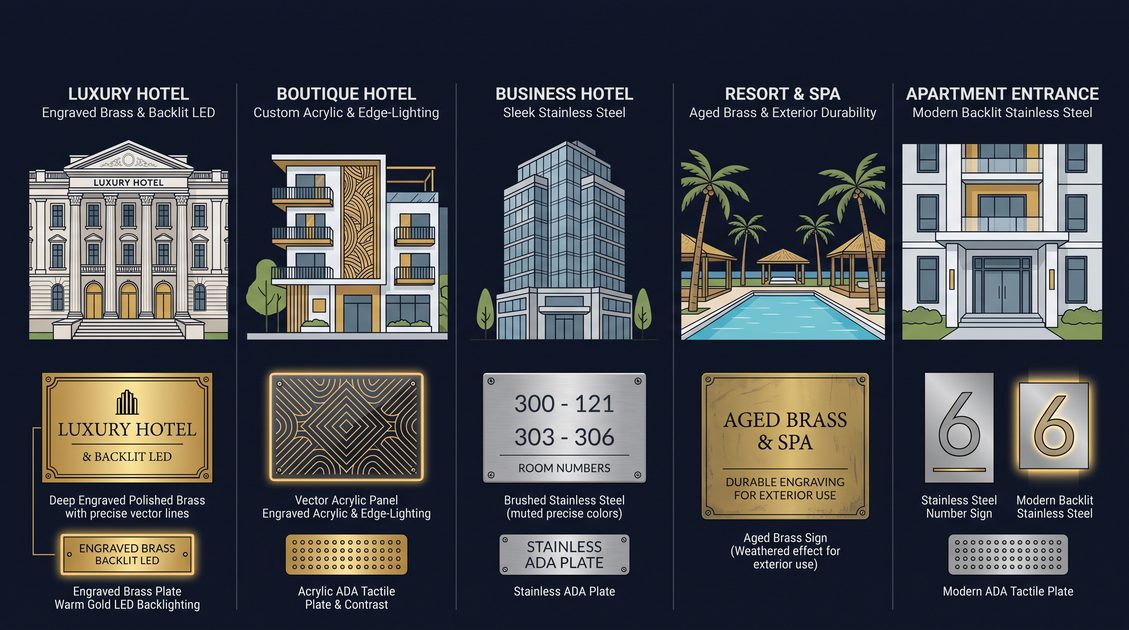
Hotel door signs for hospitality projects are a coordinated set of room identification, privacy, accessibility, and wayfinding markers specified for a hotel, resort, serviced apartment, or guest accommodation project. A useful specification defines the message, viewing distance, substrate, finish, mounting method, accessibility requirements, artwork approval process, spare quantity, and delivery schedule before production begins. The right program lets guests find rooms quickly, helps housekeeping communicate status, and gives every floor a consistent brand language. For a new build or renovation, the most reliable approach is to create one approved sign schedule and use it across guest rooms, public facilities, staff areas, and directional points.
How hotel door signs for hospitality projects work
Hotel door signs for hospitality projects work as a system rather than as isolated plaques. A guest room may need a room number, tactile identifier, DND message, housekeeping message, and floor or suite marker. Public areas may need restroom, elevator, meeting room, pool, restaurant, and exit signs. Each sign should have a defined location in the door schedule, an approved artwork reference, and a clear owner for final approval.
Start with a complete sign schedule
The schedule should identify every sign type, quantity, room or zone, dimensions, material, finish, artwork, mounting method, accessibility status, and required delivery date. Include a spare allowance for damage, future room renumbering, and installation mistakes. A schedule also lets a manufacturer quote accurately instead of estimating from a general floor plan.
| Sign group | Typical hotel use | Specification decision |
|---|---|---|
| Room identification | Guest rooms and suites | Number format, size, finish, mounting |
| Privacy and service | DND and Make Up Room | Door hanger, slider, magnetic, or electronic |
| Accessibility | Permanent room and restroom identifiers | Tactile characters, Braille, contrast, location |
| Wayfinding | Corridors, lobbies, elevators | Direction, viewing distance, pictograms |
| Back-of-house | Staff rooms and service areas | Durability, replaceable inserts, labeling |
Separate permanent identification from changeable status
A permanent room identifier should remain readable when power is unavailable and should not depend on a mobile application. DND, housekeeping, occupied, or meeting-room status can be changeable and may use a slider, insert, LED, or electronic display. Keeping these functions separate makes maintenance easier and protects the permanent identifier from being hidden by a temporary message.
Materials for hotel door signs for hospitality projects
Material selection for hotel door signs for hospitality projects should follow the environment, cleaning routine, design tier, and replacement plan. Brushed stainless steel suits busy corridors and humid properties. Brass creates a warmer luxury appearance but may need a protective finish. Aluminum reduces weight and can be anodized or painted. Acrylic supports printed graphics, translucent effects, and backlighting, while plastic is useful where low weight and economical replacement are priorities.
| Material | Strengths | Questions to confirm |
|---|---|---|
| Stainless steel | Durable, modern, moisture resistant | Grade, thickness, brushed direction |
| Brass | Premium appearance, suitable for engraving | Lacquer, patina policy, cleaning method |
| Aluminum | Light, versatile, cost efficient | Anodizing, paint durability, edge finish |
| Acrylic | Graphics, color, and illumination options | UV stability, scratch resistance, thickness |
| Engineering plastic | Light and economical | Cleaning chemicals, print adhesion, fire requirements |
Request a physical sample when color, reflectivity, engraving depth, or tactile detail affects the result. A digital rendering cannot show how a brushed finish catches corridor lighting or how a plaque feels when read by touch.
Accessibility planning for hotel door signs for hospitality projects
Accessibility planning for hotel door signs for hospitality projects should begin with the project jurisdiction, not with a generic product photograph. Permanent room and restroom identifiers may require tactile characters, Braille, contrast, non-glare surfaces, and a specific mounting zone. Requirements vary by country, state, building type, and sign location. The architect, accessibility consultant, and authority having jurisdiction should approve the final specification before tooling or mass production.
Build a compliance review into the sample stage
The sample should be reviewed for character form, Braille translation, contrast, finish glare, dimensions, and installed location. Do not assume that a printed room number is equivalent to a tactile identifier. Do not let an illuminated status element replace a permanent accessible room marker. Keep the approved artwork and compliance notes with the purchase order so future reorders match the original decision.
Mounting hotel door signs for hospitality projects
Mounting hotel door signs for hospitality projects depends on the substrate, sign weight, door construction, cleaning exposure, and whether the sign must be removable. Adhesive mounting can work on clean, smooth surfaces when the tape and curing conditions are appropriate. Concealed screws provide a more secure method for heavier metal plaques. Standoffs create a shadow gap and can provide space for wiring, but they require accurate drilling and a suitable backing structure.
Before production, confirm whether the sign is installed on the door, beside the door, or on a corridor wall. Check the swing, closer, latch side, door trim, fire-rating constraints, and cleaning path. Send the manufacturer a door schedule or marked-up drawings rather than relying on a verbal description.
Customization and brand control
A hotel signage program should treat artwork as a controlled manufacturing file. Define the logo version, typeface, numeral format, icon set, color references, surface finish, and acceptable tolerances. If several room categories use different finishes, document the rule so a later reorder does not introduce an unapproved variation. Ask for a proof plate before bulk production and approve the proof in writing.
Custom hotel door signs can include:
- Room numbers and suite identifiers
- Hotel logos and brand marks
- Bilingual or multilingual text
- DND and housekeeping messages
- Floor or wing identifiers
- Pictograms and accessibility symbols
- Replaceable inserts or modular number panels
- LED or electronic status modules where the project requires them
Bulk ordering and project coordination
Bulk ordering hotel door signs for hospitality projects is easiest when the buyer groups the room schedule, public-area schedule, artwork files, material selections, installation notes, and delivery milestones into one procurement package. Ask for separate pricing for samples, tooling, standard units, custom units, packaging, freight, and replacement pieces. Confirm the supplier's minimum order, sample lead time, production lead time, inspection process, and ability to retain approved artwork for future phases.
A useful purchase-order checklist includes:
- Approved sign schedule and quantities
- Room numbering and spelling verification
- Material, finish, thickness, and dimensions
- Mounting method and hardware
- Accessibility review and Braille file
- Sample approval record
- Packaging by floor, room, or sign type
- Spare quantity and reorder procedure
- Required shipping term and destination
- Inspection and nonconformance process
Hotel door signs for hospitality projects by project stage
During design development, freeze the sign family, room numbering logic, and material palette. During construction documentation, assign every sign to a location and coordinate with doors, hardware, lighting, and electrical drawings. During procurement, approve physical samples and verify the delivery sequence. During installation, use labeled cartons, a room-by-room checklist, and photographs for the punch list. During handover, retain artwork, compliance records, spare stock, and cleaning instructions.
For renovation projects, survey existing doors before selecting replacement mounting. A new plaque may not fit over an old recess, and an adhesive selected for painted drywall may fail on a textured laminate. If the hotel remains open, divide production and installation by floor or wing and protect guests from drilling, dust, and adhesive curing odors.
Comparing hotel door sign supplier options
The lowest unit price is not always the lowest project cost. Compare suppliers on proofing discipline, material control, tactile and Braille capability, artwork retention, packaging, inspection evidence, spare support, and communication during changes. A supplier that can produce only one material may require several vendors and create finish variation. A manufacturer that can coordinate multiple sign types may simplify the purchase order, but the buyer should still verify each claimed capability with samples and documents.
| Evaluation area | Evidence to request |
|---|---|
| Manufacturing | Product samples and process photographs |
| Accessibility | Tactile/Braille sample and project review process |
| Quality | Inspection plan, tolerance records, corrective-action process |
| Project delivery | Sample and production schedule with milestones |
| Reorders | Artwork retention and spare-part procedure |
| Export | Packing method, shipping terms, and applicable declarations |
Frequently asked questions about hotel door signs for hospitality projects
What should a hotel room door sign include?
A room sign normally includes a room number or suite identifier. Depending on the project, a separate permanent accessible identifier, DND message, housekeeping message, floor marker, or status indicator may also be required.
Should DND be part of the room number plaque?
It can be integrated as a slider or supplied as a separate door hanger. The choice depends on the door design, housekeeping workflow, replacement plan, and whether the permanent room identifier must remain fully visible.
Which material is best for a hotel corridor?
There is no universal best material. Stainless steel is often selected for high traffic and moisture, brass for premium interiors, and acrylic or plastic where graphics, lower weight, or economical replacement matter.
How many spare signs should a hotel order?
The appropriate allowance depends on the project, installation risk, and operating environment. Agree on a spare percentage with the facilities team before production and retain the approved artwork for future reorders.
Can hotel door signs be made in multiple languages?
Yes, when the message length, character size, layout, and local accessibility requirements are reviewed together. Numbers and pictograms can reduce text dependence, but they do not remove the need for a compliant permanent identifier.
What should be sent for a quotation?
Send the sign schedule, quantities, dimensions, materials, finish references, artwork, mounting requirements, destination, delivery date, and any accessibility or inspection requirements.
Next steps for a hotel door sign project
Start with a room and facility inventory, then separate permanent identification from changeable status messages. Select materials by environment and brand tier, confirm accessibility requirements with the project team, and approve a physical sample before mass production. Link the final purchase order to a controlled sign schedule so every room, spare, carton, and reorder can be traced.
Related planning resources include the hotel room door sign specification guide, hotel room number sign guide, hotel DND sign guide, and ADA hotel sign guide.
Not sure which sensor fits your project?
Talk to our mmWave application engineers for a free consultation.
Specify your hotel project with our engineers
Send your room count, ceiling type, and protocol preference. We will return a sample plan and quote within 24 business hours.
- Move from general guidance into a product or application discussion.
- Use RFQ when pricing, drawings, MOQ, or launch timing needs structure.
- Keep a direct contact path visible for fast clarifications and handoff.